
When you first set foot on the wide, tree-lined avenues of the nation’s capital, something shifts inside you. The air feels heavier — not oppressively so, but weighted with consequence. The places to visit in Washington DC don’t feel like tourist stops. They feel like chapters in the longest, most complicated story ever told. Unlike most American cities, DC refuses to dazzle you with skyscrapers. Instead, it spreads low and wide, elegant and deliberate, drawing you down boulevards that end with a monument, a memorial, or a marble building holding the machinery of democracy. It is a city where you can touch a moon rock in the morning, stand where Lincoln once stood in the afternoon, and eat world-class Spanish seafood by the water at night. Few cities in the world pack this kind of layered experience into such a walkable, navigable space — and that’s precisely what makes washington dc attractions so endlessly compelling.
Table of Contents
The Guardians of History: The National Mall and Memorials
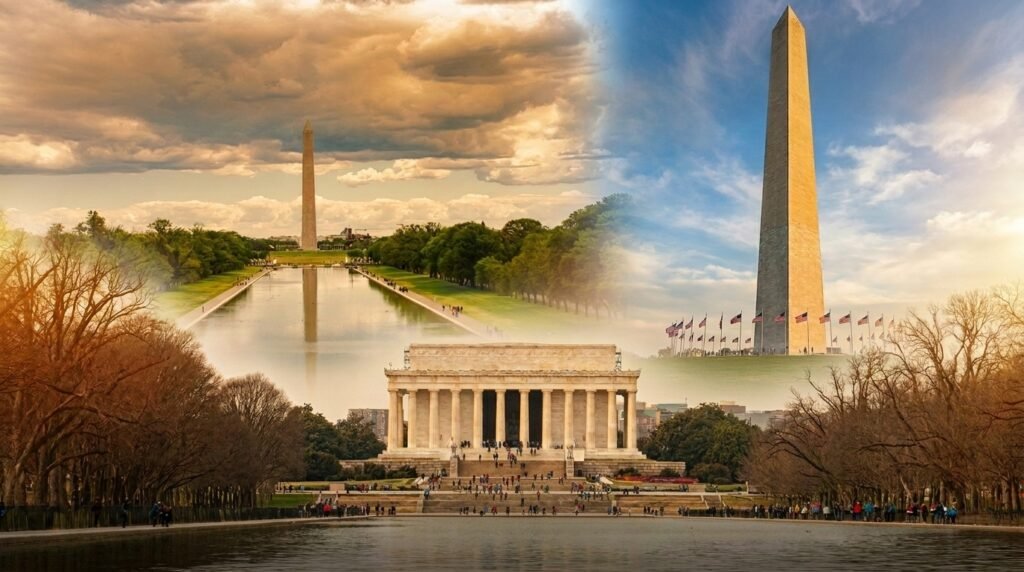
There is a reason first-time visitors to DC spend most of their trip on the National Mall. Stretching roughly two miles from the Capitol steps to the Lincoln Memorial, it is arguably the most historically loaded strip of public land on the planet. The washington dc tours that trace this corridor — whether on foot, by bike, or aboard a trolley — have a way of making you feel like a participant in history rather than a spectator.
The Lincoln Memorial and the Reflecting Pool
Stand at the base of the Lincoln Memorial steps just after sunrise, when the light is still soft and the crowds haven’t arrived, and you’ll understand exactly why Martin Luther King Jr. chose this spot to deliver his “I Have a Dream” speech in 1963. The neoclassical Greek temple — 36 columns for the 36 states in the Union at the time of Lincoln’s death — frames the man himself in white Georgia marble, 19 feet tall and utterly commanding.
Walk up slowly. Read the Gettysburg Address carved into the south chamber wall. Then turn around and look down the length of the Reflecting Pool toward the Washington Monument. That view, particularly at dawn or dusk, is one of those rare moments where a place actually matches its reputation.
The Reflecting Pool is underrated in its own right. People stroll its edges, jog its length, and pause at its center to watch the Capitol dome shimmer in the still water. It’s a meditative space in the middle of a very loud city.
Secure your spot and book your National Mall & Memorials experience today.
The Washington Monument
At 555 feet, the Washington Monument remains the tallest obelisk in the world and offers the best panoramic views of any washington dc attractions on the Mall. The trick? Free timed-entry tickets disappear fast — reserve yours online at recreation.gov as soon as they’re released (usually 30 days in advance). The elevator ride takes you to the 500-foot observation level, where you can see Georgetown, the Pentagon, the Potomac, and on clear days, all the way to the Blue Ridge Mountains. There’s a subtle detail most visitors miss: the slight color change in the marble about a third of the way up the monument, where construction paused for 23 years during the Civil War before resuming with stone from a different quarry.
Moving Tributes: Vietnam, Korea, and WWII
The three war memorials clustered near the western end of the Mall represent three very different approaches to grief and honor, and visiting them in sequence is a quietly devastating experience.
The Vietnam Veterans Memorial is a masterpiece of restraint. Two black granite walls sink into the earth at a shallow angle, meeting at the center. Etched into the surface are 58,281 names. Visitors leave offerings — flowers, photographs, medals, folded notes. Park rangers say they find mementos every single morning. The Wall doesn’t lecture you; it simply asks you to look.
The Korean War Veterans Memorial is more theatrical: 19 stainless steel statues of soldiers on patrol, faces creased with exhaustion and alertness, moving through a field of juniper bushes meant to evoke rough terrain. They look uncomfortably real. The adjacent “Freedom Wall” features 2,500 photographic images sandblasted into black granite, representing the 36,516 Americans who died. The inscription reads: “Freedom Is Not Free.” Three words. No further explanation needed.
The National World War II Memorial is the grandest of the three — 56 granite pillars arranged in a semicircle around a central plaza, one for each state and territory that served. The “Field of Stars” on the Freedom Wall holds 4,048 gold stars, each representing 100 American deaths. Things to Do in Boston offers a fascinating East Coast complement to DC’s historical story — both cities carry the bones of American history in very different but equally compelling ways.
Secure your spot and book your “Hop-On Hop-Off Tour with 18 Stops & Arlington Audio Tour“ experience today.
The Seats of Power: Government Landmarks
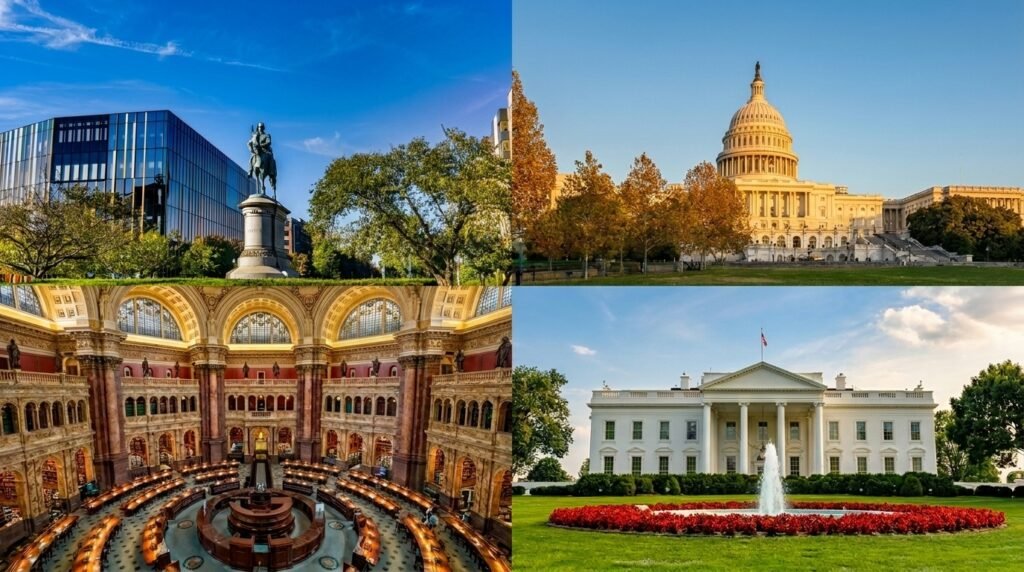
Washington DC’s government buildings aren’t museum pieces — they’re active, working structures where legislation is written, laws are interpreted, and the executive branch operates every single day. That combination of accessibility and ongoing power makes washington dc tours of these sites feel unlike anything you’ll experience anywhere else.
The United States Capitol
Book a free 90-minute guided tour through your congressional representative’s office well in advance (the website is visitmembers.house.gov), and you’ll get access to the Rotunda, the Crypt, and the National Statuary Hall. The Rotunda alone is worth the effort: the canopy painting, “The Apotheosis of Washington,” soars 180 feet above you, depicting Washington ascending to the heavens surrounded by 13 maidens representing the original states. It’s baroque, it’s earnest, and it’s strangely moving.
The Crypt, directly below the Rotunda, was originally designed as Washington’s burial chamber — he declined and chose to be buried at Mount Vernon instead. Today it houses a sandstone compass set into the floor that marks the geodetic center of the original District.
Secure your spot and book your US Capitol experience today.
The White House and Lafayette Square
Here’s the honest truth: public White House tours are available only through congressional requests submitted months in advance, and even then, access is limited to the formal state rooms. Most visitors experience the White House from the outside, and that’s perfectly fine. The north side view from Lafayette Square — framed by magnolia trees planted by Andrew Jackson — is the classic angle you’ve seen in a thousand photographs.
For a deeper experience, cross the street to the White House Visitor Center on Pennsylvania Avenue, which has been significantly upgraded in recent years with exhibits, artifacts, and multimedia content that actually explains what happens inside those walls. Things to Do in Philadelphia pairs well with a DC itinerary — the two cities share a founding-era connection that makes visiting both feel like reading a two-volume history.
The Library of Congress
Almost everyone skips it. Almost everyone is wrong. The Library of Congress — specifically the Thomas Jefferson Building just behind the Capitol — may be the single most beautiful interior space in all of Washington DC. The Great Hall is an explosion of marble, gilded columns, mosaic floors, and painted ceilings that would look at home in a Venetian palace. Apply for a free reader card online, and you can access the magnificent Main Reading Room, where scholars sit beneath a 160-foot-high dome surrounded by 49 million items in 470 languages.
Secure your spot and book your Library of Congress experience today.
The Knowledge Vaults: The Smithsonian Institution
Nineteen museums, 21 libraries, nine research centers, and all of it free. The Smithsonian Institution is one of the most extraordinary public gifts in American history, and it anchors the washington dc activities scene in a way that no other city in the country can match. The challenge isn’t finding something interesting — it’s choosing what to skip.
National Museum of Natural History
The Hope Diamond is the obvious draw — 45.52 carats of deep blue steel, housed behind thick glass in the Janet Annenberg Hooker Hall of Geology, Gems, and Minerals. It is smaller than most people expect and more beautiful than any photograph suggests. But don’t let the diamond monopolize your time. The Sant Ocean Hall is one of the finest marine exhibits in the world, with a suspended 45-foot North Atlantic right whale model and floor-to-ceiling coral reef dioramas. The insect zoo on the upper floor, where kids (and quietly delighted adults) can handle live Madagascar hissing cockroaches, is unexpectedly brilliant.
National Air and Space Museum
The lunar sample in Case 71, on the museum’s ground floor, weighs about 8.5 pounds and is approximately 3.8 billion years old. You can touch it. That fact never stops being extraordinary. The Apollo 11 command module Columbia, which carried Armstrong, Aldrin, and Collins back from the Moon in July 1969, sits nearby — a scorched, impossibly small capsule that somehow carried three people across 239,000 miles of space and back. The museum is one of the most visited washington dc attractions on the entire Mall, so arrive early or plan for a late afternoon visit when crowds thin.
Things to Do in New York is another great pairing for science and culture lovers — the American Museum of Natural History and the Intrepid Sea-Air-Space Museum offer complementary experiences to what DC’s Air and Space provides.
National Museum of African American History and Culture
The building itself makes a statement before you even walk through the door. The three-tiered bronze lattice corona, inspired by the ironwork of enslaved African craftsmen in the American South, glows copper in the afternoon light. Inside, the experience begins underground, at the beginning — with the trauma of the Middle Passage — and rises, floor by floor, through Reconstruction, the Harlem Renaissance, the Civil Rights Movement, and into contemporary culture. It is emotionally demanding and completely essential.
Timed-entry passes are required and often sell out weeks in advance. Check the museum’s website daily for last-minute releases, which happen regularly due to cancellations.
Historic Charm and Modern Vibes: Neighborhood Deep-Dives
Beyond the monuments and museums, some of the best places to visit in Washington DC are simply its neighborhoods — places where the city exhales, where history and daily life coexist on the same block, and where you eat, drink, and wander without an agenda.
Georgetown
Georgetown predates DC itself — it was already a thriving tobacco port when the federal city was still a survey on paper. Walking its cobblestone streets, particularly M Street and Wisconsin Avenue, you’re passing buildings that George Washington and Thomas Jefferson frequented. Martin’s Tavern, which opened in 1933, has a corner booth — “the proposal booth” — where John F. Kennedy reportedly proposed to Jackie Bouvier in 1953. The bartenders will tell you about it if you ask nicely.
Beyond the restaurants and boutiques, Georgetown’s waterfront is underrated. The C&O Canal towpath runs 184 miles to Cumberland, Maryland, and even a short walk along it, past the old stone lock houses, puts you in a different century. In warmer months, rent a kayak or paddleboard from the Boathouse at Fletcher’s Cove and spend an hour on the Potomac. Things to Do in Arlington Texas offers a very different American urban experience — but if you’re building a cross-country itinerary, Arlington’s energy contrasts fascinatingly with Georgetown’s colonial stillness.
Secure your spot and book your Georgetown experience today.
The Wharf DC
Opened in 2017 and expanded in 2022, The Wharf has transformed DC’s Southwest waterfront from one of the city’s most neglected stretches into one of its most compelling destinations. Floating concert stages, a live-music venue called The Anthem, seafood vendors, upscale boutiques, and a marina line the mile-long waterfront. Del Mar, from celebrity chef Fabio Trabocchi, serves coastal Spanish cuisine — the Galician-style octopus is extraordinary — while the lobster rolls at Mason’s are the kind of thing DC locals keep to themselves.
On summer evenings, the entire Wharf comes alive. Families, couples, and groups spill out onto the piers, drinks in hand, watching the boats and listening to whatever’s happening on the floating stage. It’s one of those washington dc activities that doesn’t feel like tourism at all — it just feels like living in a great city.
Union Market District
A 20-minute ride from the Mall on the Metro, Union Market has become DC’s most interesting food neighborhood. The original market hall — a converted warehouse — holds dozens of vendors selling everything from Vietnamese bánh mì to artisanal charcuterie boards. La Cosecha, the Latin American market next door, focuses specifically on Central and South American producers: Guatemalan coffee, Peruvian ceviche, Colombian empanadas. Saturday mornings here are worth planning your entire trip around.
Washington After Dark: The City Illuminated
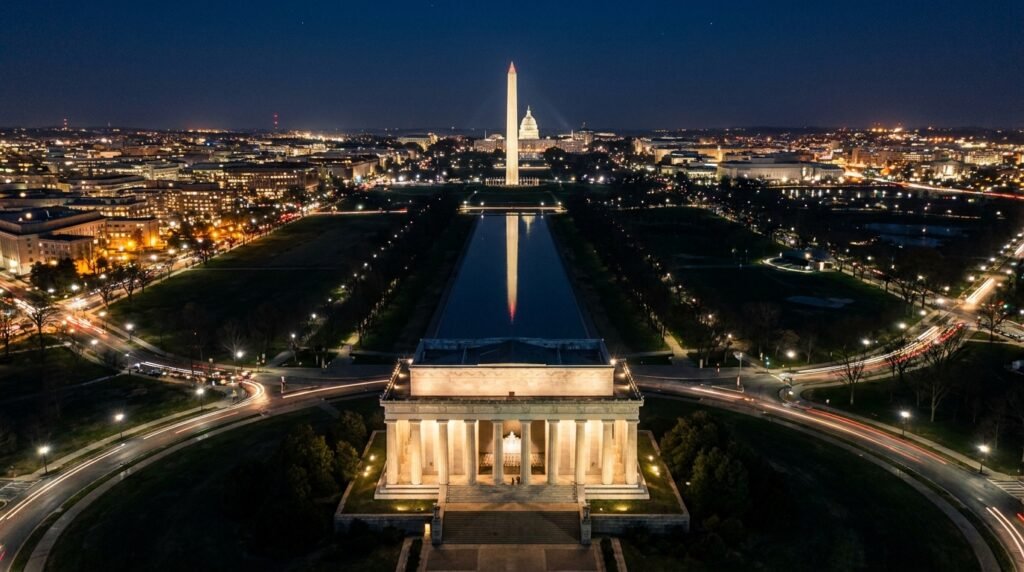
One of the best-kept open secrets among experienced DC travelers: the monuments look significantly more powerful after dark. If you’ve spent your days navigating crowds at the Lincoln Memorial and Washington Monument, going back at night feels like discovering an entirely different city.
Monuments by Night
Under floodlights, the white marble takes on a different quality — sharper, more dramatic, almost cinematic. The Reflecting Pool at night, with the Washington Monument doubled in its still surface, is one of those images that stays with you for years. The Vietnam Veterans Memorial at night, lit by nothing but ground-level spotlights along the path, is almost unbearably quiet and moving. Fewer than a dozen people, maybe, where there were hundreds during the day.
The monuments are technically open 24 hours, with park rangers on duty from 9:30 AM to 11:30 PM. The hour between 9 and 11 PM is the sweet spot — dark enough for the floodlights to do their work, not so late that you’re the only person there.
Night Cycle and Trolley Tours
Washington DC tours after dark come in two main flavors: active and narrated. Bike-and-Roll DC runs a popular nighttime monuments bike tour that covers four to five miles at a comfortable pace, stopping at the key memorials with a guide who knows the history cold. It’s genuinely one of the best washington dc tours you can book — the combination of physical movement and open air makes the experience feel more alive than a bus would. Things to Do in Las Vegas offers its own version of electrifying after-dark experiences, but few cities can match DC’s combination of historical gravitas and nocturnal beauty.
For those who prefer to sit back, Old Town Trolley Tours runs a narrated evening circuit that covers the major sites with comfortable seating and entertaining commentary. It’s a great option for families with younger children or travelers who’ve already covered the Mall on foot.
Sacred Ground and Outer Limits
Some of the most significant places to visit in Washington DC aren’t technically in DC at all — they’re across the Potomac in Virginia, just minutes from downtown. Don’t let the geography stop you.
Arlington National Cemetery
Over 400,000 people are buried here, on 639 acres of hillside overlooking the DC skyline. The numbers are almost too large to hold in your mind. Walking the grounds in the mid-morning quiet, past row after row of identical white marble headstones, you feel the weight of it accumulate slowly.
The most-visited site is President Kennedy’s grave, marked by an eternal flame that has burned continuously since 1963. The headstone is simple — far simpler than most visitors expect. Nearby, Robert F. Kennedy’s grave is marked by a plain white cross and a quotation from his 1966 speech in South Africa about moral courage.
The Changing of the Guard at the Tomb of the Unknown Soldier, conducted by the Army’s 3rd Infantry Regiment every hour on the hour in winter (every 30 minutes in summer), is one of the most precisely choreographed military ceremonies you’ll witness anywhere on earth. Arrive 15 minutes early for a good position.
Secure your spot and book your Arlington National Cemetery experience today.
The Pentagon
The world’s largest office building — 6.5 million square feet, 17.5 miles of corridors — sits just south of Arlington Cemetery and offers free guided tours for American citizens, booked through the Pentagon Tours website. Processing takes 2–3 weeks for background screening. The tour covers the 9/11 memorial corridor, the Hall of Heroes, and several of the five-sided building’s iconic interior “rings.” It’s not for everyone, but if military history and architecture interest you, it’s an unmatched experience.
Things to do in San Diego is worth exploring if your itinerary includes US military history sites — the USS Midway museum there is one of the finest naval history experiences in the country.
Unique Sights and Seasonal Wonders
The washington dc activities calendar extends well beyond the monuments and museums. Some of the most memorable experiences in the city are unexpected, seasonal, or simply off the mainstream tourist radar.
International Spy Museum
Relocated in 2019 to a striking new building near L’Enfant Plaza, the International Spy Museum has evolved from a novelty attraction into one of the most thoughtfully designed interactive museums in the city. From the moment you enter, you’re assigned a cover identity and given a “mission” that evolves throughout the building. Exhibits cover tradecraft, Cold War espionage, cyberwarfare, and the history of intelligence agencies from multiple countries. The gadgetry is genuinely extraordinary — lipstick pistols, hollow coins, button cameras. Adults enjoy it as much as teenagers.
The Museum of the Bible
Eight floors. Thirty-thousand artifacts. A rooftop biblical garden with views of the Capitol. The Museum of the Bible, opened in 2017 and still evolving, takes a remarkably academically rigorous approach to its subject, with content vetted by scholars from multiple religious traditions. The immersive “Washington DC Streets of the First Century” exhibit — a full-scale recreation of a biblical-era village — is experiential in a way that most DC museums simply aren’t. The digital ceilings in the lobby, which can display everything from illuminated manuscript pages to aerial footage of Jerusalem, are genuinely stunning.
Things to Do in Miami and things to do in Chicago both offer world-class museum scenes of their own — but the Museum of the Bible brings a distinctly Washington sensibility to an ancient subject.
Cherry Blossom Season
Roughly 3,800 Japanese cherry trees ring the Tidal Basin and extend into East Potomac Park, and when they bloom — typically late March to mid-April, though climate variability has shifted the timing — Washington DC briefly becomes one of the most beautiful cities in the world. The peak bloom window lasts four to six days. Crowds are formidable. Here’s how to handle them:
- Arrive by 6:30 AM. The light is better, the air is cooler, and the crowds are thin.
- Skip the obvious spots. The east side of the Tidal Basin near the FDR Memorial is less photographed and equally beautiful.
- Consider East Potomac Park. The trees there bloom slightly later and attract a fraction of the visitors.
- Check the National Park Service forecast. They publish real-time bloom predictions that are remarkably accurate.
Things to Do in Atlanta in spring has its own floral story with dogwoods and azaleas — but DC’s cherry blossoms remain one of the great seasonal spectacles on the American East Coast.
The Foodie Scene and Nightlife
The culinary landscape of DC has changed dramatically in the last decade. What was once a city where restaurants closed at 9 PM and the food was reliably forgettable has become one of the most exciting dining cities in the country — driven by a diverse population, serious chef talent, and neighborhoods that generate their own food cultures. Among all the things to do in Washington DC, eating your way through the city might be the most satisfying.
Iconic Eats
Ben’s Chili Bowl on U Street has been feeding DC since 1958 — a survivors’ institution that stayed open through riots, urban decay, and gentrification, and remains one of the most beloved spots in the city. The half-smoke (a DC-style spicy sausage, split and griddled, served in a steamed bun with chili, mustard, and onions) is the thing to order, ideally at 2 PM on a weekday when the line is manageable.
Old Ebbitt Grill, two blocks from the White House, has been open since 1856, making it the oldest saloon in DC. Brass rails, dark wood, gas lamps, and oysters. Lots of oysters. The oyster bar is genuinely excellent — sourcing from multiple East and West Coast farms daily — and the raw bar happy hour (11 AM to 5 PM daily) is one of the best deals in DC dining.
Founding Farmers, near the World Bank, is a farm-to-table institution that does brunch better than almost anyone in the city. The fried chicken and waffles with bourbon maple syrup is the kind of dish that inspires long conversations about breakfast food. Book a table; the line without one is punishing.
The Bar Scene
The Round Robin Bar inside the Willard InterContinental Hotel is DC’s most storied watering hole — a circular room of dark wood and leather where Henry Clay reportedly introduced the mint julep to Washington society in the 1840s. The classic cocktail list is impeccably executed. It’s quiet enough to have a real conversation, which is rarer than you’d think in this city.
For whiskey, Shelly’s Back Room on F Street — tucked below street level — maintains one of the most comprehensive Scotch and bourbon programs in DC. Over 100 single malts, a serious selection of American craft whiskeys, and a cigar-friendly back patio that somehow manages to feel like an old gentleman’s club without any of the stuffiness.
Things to Do in Kansas City, Things to Do in Houston, and Things to Do in Dallas all claim strong food and bar scenes — and they’re right — but DC’s combination of global diplomats, policy professionals, and local creatives gives its restaurant culture a distinct electricity. Things to Do in Los Angeles approaches food from a completely different angle, but both cities reward serious eaters.
Logistics: Navigating the Capital Like a Local
Getting Around
DC’s Metro system is clean, reliable, and covers most of the major washington dc activities zones efficiently. The Blue, Orange, and Silver lines handle everything from Reagan National Airport to Georgetown’s edge. SmartTrip cards (reloadable tap cards) are worth picking up at any Metro station on arrival — they’re cheaper per ride than single-trip paper cards. Note: Metro does not accept cash for fare purchases.
Uber and Lyft work fine in DC but surge pricing during rush hours and major events can be steep, and traffic around the Mall is frequently gridlocked. For short distances between neighborhoods, electric scooters (Lime and Capital Bikeshare both operate here) are genuinely faster than rideshare during peak hours. Helmets are technically required; enforcement is inconsistent.
Walking is underrated. The Mall is 2.5 miles end to end, and most neighborhoods worth visiting are within a mile of a Metro station. Comfortable shoes are the single most important packing decision you’ll make.
Planning Your Time
Two days in DC is not enough. It’s not even close to enough. Three days gets you the essentials — the Mall, a government landmark tour, one or two Smithsonian deep-dives, and an evening in a good neighborhood. Four days lets you breathe. Five days, and you’re starting to feel the city rather than just seeing it.
The single most common mistake visitors make is “Mall fatigue” — trying to cover the entire two-mile stretch in a single day and arriving at the Lincoln Memorial exhausted and hungry. The solution is geographic clustering:
- Day 1: East Mall (Capitol, Library of Congress, National Galleries, Natural History Museum)
- Day 2: West Mall (Lincoln, Korean, Vietnam, WWII memorials; Washington Monument; early evening monuments walk)
- Day 3: Government landmarks + a neighborhood (Georgetown or The Wharf)
- Day 4: Off-Mall museums (NMAAHC, Spy Museum, Museum of the Bible) + Arlington Cemetery
Booking washington dc tours for at least one or two experiences — particularly night tours and government building tours — significantly enhances the overall experience and ensures access to sites that require advance reservations.
Frequently Asked Questions About Places to Visit in Washington DC
Are most washington dc attractions free? Yes. The Smithsonian museums, the National Mall and all its memorials, the National Gallery of Art, the National Zoo, and the Library of Congress (Great Hall) are all free to enter. Some newer attractions — the International Spy Museum, the Museum of the Bible, and some washington dc tours — charge admission.
How many days do you need for washington dc activities? Most travel experts recommend a minimum of three full days to cover the essential places to visit in washington dc, with four to five days for a more relaxed experience that includes neighborhoods, nightlife, and day trips.
What are the best washington dc tours for first-time visitors? The most highly rated washington dc tours for first-timers include the Old Town Trolley monuments tour, Bike-and-Roll DC’s nighttime monuments ride, the free Capitol Building guided tour, and the National Archives highlights tour. For a deeper historical experience, multiple companies offer washington dc tours focused specifically on Civil War history, the Underground Railroad, or presidential sites.
When is the best time to visit washington dc? Spring (late March through May) and fall (September through November) offer the best combination of weather and manageable crowds. Cherry blossom season in late March/early April is spectacular but extremely busy. Summer brings peak crowds and intense humidity. Winter is quieter, cold, and — particularly around the holidays — surprisingly beautiful.
What is the best way to get from the airport to DC’s washington dc attractions? From Reagan National (DCA), the Metro’s Blue and Yellow lines connect directly to downtown in about 20 minutes — the fastest and cheapest option. From Dulles (IAD), a dedicated Metrorail Silver Line extension now connects directly to downtown. From BWI, the MARC Penn Line commuter train offers the most reliable service.
Are there good washington dc tours for families with children? Absolutely. The washington dc activities designed for families include the Sant Ocean Hall and insect zoo at Natural History, the interactive exhibits at Air and Space, the Spy Museum’s cover identity missions, and several family-focused washington dc tours that break down historical sites in age-appropriate ways.
Final Thoughts: A City Worth Slowing Down For
The best version of Washington DC isn’t the one you rush through in a weekend, snapping photos at monuments and sprinting between museum galleries. It’s the one you find when you slow down — when you sit at the Tidal Basin at dusk and watch the light change on the Jefferson Memorial, when you linger in the Reading Room of the Library of Congress, when you let the Wall at the Vietnam Veterans Memorial do what it’s designed to do.
The places to visit in Washington DC are more than landmarks. They’re an ongoing argument about what America is, what it has been, and what it’s still trying to become. That argument is worth sitting with. The washington dc attractions here are layered and complex, the washington dc tours are varied and accessible, and the overall depth of washington dc activities available across every budget and interest level makes it one of the most compelling travel destinations on the continent.
Come for the monuments. Stay for the city underneath them.
Explore more American city guides: Things to Do in Boston | Things to Do in New York | Things to Do in Philadelphia | Things to Do in Miami | Things to Do in Atlanta | things to do in Chicago | Things to Do in Houston | Things to Do in Dallas | Things to Do in Los Angeles | Things to Do in Las Vegas | things to do in San Diego | Things to Do in Kansas City | Things to Do in Arlington Texas
Quick Reference: Top Places to Visit in Washington DC
Planning your trip? Here’s a fast-reference breakdown of the most essential washington dc attractions, organized by type. Whether you’re booking washington dc tours in advance or going freestyle, this list covers the non-negotiables.
With so many incredible places to visit in Washington DC across neighborhoods, museums, and memorials, it helps to organize them by category. The washington dc attractions listed below represent the consensus top picks among repeat visitors, travel writers, and locals — the places that consistently deliver, regardless of season or budget. For travelers wondering about things to do in Washington DC beyond the standard Mall walk, many of these will be revelations.
Top Free washington dc attractions:
- National Mall Memorials (Lincoln, Vietnam, Korea, WWII)
- All 19 Smithsonian museums
- National Gallery of Art (East and West buildings)
- Library of Congress (Great Hall)
- Arlington National Cemetery
Best washington dc tours to book in advance:
- Capitol Building 90-minute guided tour (book through your representative’s office)
- Monuments by Night bike tour (Bike-and-Roll DC)
- Old Town Trolley narrated tour
- Spy Museum cover-identity experience
Best washington dc activities by neighborhood:
- Georgetown: cobblestone walks, C&O Canal, kayaking, Martin’s Tavern
- The Wharf: waterfront dining, live music, Mason’s Lobster Rolls
- Union Market: food hall eating, La Cosecha Latin market
- U Street: Ben’s Chili Bowl, live music venues, local bar scene
Seasonal washington dc activities:
- Cherry blossom viewing (late March to mid-April, Tidal Basin)
- Outdoor summer concerts at The Wharf and Kennedy Center
- Holiday season light displays and museum events (November–January)
The range of things to do in Washington DC spans every budget, interest, and travel style — from free afternoon museum walks to ticketed evening washington dc tours under the floodlit monuments. First-timers often underestimate how much is available; return visitors usually wish they’d stayed longer. Among all the places to visit in Washington DC, the hardest part is deciding what to prioritize — not finding things worth doing.
Every neighborhood has its own character. Every monument has a story that goes deeper than the plaque. And every time you think you’ve found the best of the washington dc attractions, the city reveals another layer. That’s the thing about DC: it keeps giving if you keep looking.
The full spectrum of things to do in Washington DC — from free Smithsonian galleries to world-class restaurant dining, from solemn war memorials to rooftop cocktail bars — makes it one of the most complete travel destinations in North America. Plan carefully, pack comfortable shoes, and give yourself more time than you think you need. These places to visit in Washington DC will reward every extra hour you give them.
The full spectrum of things to do in Washington DC — from the profound to the playful — is what sets the city apart. No matter how long your trip, the question of what things to do in Washington DC will occupy most of your pre-trip planning — and rightly so. There are few cities anywhere in the world that offer this density of meaningful experience per square mile. The things to do in Washington DC list keeps growing, and it keeps improving, which is why first-timers so often become repeat visitors.
As you plan your visit, keep in mind that things to do in Washington DC span far beyond the tourist trail — the city’s independent bookstores, jazz clubs, rooftop bars, and weekend farmers markets are just as worth your time as the monuments. The places to visit in Washington DC that locals treasure most are often the ones that never appear on the standard brochure. That’s the invitation this city extends: come for the obvious, stay for everything else.
For anyone building a broader East Coast itinerary, the washington dc tours and washington dc activities experience pairs naturally with Things to Do in Boston, Things to Do in Philadelphia, and Things to Do in New York — three cities that together form an unrivaled corridor of American history, culture, and food. And if you’re planning a Southern swing afterward, Things to Do in Atlanta and Things to Do in Miami offer vivid contrasts to DC’s formal grandeur.
Reviews
There are no reviews yet. Be the first one to write one.