
The first thing you notice isn’t the neon — it’s the sound. A low, electric hum that seems to rise from the pavement itself, layered beneath the distant thrum of bass lines escaping casino floors and the rhythmic clatter of slot machines that never, not once, go silent. If you’ve come here hunting the best things to do in Las Vegas, you’ve stumbled into one of the most misunderstood cities in the world. Most visitors arrive expecting excess and spectacle. What they find — if they look past the obvious — is a place of surprising depth, genuine culture, and experiences that linger long after the taxi ride back to the airport.
Las Vegas rewards the curious. The restless. The ones willing to wander three blocks off the Strip at 2 a.m. to find a neon-lit taco truck serving some of the best carnitas on the West Coast. This guide isn’t about listing attractions — it’s about understanding what this city actually offers and how to receive it fully.
Table of Contents
Where the Strip Begins to Make Sense
Maria, a cocktail waitress at one of the older Strip properties, has worked the casino floor for eleven years. She once told me something that stuck: “Tourists come here and spend four days looking at the same four blocks. They think they’ve seen Vegas. They haven’t even touched it.”
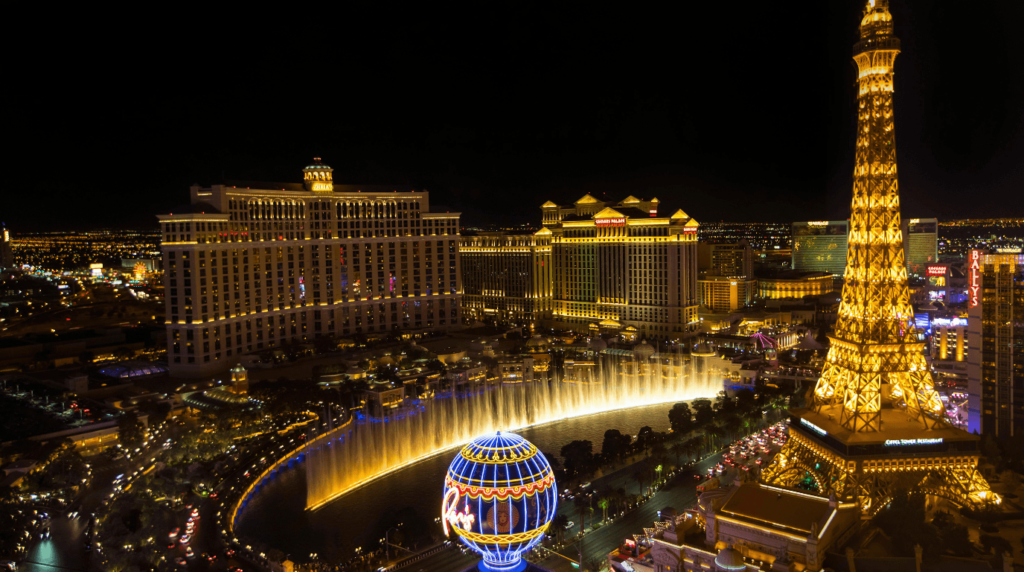
She’s right. The best things to do in Las Vegas are not all concentrated in a single corridor. But the Strip itself — that famous stretch of Las Vegas Boulevard South running roughly from the Stratosphere down to the Mandalay Bay — is where you need to begin. Not because it’s the only place, but because you can’t understand the city without first confronting its most famous version of itself.
The Bellagio fountains should be seen at night. There’s no point debating this. The choreography of water and light set to music — anything from Sinatra to Lady Gaga — is genuinely breathtaking at full dark, with the hotel’s facade as a glowing backdrop. Stand on the east sidewalk, not the west, where the viewing angle places you directly in front of the central jets. The show runs every 15 minutes after 8 p.m. and costs absolutely nothing.
Inside the Bellagio itself, few visitors bother to find the Conservatory and Botanical Gardens — a massive, glass-ceilinged room just off the lobby where the displays change with the seasons. Fifty or sixty thousand flowers, arranged by a team of 140 horticulturists, forming landscapes that take your breath away. Completely free. Completely overlooked by most visitors rushing to the casino floor.
Las vegas tours of the Strip typically run in the evening for exactly this reason — the city transforms at dusk into something almost cinematic. Most las vegas tours are offered as guided walking experiences, private car tours, or hop-on bus circuits — each with its own merits depending on how you like to move through a city. But the best las vegas tour experience of the Strip isn’t in a bus. It’s on foot, somewhere around 10 p.m., moving slowly from property to property, letting the architecture and the theater of it wash over you. Among all the las vegas tours available for first-timers, an evening stroll from Mandalay Bay to the Stratosphere — roughly three miles — remains the single best orientation to the Boulevard’s full scope.
Finding the Hidden Layers: Downtown and the Fremont Experience
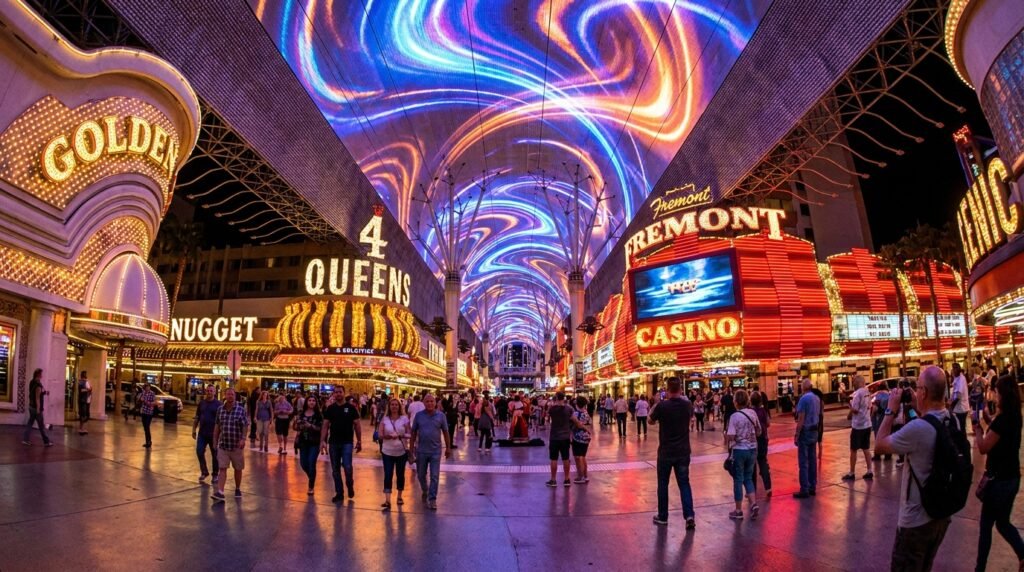
Take a cab — or the Deuce bus, which runs 24 hours — north to Downtown Las Vegas, and you’ll encounter the city’s older, stranger, more honest version of itself.
Fremont Street is the original Las Vegas. The Horseshoe, the Golden Nugget, Binion’s — these casinos predate the Strip by decades. The Fremont Street Experience, a five-block pedestrian promenade covered by the world’s largest LED canopy (1,500 feet long, displaying images at 32 million pixels), hosts free concerts and light shows every hour after dark. It’s louder, grittier, and somehow more human than anything you’ll find among the corporate polish of the Boulevard.
But it’s the blocks around Fremont — the arts district known as 18b, the coffee shops, the independent galleries, the food trucks parked along Carson Avenue — that reveal something genuinely worth knowing. The Downtown Project, a revitalization effort that drew artists, chefs, and entrepreneurs to the city’s core, didn’t fully succeed by every measure, but it seeded something real. There are murals here that rival anything in Miami’s Wynwood. There are restaurants here where local chefs do serious, ambitious work.
For anyone exploring places to visit in Las Vegas with genuine curiosity, Downtown is essential. It’s where you find locals on their nights off, where bartenders talk to you like you’re a person rather than a walking chips balance, and where the stories you’ll actually remember tend to happen.
Among the best las vegas tours available for exploring this area are the walking food tours that depart from the Arts District on weekends, stopping at a rotating selection of local restaurants and bars that most guidebooks haven’t catalogued yet. These las vegas tours are typically small-group experiences — eight to twelve people — led by guides who grew up in the valley and have opinions about where the real food is. A guide named Carlos, who runs one such tour, says it plainly: “The Strip is Vegas for visitors. Downtown is Vegas for people who live here. My job is to introduce you to both in one night.” If you search for las vegas tours of the Downtown arts district, look for operators who’ve been running their routes for at least three years — they’ll have refined the experience past the novelty stage and into something genuinely instructive.
The Desert, Just Beyond the Lights
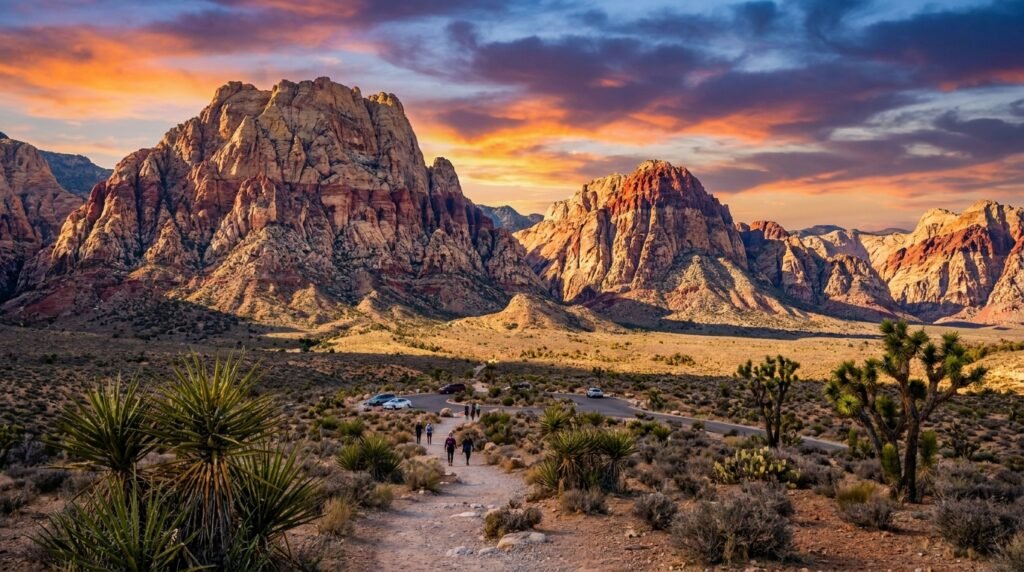
Here’s what surprises people most: Las Vegas is surrounded by some of the most dramatic landscape in North America, and most visitors never see any of it.
Red Rock Canyon National Conservation Area sits 17 miles west of the Strip. A 13-mile scenic loop winds through formations of Aztec sandstone rising up to 3,000 feet — ancient seabed compressed into blazing red and orange rock, streaked with cream and purple. The park opens at 6 a.m., and the early light on those canyon walls is one of the finest things to do in las vegas that nobody talks about. Hikers, climbers, and birders come here for the silence, the Joshua trees, and the particular quality of desert air that smells of sage and iron.
Las vegas tours into the desert have expanded significantly in recent years. You can join a guided half-day hike through Red Rock with naturalists who know the geology and the local flora. Several las vegas tours combine Red Rock Canyon with a stop at the Spring Mountains — Mount Charleston — where pine forests replace the Mojave scrub at elevations above 7,000 feet. You can book a sunrise horseback tour along trails that overlook the valley. You can rent a bike and complete the scenic loop by pedal, stopping at spring-fed oases hidden in the canyon walls.
Twenty-five miles south lies the Valley of Fire State Park — Nevada’s oldest state park, where petroglyphs left by the Ancestral Puebloans mark the sandstone in images that are thousands of years old. The las vegas tours operators who run day trips to Valley of Fire tend to be the ones most passionate about the region, and it shows. A number of las vegas tours bundle Valley of Fire with a stop at Lake Mead, the vast reservoir created by Hoover Dam, where kayaking on the blue water with red canyon walls rising on every side is one of the quietest, most meditative experiences Nevada has to offer. This isn’t sightseeing — it’s a confrontation with deep time.
And then there’s the Hoover Dam, one of the most impressive engineering achievements of the 20th century, rising 726 feet above the Colorado River in Black Canyon. The standard las vegas tour to Hoover Dam takes about four hours round-trip, but the experience of standing on that concrete arch and understanding the scale of human ambition and Depression-era determination is worth every minute. A las vegas tour that includes the dam’s interior — the generator room, the intake towers — gives you a sense of how the American West was literally reshaped by this structure.
Understanding Local Life: Food, Music, and Neighborhoods
The food scene in Las Vegas has matured into something genuinely remarkable, and it has almost nothing to do with celebrity chef restaurants in casino hotels (though some of those are excellent). The places worth knowing are harder to find and more worth finding.
Lotus of Siam, a Thai restaurant on Commercial Center Boulevard that food critics have been writing about since Jonathan Gold first visited in the 1990s, serves Northern Thai cuisine of uncommon authenticity. The wine list — improbably — is world-class, with one of the finest selections of German Rieslings in the country. Reservations are essential on weekends.
On the east side of the valley, Esther’s Kitchen serves Italian-inspired dishes using Nevada-grown produce in a space that feels nothing like Las Vegas and everything like a serious neighborhood restaurant in the best possible sense. The pasta is made fresh daily. The wine list was assembled with genuine thought. The staff knows the menu the way chefs know their kitchens.
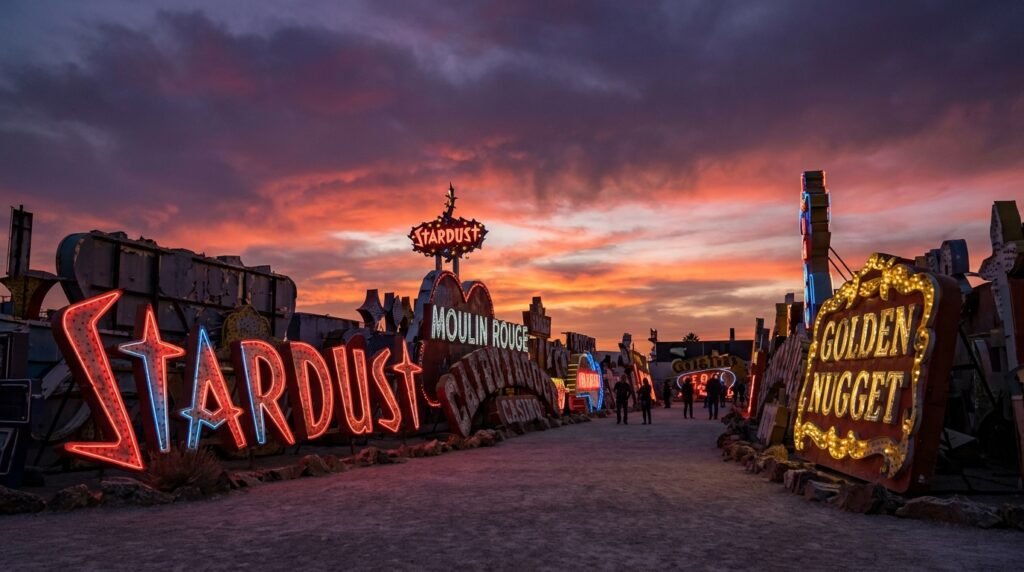
Places to visit in Las Vegas that go beyond the expected include the Neon Museum — a boneyard of retired casino signs spread across a two-acre lot in the Fremont East district. Here, the old signs of Vegas history lie horizontal in the desert dirt: the original Hacienda horse, the Stardust’s starburst, the Moulin Rouge’s iconic marquee. A las vegas tour guide named Dominique, who leads the museum’s after-dark tours, frames the collection as a graveyard of American dreaming. “Every one of these signs,” she says, walking past the salvaged brilliance of the La Concha Motel lobby, “represented someone who bet everything on this city.”
The Las Vegas Natural History Museum and the Nevada State Museum at the Springs Preserve offer further places to visit in Las Vegas for those who want context — natural, geological, and cultural — for where they’ve landed. The Springs Preserve, built on the site of Las Vegas’s original springs (which dried up in the 1960s as the aquifer was drawn down), is 180 acres of desert gardens, trails, and educational exhibits about sustainability in an arid landscape. It is one of the finest things to do in las vegas for families, yet it remains quietly undervisited.
Where Tradition Meets Change: Arts and Culture
Something happened to Las Vegas in the years following 2008. The financial collapse exposed how fragile the city’s economy truly was, and out of that vulnerability emerged a genuine arts scene — scrappy, earnest, and real.
The Nevada Museum of Art in nearby Reno gets much of the state’s attention, but Las Vegas has its own growing institutions. The Arts Factory in the 18b Arts District is a complex of galleries, studios, and creative businesses that hosts the monthly First Friday festival — a street-fair-meets-gallery-opening that draws thousands of locals for live music, art sales, food vendors, and performances that range from the polished to the raw and everything in between.
Las vegas tours that incorporate the arts scene — particularly the walking tours of the 18b murals and the gallery exhibitions in the Arts Factory — are among the most genuinely revealing ways to understand what Las Vegas is becoming. Among all the las vegas tours on offer, these tend to attract a different kind of traveler: one less interested in jackpots and more drawn to the quiet evolution of a city finding its cultural footing. The city has always been in flux, always reinventing itself every decade or so, shedding old identities like a casino shedding an old carpet. But what’s emerging now feels less like reinvention and more like the formation of an actual local identity.
Among the things to do in las vegas that most visitors miss entirely is the Smith Center for the Performing Arts — a stunning Art Deco-inspired concert hall in Symphony Park that opened in 2012 and hosts the Las Vegas Philharmonic, touring Broadway productions, and a year-round calendar of performances that would be remarkable for a city twice the size. Sitting in Reynolds Hall, watching a full orchestra perform beneath a chandelier of 90,000 Swarovski crystals, you understand that this city contains multitudes.
Navigating the Casinos: Playing It Smart
You don’t have to gamble in Las Vegas. But if you do, a few things are worth knowing.
The games with the best odds for the player are blackjack (when basic strategy is applied), baccarat, and craps. Slot machines and keno are the worst bets mathematically. Video poker, if you find a full-pay machine and understand the strategy, can return better than 99% — one of the best deals on the casino floor.
Set a loss limit before you walk in. Decide, with specificity, how much you’re willing to spend on entertainment. Then treat that number the way you’d treat the cost of a concert ticket — not as money you expect back, but as the price of an experience.
The older casinos — the Horseshoe, the Golden Gate on Fremont Street — tend to offer better table minimums and a different energy than the Strip mega-resorts. The Palms and the Sahara (recently renovated as a sleeker property) offer something between the two extremes.
Experiencing the Grand Canyon: The Day Trip Worth Taking
No discussion of the best things to do in Las Vegas is complete without acknowledging what sits a few hours away.
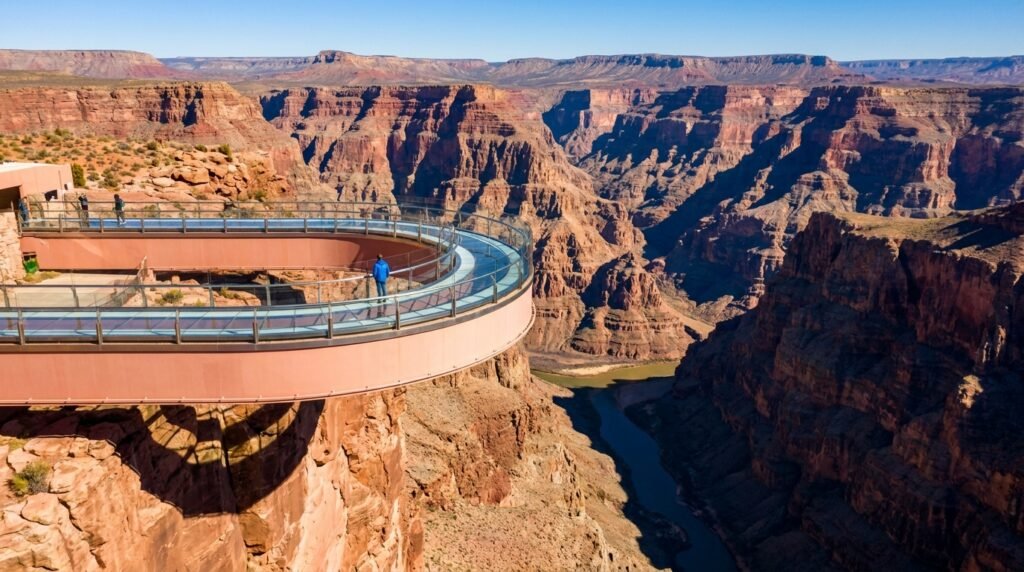
The South Rim of the Grand Canyon is approximately a 4.5-hour drive from Las Vegas. The West Rim — managed by the Hualapai Tribe — is considerably closer, about 2.5 hours, and is the destination served by most las vegas tours running day trips. The Skywalk, a glass-bottomed horseshoe bridge extending 70 feet beyond the canyon rim at a height of 4,000 feet, is genuinely vertiginous and genuinely magnificent.
A las vegas tour to the Grand Canyon via helicopter — either landing on the canyon floor or hovering above the South Rim — is one of the most extraordinary travel experiences available in the American Southwest. Several las vegas tour operators offer helicopter departures from the Boulder City airport or directly from the Strip, with packages that include champagne lunches on the canyon floor. For those seeking a more leisurely pace, las vegas tours by ground vehicle — SUVs with knowledgeable naturalist guides — provide deeper geological and ecological context along the route.
Las vegas tours of this kind book out weeks in advance in peak season (March through May, and September through November). Plan accordingly.
The Practical Poetry of Getting Around
Las Vegas is easier to navigate than it appears. The Strip runs north-south. Everything of interest sits either on the Strip, east or west of it within a few miles, or in the Downtown corridor about four miles north.
The Deuce bus runs the full length of the Strip and into Downtown 24 hours a day. The Las Vegas Monorail connects several major Strip properties on the east side. Rideshares are ubiquitous and relatively affordable. Most Strip hotels offer free self-parking — though the policy has changed at several properties in recent years, so confirm in advance.
The best time to visit is October and November, when temperatures drop from the summer’s punishing 110°F to a dry, perfect 70–75°F, crowds thin slightly after the peak summer season, and the city feels most like itself. March and April are nearly as good.
Spring breakers arrive in waves beginning in late February and continuing through April. New Year’s Eve draws over 400,000 people to the Strip. Both periods are worth avoiding unless the crowd is part of the experience you’re seeking.
If you’re planning a broader American road trip and want to explore other vibrant cities beyond Nevada, consider pairing your Las Vegas adventure with visits to nearby destinations. You might find equally compelling Things to Do in Los Angeles just a few hours west, or explore the diverse offerings of Things to Do in Houston and Things to Do in Dallas for a broader American experience. The Gulf Coast and Deep South offer their own rich cultures — from Things to Do in Miami to Things to Do in Atlanta. For the Northeast, Things to Do in New York, Things to Do in Boston, and Things to Do in Philadelphia each offer centuries of history and culture. The Midwest beckons too, with Things to Do in Kansas City and Things to Do in Arlington Texas rounding out a remarkable cross-country experience.
After Dark, Beyond the Expected
Las Vegas after midnight is a different city than Las Vegas at 7 p.m. The energy shifts. The tourists thin. The workers come off shift. The 24-hour diners — like the legendary Peppermill Restaurant and Fireside Lounge, which has been serving breakfast at 3 a.m. since 1972 — fill with an entirely different population.
The Peppermill is worth a visit at any hour, but particularly late. The booths are enormous. The cocktails are served in fishbowls. The fire pit in the lounge casts a warm, orange light over everything. A couple of off-duty dealers from the Wynn were there the last time I visited, unwinding over pancakes and discussing the particular mathematics of luck.
One of the most memorable things to do in las vegas after dark is simply to walk. The Strip at 2 a.m. has a strange, hallucinatory quality — all that light and no daylight to dilute it, the neon and LED transforming the sidewalk into something half-real. The las vegas tour guides who run midnight and early-morning walking tours through the Fremont East district understand this quality intuitively. They’re selling something no brochure can quite capture: the feeling of a city that has decided, collectively, that time is optional.
What Las Vegas Actually Offers
There is a version of places to visit in Las Vegas that is pure spectacle — the magic shows, the Cirque du Soleil productions at multiple venues, the residencies by artists who have traded touring for a permanent stage in the desert. All of it is worth experiencing, some of it is genuinely extraordinary, and none of it is the real answer to what makes this city worth your time.
The real answer is stranger and more human. Las Vegas is a city built by dreamers on borrowed money in the middle of a desert, and it has never entirely stopped operating on that original energy. Every las vegas tour, every late-night walk past the neon-lit casinos, every conversation with a dealer or a cocktail waitress or a cab driver carries the faint residue of that original bet: that people would come, that pleasure would sustain them, that the lights in the desert would be visible from very far away.
They were right. The lights are extraordinary. And the city behind them — the one that most visitors never quite find — is even more so.
The best las vegas tour you can take is the one that leads you slightly off the obvious path. Out into the desert at dawn. Into a dim sum restaurant on Spring Mountain Road. Into the Neon Museum after dark. Into the back of a bar in the Arts District where someone is playing jazz for an audience of fifteen people who know exactly how lucky they are to be there.
That city is available to anyone willing to look. And if these things to do in Las Vegas have pointed you toward even one experience you wouldn’t have found on your own, then the guide has done what guides are supposed to do: it has helped you find a place for yourself in a city that, for all its noise and bluster, is quietly waiting to be discovered.
Reviews
There are no reviews yet. Be the first one to write one.