
The neon hasn’t gone dark yet. It’s 2 a.m. on a Tuesday, and Fremont Street hums like a living thing — a bass note you feel in your chest before you hear it with your ears. Somewhere behind you, a woman shrieks with laughter as a slot machine pays out. Ahead, a street performer dressed as a silver robot bows to a crowd of fifty strangers who all somehow became friends in the last three minutes. This is your first real breath of Las Vegas, and you realize immediately that no amount of advance reading could have prepared you for it. The places to visit in Las Vegas are not just destinations — they are experiences that rewire your sense of what a city can be, what a night can hold, and what you’re capable of feeling when every sensory dial gets turned to eleven. Whether you’re planning las vegas tours with a packed group itinerary or designing your own solo las vegas tour at your own pace, this city meets you exactly where you are and dares you to keep up.
Table of Contents
The Strip After Dark: Where the City Introduces Itself
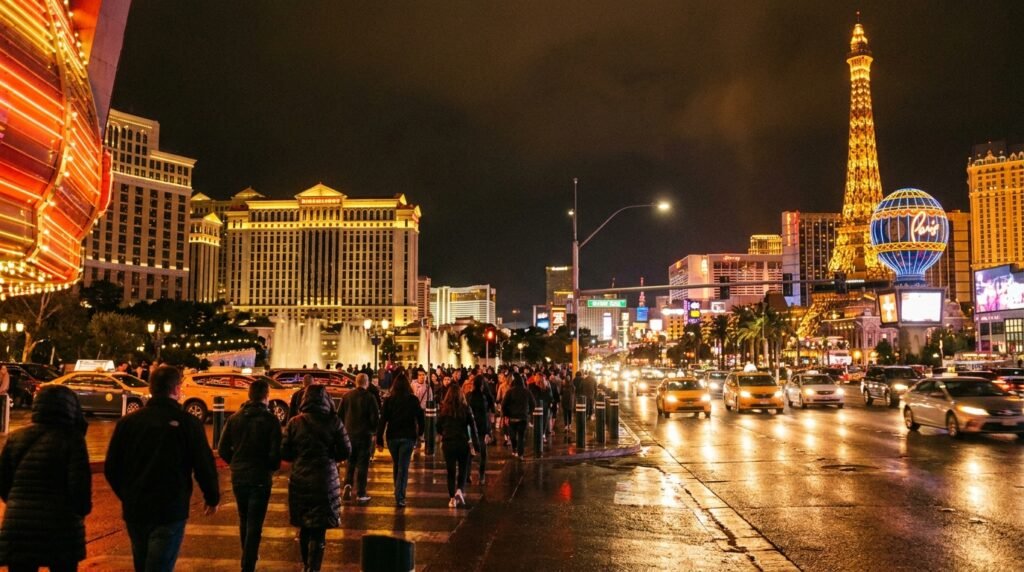
You don’t walk the Las Vegas Strip so much as surrender to it. Among all the places to visit in Las Vegas, the Strip is the one that earns its mythology.
Begin at the southern end, near the Welcome to Fabulous Las Vegas sign — that mid-century diamond of kitsch that has appeared in more Instagram feeds than perhaps any other roadside marker in America. Las Vegas tours almost always include a stop here, and for good reason: it anchors you to the mythology of the place before the scale of everything else overwhelms your sense of direction. A dedicated las vegas tour of just the Strip could fill three days and still leave you feeling you’ve only scratched the surface. A local photographer named Marco, who shoots weddings and elopements on the Strip, once told me: “People come here thinking they know Vegas from TV. Then they see the sign and they realize — they don’t know anything yet. That sign is the city saying, ‘Welcome. Now forget everything.'”
From there, the boulevard unfolds northward in a pageant of architecture that takes no orders from physics or good taste. The Luxor’s pyramid pierces the sky with a beam of light visible from aircraft at cruising altitude. New York-New York delivers a compressed skyline of a different American city, its roller coaster screaming through a replica Brooklyn Bridge. Paris Las Vegas offers a half-scale Eiffel Tower from which you can watch the Bellagio fountains perform their synchronized ballet across the street — a show that runs every fifteen minutes after dark and remains, despite occurring freely and outside, one of the most consistently moving spectacles in the city.
Things to Do in Las Vegas at this hour means leaning against a railing with a drink from the Bellagio’s bar, watching 1,200 water jets choreograph themselves to opera, and feeling briefly, absurdly grateful to be alive. The show is free. The feeling is priceless.
Las Vegas tours of the Strip work best on foot, despite what every taxi driver will suggest. The distances between properties appear shorter than they are — a Vegas optical illusion engineered to keep you moving toward the next casino — but walking is the only way to absorb the details: the hawkers pressing printed cards into your hands, the scent of air conditioning bleeding through automatic doors, the carpets inside every casino entrance patterned specifically to disorient and slow you down. A las vegas tour on foot, camera in hand, at your own speed, is an entirely different experience from being shuttled between properties. Among the places to visit in Las Vegas, the Strip at midnight on foot might be the single most irreplaceable one.
Finding the Soul of Old Vegas: Fremont Street and the Arts District
The Strip gets the postcards. Fremont Street gets the poets.
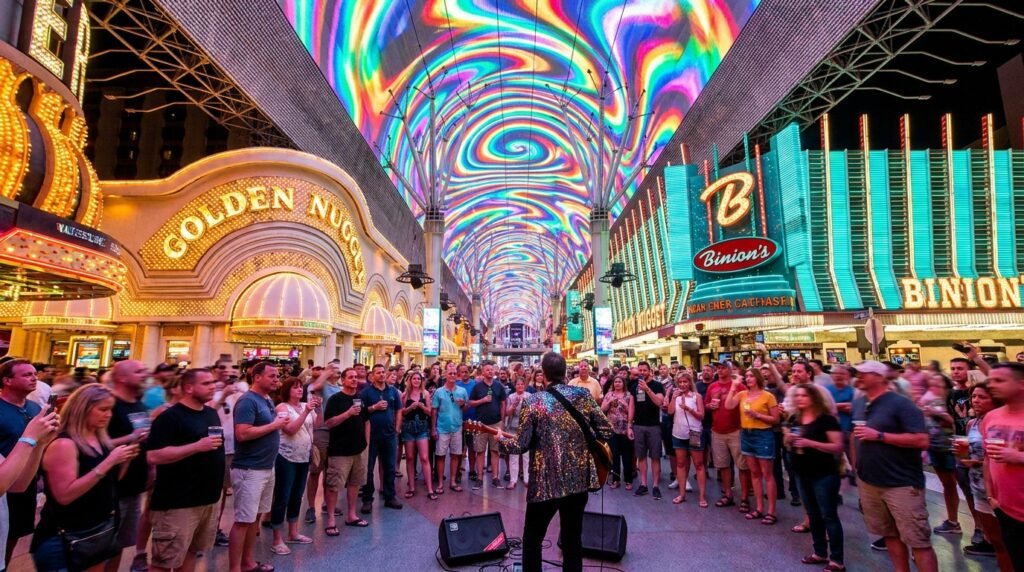
Downtown Las Vegas, just a twenty-minute rideshare from the southern end of the boulevard, operates at a completely different frequency. The Fremont Street Experience — a barrel-vaulted LED canopy stretching four city blocks — was built in 1995 to revitalize a downtown that the mega-resorts had left behind. What it actually created was something the Strip can’t replicate: a neighborhood. One with dirt under its fingernails and music leaking from every doorway.
The Golden Nugget anchors the eastern end, its shark tank visible through floor-to-ceiling glass behind the pool. At the western end, Container Park — a shopping and entertainment complex built from repurposed shipping containers — houses independent restaurants and a giant praying mantis sculpture that breathes actual fire on weekend nights. Between these two poles, the street belongs entirely to the people in it.
Las Vegas tours that skip Fremont Street are missing the city’s heartbeat. Among all the places to visit in Las Vegas, Fremont Street is where the city is most honestly, uncomplicatedly itself. Come hungry. Eat a meal at Eat. — yes, that’s actually the name, a deliberate bit of Fremont Street pragmatism — where the menu is simple and the portions are honest. Or walk half a block to the 18b Arts District, where converted warehouses hold galleries, boutiques, and coffee shops run by people who moved to Las Vegas not for the casinos but for the cheap rent and the community that grew up around the freedom that cheap rent enables. Whether you’re booking organized las vegas tours or going solo, build Fremont Street into any las vegas tour worth the name.
A ceramicist named Priya, who has had a studio in the arts district for six years, describes the neighborhood as “Vegas for people who live in Vegas.” She’s right. On the first and third Friday of every month, the district hosts Art Walk, when galleries stay open late and the streets fill with locals who have no interest in the slot machines two miles away. For the curious traveler, this is one of the most authentic places to visit in Las Vegas — a reminder that the city has layers, that underneath the sequins and the spectacle is a community of artists, chefs, makers, and storytellers building something real.
Things to Do in Las Vegas in the Arts District means gallery-hopping until midnight, ending at a mezcal bar where the bartender explains the difference between varieties with the patience of a professor and the enthusiasm of a convert.
Beyond the Neon: Natural Wonders Within Reach
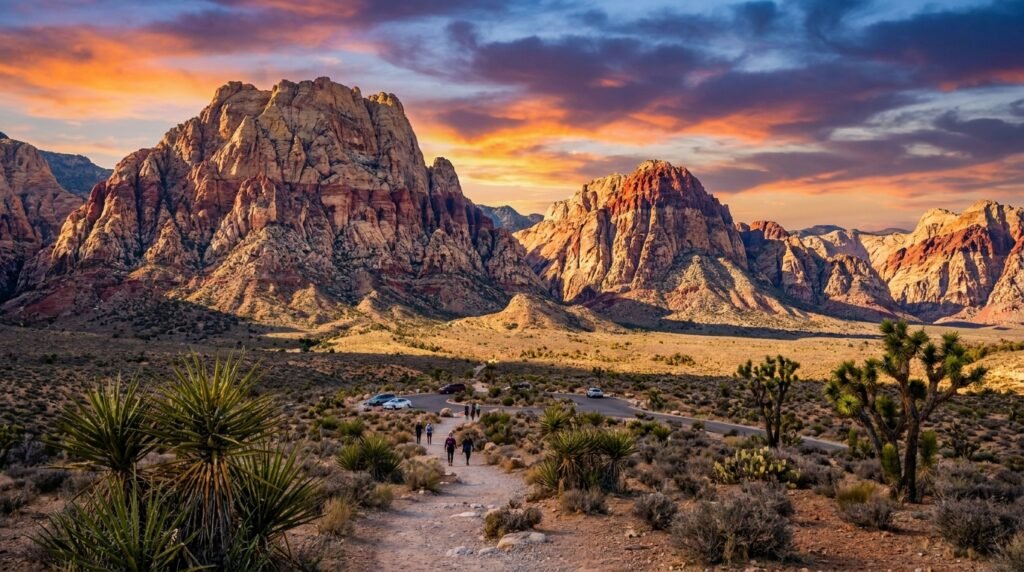
Here is a fact that surprises almost every first-time visitor: Las Vegas sits at the edge of one of the most dramatic landscapes on earth.
Thirty minutes west of the Strip, Red Rock Canyon National Conservation Area offers 197,000 acres of Mojave Desert terrain — rust-red sandstone formations, ancient petroglyphs, and a thirteen-mile scenic drive that feels like driving through a painting. Las Vegas tours to Red Rock Canyon typically run in the morning, when the light falls at angles that make the rock faces glow, and the temperature hasn’t yet climbed to its afternoon peak. Among the places to visit in Las Vegas that extend beyond the casino floor, Red Rock Canyon is the one that makes visitors suddenly understand why people choose to live in this desert. Hikers of every ability level find something here: the Calico Hills loop for casual walkers, the Keystone Thrust trail for those who want elevation and the full sweep of the valley below.
An hour’s drive in the opposite direction brings you to the Hoover Dam — an engineering marvel that deserves every superlative it’s received since its completion in 1936. Las Vegas tours to the dam let you walk across the top, look down into Black Canyon, and learn the story of the thousands of workers who built it during the Great Depression. The dam’s visitor center is excellent, but the most moving moment comes simply from standing on the structure itself and registering its scale — the way the water below disappears into a haze of distance, the way the canyon walls press in on either side, the way human ambition and desert emptiness negotiate the same space. A las vegas tour that combines Red Rock Canyon in the morning and the Hoover Dam in the afternoon gives you two completely opposite faces of Nevada in a single day.
The Grand Canyon’s South Rim is a four-hour drive from Las Vegas, and the West Rim — on Hualapai tribal land — is roughly two hours by road. Las Vegas tours operators offer helicopter trips to both rims, some including a landing at the canyon floor with a champagne toast beside the Colorado River. These are not cheap. They are not forgettable. The canyon las vegas tour experience — departing from a city built on manufactured thrills and arriving at one of earth’s most genuine ones — produces a particular kind of cognitive dissonance that travelers describe for years afterward.
For those who have traveled to comparable American cities — explored the history of Things to Do in Boston or navigated the cultural richness of Things to Do in Philadelphia — the desert landscape surrounding Las Vegas offers something those cities cannot: geological time, rendered visible.
The Art of Eating in Las Vegas: A City That Takes Food Seriously
The old reputation of Las Vegas dining — cheap buffets, mediocre steak houses, food as an afterthought between gambling sessions — is decades out of date.
The city has become one of the most interesting restaurant cities in America, and the concentration of culinary talent per square mile is genuinely staggering. Nearly every major chef with a global profile has a presence here. But the most interesting eating is not always in the celebrity kitchens. It’s in the neighborhoods.
Chinatown — running along Spring Mountain Road west of the Strip — is the most consistent meal you’ll find in Las Vegas, and almost no first-time visitor knows it exists. The strip mall aesthetic is deceptive; behind those unremarkable facades are some of the best Vietnamese pho in the Southwest, Japanese ramen shops that stay open until 3 a.m. to serve the casino industry’s night shift workers, Korean barbecue joints where you grill your own meat over charcoal and the banchan keeps coming whether you ask for it or not.
A server at one of the Korean restaurants, a young woman who has worked there since she was in high school, describes the neighborhood without sentimentality: “People think Vegas is all show. But here, it’s just food. Good food. You eat, you’re happy. That’s it.” That directness — that refusal to package and sell the experience — is exactly what makes Chinatown worth seeking out.
Las Vegas tour guides sometimes include Chinatown on extended food tours, but the neighborhood rewards independent exploration. Come with no reservations and follow the longest queues.
Back on the Strip, a splurge dinner at one of the signature restaurants is worth the investment once. The tasting menus at the top properties — Joël Robuchon, é by José Andrés, Picasso at Bellagio — are as technically accomplished as anything you’ll find in New York or Paris. The rooms are beautiful. The service is precise. And unlike their counterparts in cities that offer similar dining experiences — Things to Do in New York includes some of the world’s most coveted restaurant reservations — Las Vegas tables are often easier to book and set you back only fractionally more in a city where everything else is slightly cheaper.
Things to Do in Las Vegas through its food means eating dim sum in Chinatown at noon, grabbing a pastrami sandwich from the Cosmopolitan’s food hall in the afternoon, and sitting down to a seven-course dinner at a Michelin-recognized kitchen by eight — all in the same day, in the same city, without the experience feeling remotely contradictory.
Entertainment, Spectacle, and the Art of the Residency
Las Vegas invented the residency before the music industry had a name for it.
Elvis understood this. So did Celine Dion, who performed more than 1,100 shows at Caesars Palace over sixteen years. The city’s relationship with live performance is unlike any other — artists don’t come to tour through Las Vegas, they come to live inside it, shaping shows specifically for rooms that were designed to make spectacle feel inevitable.
The current residency landscape shifts constantly, but the venues themselves are worth visiting regardless of who’s performing. Dolby Live at Park MGM seats nearly 6,000 people with sightlines engineered so that every seat feels close. The Sphere — opened in 2023 on the northeastern end of the Strip — is the most technologically advanced entertainment venue ever built, with a fully programmable interior LED surface covering 160,000 square feet and a haptic seat system that lets audiences feel the bass of the music through their bodies. Las Vegas tours that include a show at the Sphere come back fundamentally changed in how they talk about what “going to a concert” can mean. If there’s a single las vegas tour experience that didn’t exist a decade ago and now defines the city’s future identity, it is the Sphere. As a destination, it belongs on every list of places to visit in Las Vegas, right alongside the Bellagio fountains and the canyon helicopters.
Cirque du Soleil has maintained a presence in Las Vegas for three decades, and several of their shows run permanently in purpose-built theaters on the Strip. “O,” the water-based production at Bellagio, remains technically astonishing after twenty-five years of performances. The Mystère production at Treasure Island is where Cirque’s Las Vegas story began, and it shows the original company’s ambition in its clearest form. Las Vegas tours centered on live entertainment can fill an entire week without repeating an experience — there is simply that much to see.
For comedy, the Laugh Factory inside the Tropicana and Brad Garrett’s Comedy Club at MGM Grand host working comedians in rooms that feel intimate despite the city around them. Las Vegas tour packages rarely include comedy shows, which means they’re often undersold to visitors who would love them.
Where Tradition Meets Change: The New Las Vegas Taking Shape
The city is transforming in ways that deserve attention.
The T-Mobile Arena, which opened in 2016, brought the NHL’s Vegas Golden Knights to a city that had long resisted major sports franchises. The team’s immediate success — reaching the Stanley Cup Finals in their inaugural season — unlocked something in Las Vegas that the tourism industry had never quite accessed before: civic pride. Locals who previously defined their relationship to the city through cynicism about the tourist economy suddenly had something to root for.
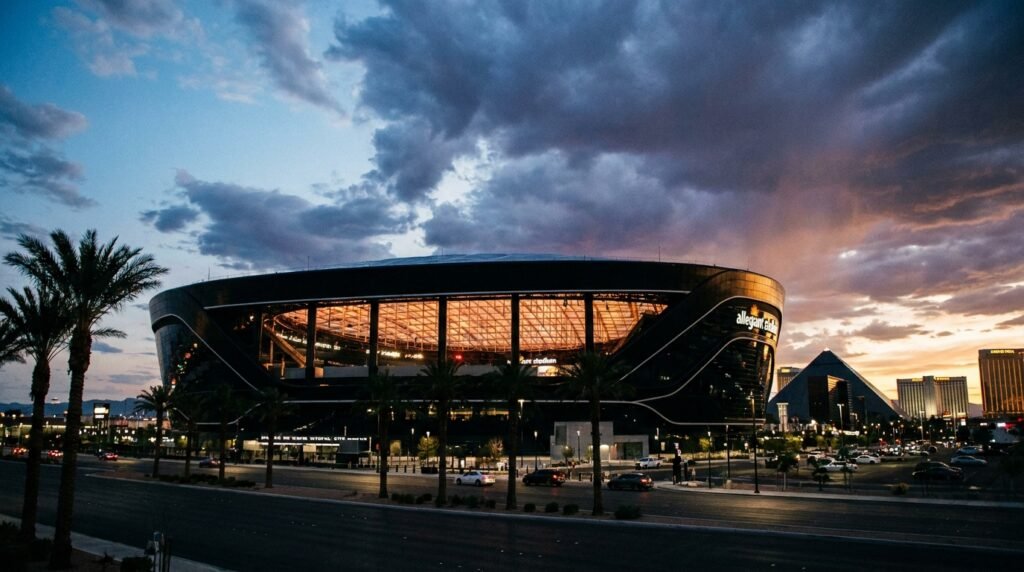
In 2020, the NFL’s Las Vegas Raiders moved into Allegiant Stadium, a 65,000-seat venue partially buried beneath the desert floor to control temperatures, with a translucent roof that floods the field with natural light without exposing it to direct sun. Las Vegas tour operators now include stadium tours of both arenas, and the stadiums themselves have become legitimate places to visit in Las Vegas for sports fans who might otherwise skip the gambling-focused attractions. A game-day las vegas tour of the stadium district — with tailgating culture transplanted from Oakland to the Mojave — is one of the most unexpectedly moving things you can do in this city. Meanwhile, the residential neighborhoods east of the Strip — Henderson, Summerlin, and the increasingly vibrant area around the arts district — are developing food and cultural scenes that mirror what visitors would find in cities with longer histories of urban cool. Locals point to these areas with the same pride that residents of similar emerging neighborhoods in Things to Do in Atlanta, Things to Do in Houston, or Things to Do in Dallas might express about their own cities’ transformations.
Las Vegas tour operators increasingly offer itineraries that acknowledge this evolution — “locals’ Las Vegas” tours that bypass the Strip in favor of coffee shops, record stores, and neighborhood breweries that make no concessions to the visitor economy. Among all the las vegas tours you can book, these neighborhood-focused ones tend to produce the most lasting impressions.
Practical Wisdom for the First-Time Visitor
Las Vegas rewards certain approaches and punishes others.
Walk less than you think you should. The heat in summer — regularly exceeding 110°F — is not metaphorical. Casinos are cooled to sub-Arctic temperatures as a deliberate contrast, which means you move from furnace to freezer repeatedly. Stay hydrated with more deliberateness than you think necessary, especially if alcohol is involved, which in Las Vegas it almost certainly will be.
Book your las vegas tour well in advance if it involves the Grand Canyon, Hoover Dam, or any helicopter experience. These fill weeks out during peak season (March through May, September through November). Las Vegas tour pricing is dynamic in the way airline tickets are — the same experience can cost dramatically different amounts depending on when you book. Most organized las vegas tours include hotel pickup, which saves the logistical headache of navigating the Strip’s traffic patterns during peak hours.
Stay on the Strip for your first visit, off it for your second. The first time, proximity to the spectacle is the experience. The second time, having a base in a residential neighborhood and commuting to the Strip changes everything about how the city feels. Las vegas tours are optimized for first-timers; your second visit deserves a plan you build yourself.
Allocate one morning to complete sobriety and silence. Wake early, before 8 a.m., and walk the Strip when the service workers are still setting up. The fountains run. The lights are still on. But the crowds haven’t arrived, and you can see the architecture and the ambition of the place without the noise. It is the most intimate the city gets with strangers.
For those who’ve experienced similar mornings of quiet discovery in cities like Things to Do in Miami or early-rising walks along the waterfront in Things to Do in Los Angeles, the pre-dawn Strip offers that same quality of earned intimacy — a city caught without its performance face on.
Understanding Las Vegas Through Its Casinos
You do not have to gamble to understand what the casinos are doing architecturally and psychologically.
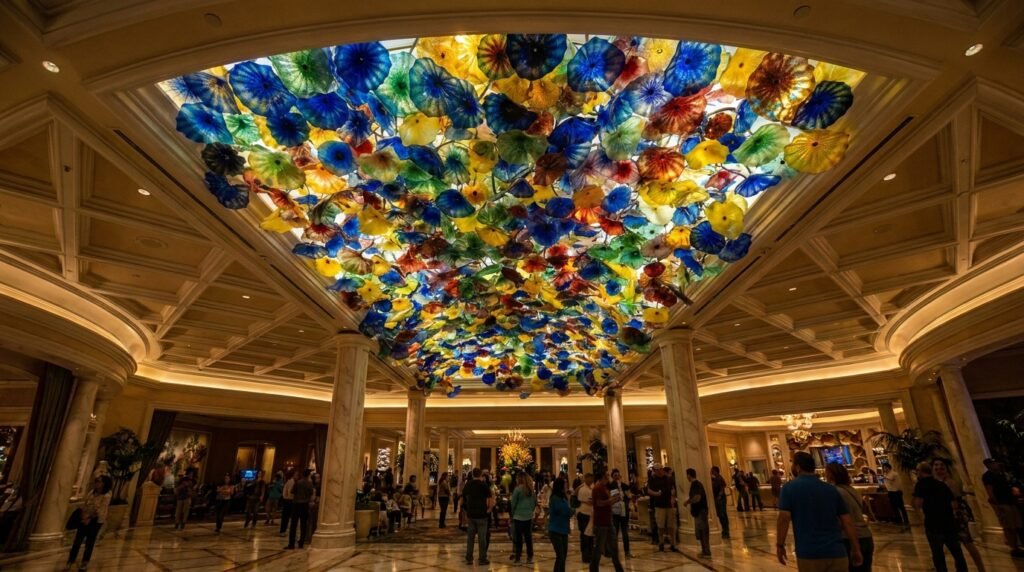
Walk through the Bellagio lobby and look up at the Dale Chihuly glass ceiling installation — 2,000 hand-blown glass flowers in sixteen colors, installed in 1998. It is serious public art, placed deliberately in the path of every guest who enters the hotel. Walk through the Wynn and notice how every interior space is designed to feel like someone’s private garden — lush, quiet, expensive in ways that don’t announce themselves loudly. Walk through the Cosmopolitan and find the Wicked Spoon buffet, the secret pizza place on the third floor that locals eat at late at night, and the art installations scattered through the corridors.
The casinos spend more on interior design per square foot than almost any other type of building in the world. Understanding why — what they’re trying to make you feel, how they’re calibrating your sense of time and money and possibility — is one of the most interesting intellectual exercises available in any of the places to visit in Las Vegas. Among the places to visit in Las Vegas that require no money to enjoy, the casino interiors offer free access to some of the most ambitious interior design in the world.
Las vegas tours focused specifically on casino architecture and design exist, though they’re rare. More commonly, a knowledgeable local guide will weave these observations into a broader las vegas tour narrative. Seek them out. The best guides here are former dealers, interior designers who worked on the properties, or historians who specialize in the postwar American Southwest. They carry the city differently from the inside. A las vegas tour conducted by someone who worked the floor at the Bellagio in the early 2000s is worth more than any guidebook.
Things to Do in Las Vegas can include a casino walkthrough that never involves placing a bet — a form of architectural tourism that treats the floors as galleries and the dealers as performers in a show that never stops.
A Note on Neighboring Cities Worth Combining
Las Vegas sits within driving distance of destinations that offer restorative contrast. For those building a longer Southwest itinerary, the drive to Zion National Park takes approximately two and a half hours and passes through St. George, Utah — a small city with excellent restaurants that have no relationship to the casino economy.
Travelers who approach the region from the east might combine Las Vegas with a leg through the Southwest before continuing to cities where the entertainment operates on a different scale — Things to Do in Arlington Texas for sports and theme parks, or Things to Do in Kansas City for barbecue and jazz. The contrast makes each destination sharper, more itself.
What Las Vegas Finally Means
Every city has a thesis. New York argues that ambition is a virtue. New Orleans insists that pleasure has its own dignity. Las Vegas makes a stranger claim: that reality is negotiable, that you can build any world you want if you’re willing to work hard enough and spend freely enough and refuse to acknowledge that the desert around you finds the whole enterprise absurd.
It is, in many ways, the most American city — the one that takes the national mythology of reinvention and self-creation and renders it in neon, poured concrete, and the specific frequency of hope that a slot machine generates when it almost pays out.
The places to visit in Las Vegas are not just the casinos, not just the Strip, not just the shows and the restaurants and the helicopter rides over the canyon. They are the 6 a.m. moment when the cleaning crews work in silence around the sleeping stragglers. They are the Korean restaurant in Chinatown where the banchan keeps coming. They are the ceramicist in the arts district who chose this desert city because it left her alone to make beautiful things.
Las Vegas tours show you the spectacle. The city itself, if you stay long enough and look carefully enough, shows you something more: a place that was built on the audacious premise that people deserve to feel extraordinary, even briefly, even temporarily, even in the middle of a desert. That premise is not cynical. It is, in its own peculiar way, generous.
Come ready to be surprised. Come willing to be changed. The neon will be on when you arrive. It will still be on when you leave.
Things to Do in Las Vegas is not a checklist. It is an ongoing conversation between you and a city that never fully reveals itself — and that, more than anything else, is why people keep coming back.
Reviews
There are no reviews yet. Be the first one to write one.