
The first time I ever stood at the edge of Boston Harbor, I made the mistake most visitors make. I was moving too fast. I had a list, a map, and the misguided confidence of someone who believed that a city could be ticked off like a grocery run. By the third day I slowed down — not by choice, but because a side street in the North End stopped me completely. The smell of garlic and espresso, the sound of two old men arguing in Italian over a chess board, the way the afternoon light fell at an angle across a building that had been standing since before the American Revolution. I missed my next planned stop. I never regretted it.
That is how Boston works. It does not reward the hurried. It rewards the curious. And after more than a decade of living here, I can tell you with confidence that the places to visit in Boston that will genuinely change how you see this country — and perhaps yourself — are rarely the ones that appear first in a search result.
This guide is built from that kind of attention. It covers the landmarks worth every minute, the ones not worth the hype, the neighborhoods that don’t perform for cameras, and the practical intelligence that only comes from actually living somewhere. Whether you are arriving for the 2026 FIFA World Cup or planning a long weekend, this is the honest, story-first version of Boston that you deserve.
Table of Contents
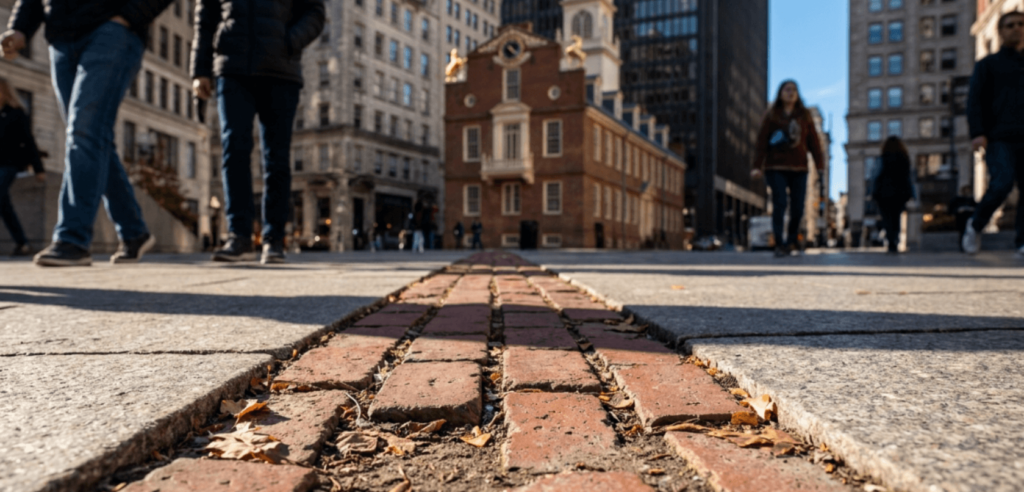
The Freedom Trail — Where the City Begins Its Confession
Every conversation about places to visit in Boston begins here, and that is not a cliché — it is geography. The Freedom Trail is a 2.5-mile red-brick path that connects sixteen of the city’s most significant historic sites, and walking it is the single best way to orient yourself in a city that was never designed on a grid.
You can join dozens of boston tours led by actors in full 18th-century costume, and some of those tours are genuinely excellent — particularly the ones that depart from the Old South Meeting House, where the interpreters recreate the colonial debate with enough heat that you forget, briefly, which century you’re standing in. But I would suggest doing your first pass independently, on a weekday morning before the school groups arrive, when the trail is quiet enough to hear your own footsteps on the brick.
Boston Common is where you start. Established in 1634 as a shared cow pasture, it became a site of public execution, a military encampment during the Revolution, and — in more recent centuries — a place where Martin Luther King Jr. and Pope John Paul II addressed enormous crowds. Today, it is where dog walkers and students and tourists all coexist on the same patch of grass, which is itself a kind of American story.
“The Freedom Trail doesn’t take you through history. It takes you through the ground where history actually happened — and there is a profound difference between the two.”
The Massachusetts State House, just up Beacon Street from the Common, is one of the most photographed places to visit in Boston, and for good reason — that gold-leaf dome catches the afternoon sun in a way that makes the whole building look slightly unreal. The dome is covered in 23-karat gold leaf, and the building sits on land that was once John Hancock’s cow pasture. Continuity is a theme here.
Granary Burying Ground stops most visitors cold. Paul Revere is here. Samuel Adams is here. John Hancock is here. The grave markers are weathered to near illegibility in places, and the stones lean at angles that suggest centuries of New England winter. There are no velvet ropes, no glass barriers. You walk among the graves on the same gravel paths that Bostonians have walked for 350 years. It is one of the most quietly powerful places to visit in Boston, and it asks nothing of you except to be still for a moment.
Many boston tours extend the Freedom Trail to include the Boston Tea Party Ships and Museum, where you can — genuinely — throw crates of tea into the harbor. It sounds gimmicky. It is not. The experience is well-researched, theatrically committed, and oddly moving. Do it.
The North End — A Neighborhood That Lives Out Loud
If the Freedom Trail is Boston’s mind, the North End is its appetite. This is the city’s oldest residential neighborhood — more than 87 food businesses operate within its narrow corridors — and walking into it from the Greenway feels like crossing a border into a different country without leaving the city.
Hanover Street is the main artery, and strolling it on a Saturday afternoon is one of the great free places to visit in Boston. Salumerias display cured meats in their windows. Old men sit outside espresso bars with newspapers folded to the crossword. The smell of slow-cooked sauce drifts from open kitchen windows on upper floors. Boston tours that cover this neighborhood often move too quickly through it — the North End is a place for wandering, not marching.
The Cannoli Debate: A Local Religion
No honest account of places to visit in Boston skips this. Mike’s Pastry draws the longest lines, the most Instagram posts, and the widest flavor selection. Those white cardboard boxes tied with baker’s twine have become as much a Boston souvenir as anything sold in Faneuil Hall. Modern Pastry, two blocks away, is quieter, slightly crisper in its shells, and fiercely preferred by longtime residents. Bova’s, open 24 hours, serves the patient and the nocturnal.
Every boston tours guide I have ever spoken to has a strong opinion on this debate. Every local I know refuses to be neutral. You should form your own view — which means you have to eat at all three, which is not a hardship.
The Skinny House and Other Hidden Truths
On Hull Street, just off the main drag, stands a four-story building that is, at its narrowest point, ten feet wide. The Skinny House — built, according to local legend, by a Civil War soldier to spite his brother who had constructed a building blocking his original home’s light — is one of the stranger places to visit in Boston. It is residential and not open to the public, but standing in front of it and understanding what it represents — that petty human grievances can become architectural landmarks — is worth the detour.
For dinner, bypass the tourist-facing restaurants near the waterfront and look for Carmelina’s on Hanover Street for their Crazy Alfredo, or head to Regina Pizzeria, which has been making the same style of pizza since 1926. The crust has a particular chewiness that you cannot fully explain and will spend the rest of your trip trying to recreate in your imagination.
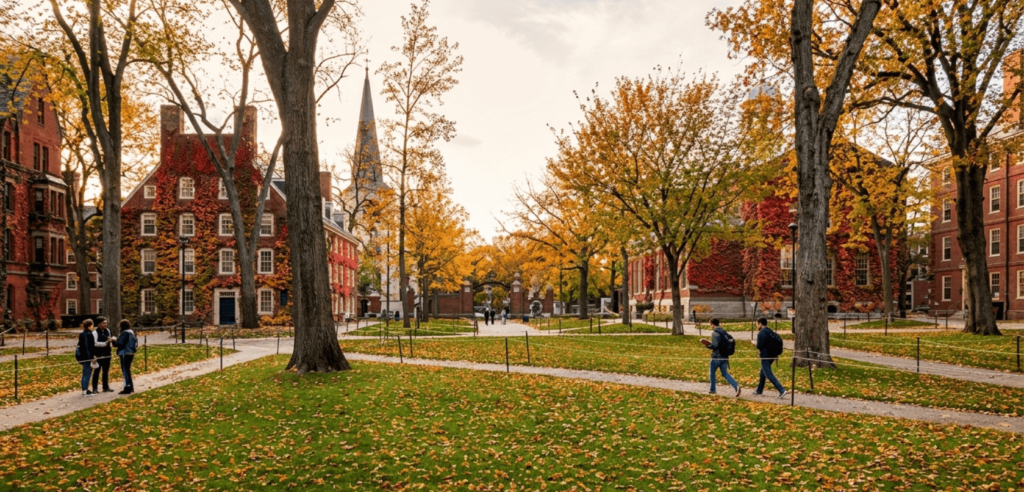
Cambridge — Crossing the River Into the City’s Brain
The Longfellow Bridge connects Boston to Cambridge across the Charles River, and the crossing itself is worth making on foot. The view downstream toward the Zakim Bridge and the city skyline is one of those accidental compositions that looks like it was designed for a film establishing shot.
Harvard University, founded in 1636, is among the most historically significant places to visit in Boston’s broader metro area. Several luxury boston tours offer narrated van rides through the Harvard Loop, but the campus is best experienced on foot, at your own pace, through the Johnston Gate and into Harvard Yard. The John Harvard Statue in the yard is known locally as the “Statue of Three Lies” — the man depicted is not actually John Harvard, the date inscribed is wrong, and Harvard was not the college’s founder but its first major donor. Locals call this out with the particular pride that comes from knowing the joke.
Harvard Square itself rewards an afternoon of wandering. Street musicians have been performing here for generations — a young Tracy Chapman played these corners before she became famous. Lovestruck Books is an excellent independent bookshop. Felipe’s, housed in a former bank building, serves tacos that have no business being as good as they are in the middle of Massachusetts.
MIT, just down Massachusetts Avenue, operates on a completely different frequency. Where Harvard feels classical and residential, MIT feels kinetic and experimental — student projects are visible through glass-walled labs, the architecture is aggressive and modern, and the entire campus hums with a specific kind of concentrated ambition. Together, the two campuses make Cambridge one of the most intellectually charged places to visit in Boston’s wider geography.
📚 Cambridge Quick Reference
- Harvard Yard: Enter through Johnston Gate. Free, open daily. The Statue of Three Lies is near the center.
- MIT Stata Center: Frank Gehry’s crumpled-aluminum building is worth seeing even if architecture isn’t your thing.
- Arnold Arboretum: 281 acres managed by Harvard. Free. Peak fall foliage in October is extraordinary.
- Felipe’s Taqueria: Inside a former bank vault. Order the carnitas. Don’t argue about it.
- Lovestruck Books: Independent bookshop with strong local and poetry sections.
Back Bay — The City’s Polished Surface
Back Bay didn’t exist until the mid-19th century. The entire neighborhood was a tidal mudflat that Boston methodically filled in over thirty years, creating the orderly grid of streets — alphabetically named, running Arlington to Hereford — that now houses some of the city’s most expensive real estate. Walking through it, you would never guess it was built on landfill.
Newbury Street is Boston’s answer to the high-end shopping boulevard, lined with Victorian brownstones that now contain everything from luxury boutiques to independent coffee shops. It is pleasant but not revelatory. More interesting is what lies just off it.
The Boston Public Garden — opened in 1837 as the country’s first public botanical garden — is one of the most genuinely beautiful places to visit in Boston. The Swan Boats have operated on the lagoon since 1877, and while they are undeniably a tourist experience, the fifteen-minute paddle around the small island at the center of the lagoon is also quietly restorative in a way that surprises most visitors who expected to feel silly.
Copley Square anchors the neighborhood’s cultural weight. Trinity Church, completed in 1877 in the Richardsonian Romanesque style, influenced American ecclesiastical architecture for decades. Standing in front of it and then turning around to face the glass facade of the John Hancock Tower — which reflects the church back at you in its modern surface — is one of those accidental Boston juxtapositions that feels deliberately staged but isn’t.
The Prudential Tower, known locally as “The Pru,” offers a 52nd-floor observation deck that gives you the best aerial read of the city’s compact geography. Many boston tours include this view as an orientation stop, and it earns its place — from up here, the walkability of the city becomes instantly legible. You can see, all at once, how close the North End is to Beacon Hill, how the Charles River separates Cambridge from Boston, how the Seaport sits just across a narrow channel from the historic waterfront.
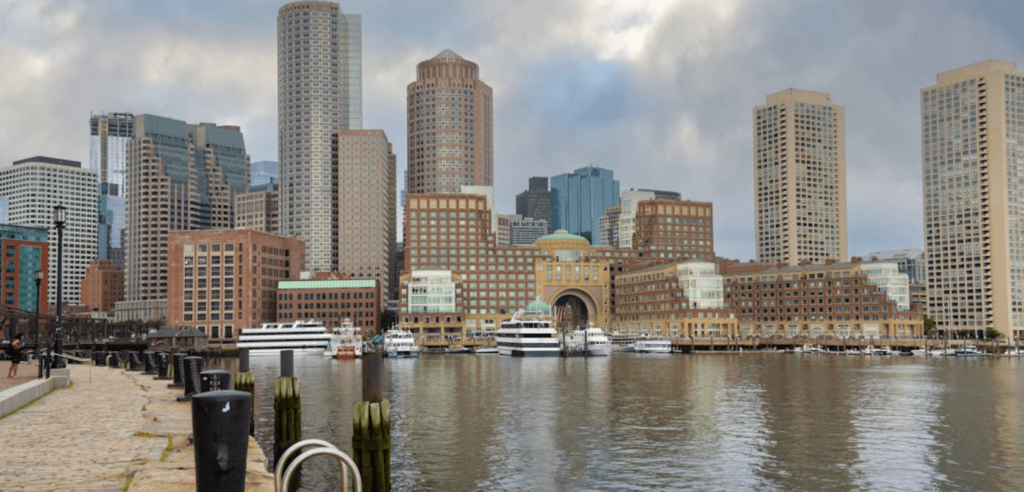
The Seaport and Waterfront — Boston’s Newest Chapter
Twenty years ago, the Seaport District was industrial warehouses, empty lots, and parking structures. Today it is the fastest-growing urban district in the city, dense with glass-walled office buildings, design studios, upscale restaurants, and cultural institutions. Whether this transformation is a triumph of urban development or a cautionary tale about displacement depends on who you ask, and an honest travel guide should tell you that both conversations are happening simultaneously.
The Institute of Contemporary Art sits on a pier at the harbor’s edge, its upper floors cantilevering out over the water. The building’s design means that some of the gallery rooms have floor-to-ceiling windows looking out over Boston Harbor, which creates the unusual experience of viewing contemporary art against a backdrop of actual ocean. It is among the most architecturally interesting places to visit in Boston, and the permanent collection is strong.
The Harborwalk — 43 miles of continuous public waterfront pathway — is free, open year-round, and almost entirely overlooked by visitors. Boston tours rarely feature it as a primary destination, but walking even a portion of it, from the Seaport back toward the North End, gives you a perspective on the city’s relationship with its harbor that no indoor experience can replicate. Fan Pier Park at sunset is worth the effort specifically.
The New England Aquarium anchors the older part of the waterfront and remains one of the best places to visit in Boston for families. The four-story Giant Ocean Tank is the centerpiece — a circular column of water containing a Caribbean coral reef ecosystem — and watching it from the spiral ramp that winds around it is both calming and slightly disorienting in the best possible way.
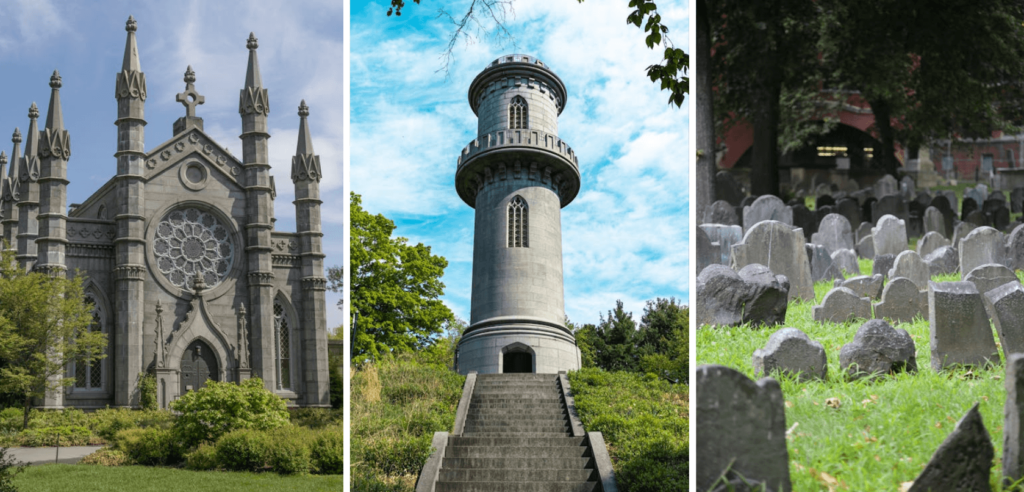
Hidden Boston — The City That Doesn’t Perform for Tourists
The places to visit in Boston that locals return to — the ones that don’t appear in most travel features — require only a small amount of local knowledge and a willingness to look slightly off-center.
Mount Auburn Cemetery: The Most Beautiful Place Nobody Talks About
Established in 1831 as the country’s first landscaped cemetery, Mount Auburn is 175 acres of botanical garden, wildlife sanctuary, and outdoor art museum — and it is technically a cemetery. Walking its winding paths, you pass the graves of Oliver Wendell Holmes, Henry Wadsworth Longfellow, and Buckminster Fuller. The Washington Tower at the center offers a panoramic view of Boston and Cambridge that almost no tourists ever see, because almost no tourists know to look for it. It is one of the most genuinely moving places to visit in Boston, and it is free.
Candlepin Bowling: A New England Original
Standard bowling uses a heavy ball with finger holes and ten chunky pins. Candlepin bowling — invented in Worcester, Massachusetts in 1880 — uses handheld balls without finger holes, narrow cylindrical pins, and gives you three rolls per frame. It sounds simpler. It is dramatically harder. Finding an alley and spending an afternoon with it is one of those things to do in Boston that separates the genuine visitor from the tourist.
The Brattle Book Shop
Operating since 1825, this is one of the oldest continuously operating used bookshops in the country. The summer sidewalk sale, where thousands of volumes are displayed on outdoor shelves against a mural-covered brick wall, is one of the great free experiences among places to visit in Boston. You will spend longer here than you plan. This is not a problem.
Coolidge Corner Theatre
A restored 1933 art-deco movie house in Brookline that screens foreign films, independent cinema, and — on Friday and Saturday midnights — B-grade cult classics to a devoted local crowd. The experience of watching a film here, with a genuinely enthusiastic audience in a room that was built for this purpose, is something that modern multiplexes have made most of us forget is possible.
The Legendary Taverns — Where the Revolution Was Planned Over Ale
Boston’s taverns were not mere drinking establishments in the colonial era. They were the internet of the 18th century — the places where information was exchanged, alliances were formed, and plans were made that changed the world. Visiting them today is one of the more historically resonant things to do in Boston, and the fact that you can order a drink while you do it is a bonus that history has very thoughtfully arranged.
The Bell in Hand Tavern, established in 1742, is the oldest continuously operating tavern in America. Its founder, Jimmy Wilson, was Boston’s last town crier. The Green Dragon Tavern — “Headquarters of the Revolution,” as it was known — is where Paul Revere and Samuel Adams reportedly coordinated the acts of defiance that preceded the war. The Omni Parker House, one of the finest places to visit in Boston for its historical layers, served as a gathering place for presidents and literary figures for generations; their bar still serves the “JFK Martini,” named for a frequent guest.
These are not tourist traps dressed in historical clothing. They are real places that have been serving people for centuries, and the fact that they are still doing so is, in its own way, one of Boston’s quiet achievements.
Boston Against the Map — How It Compares to Other Great American Cities
Travelers building broader American itineraries often ask where Boston fits in the landscape of great U.S. cities. The comparison is genuinely useful for calibrating expectations.
Boston is denser, older, and more walkable than almost any American city of comparable cultural weight. Relative to things to do in Los Angeles, Boston is more compact and historically layered, though it lacks LA’s sprawling coastline and entertainment industry. Against things to do in San Francisco, Boston holds its own on food and intellectual density — both cities are defined by their universities and their water — but San Francisco’s dramatic topography gives it a visual advantage that Boston’s relatively flat downtown cannot match.
Things to do in Seattle offer more access to dramatic Pacific Northwest wilderness, while Boston’s natural escapes are quieter and more coastal — islands, beaches, and harbor views rather than mountains and fjords. If you are comparing the South, things to do in Atlanta reflect a younger, faster-growing urban culture with a warmer climate and a different relationship to its own history — one that Boston, with its 400-year-old founding mythology, approaches very differently.
Things to do in Houston offer scale and multicultural diversity that rival any American city, though in a geographically sprawling format that is the inverse of Boston’s compact walkability. Things to do in New York sit just four hours south by train and share Boston’s density and cultural ambition — but New York is a city that performs for the world, while Boston is a city that performs for itself, which is both its limitation and its considerable charm.
Philadelphia, just two hours south, is perhaps the most useful comparison. If you’ve planned things to do in Philadelphia, you’ll notice the shared DNA immediately — the revolutionary history, the neighborhood pride, the fierce local food culture, the brick architecture. But Boston has Fenway, the Charles River, the universities, and the harbor, and the particular combination creates something that stands genuinely apart. Things to do in New Jersey offer their own coastal and culinary rewards for those building a Northeast corridor itinerary, and the Garden State is closer to both cities than most people realize.
The $10 Weekend — Rail Day Trips Across New England
One of the most practical and underused strategies for visitors is the MBTA’s weekend commuter rail pass — ten dollars for unlimited travel across all zones, Saturday and Sunday. This single pass converts Boston from a single destination into a regional base camp and opens up some of the finest coastal and historic places to visit in Boston’s wider orbit.
🚂 Best Day Trips via the $10 Weekend Pass
- Salem (30 min from North Station): The 1692 Witch Trials history is handled with more nuance than you might expect. The Peabody Essex Museum is world-class and genuinely surprising.
- Rockport (65 min): A working Cape Ann fishing village with Halibut Point State Park and Roy Moore Lobster Co. Go on a weekday. The weekend crowds change the atmosphere entirely.
- Providence (60 min): Brown University, the RISD Museum of Art, and East Side Pockets — a Mediterranean counter where the line wraps around the block and is worth every minute.
- Plymouth (60 min): Plimoth Patuxent handles the complexity of the Pilgrim story with genuine historical care. More interesting than you remember from school.
- Ipswich (75 min): Castle Hill mansion and four miles of Crane Beach — among the finest beaches in New England, uncrowded on weekdays even in summer.
These rail-connected destinations are among the most rewarding places to visit in Boston’s regional geography, and the boston tours operators who have begun building rail-based day trip packages around them are offering some of the finest travel value in the American Northeast. No rental car. No parking fees. No highway.
Practical Intelligence for the Honest Traveler
Boston is one of the most walkable major cities in the United States, and the majority of places to visit in Boston are within reasonable walking distance of one another in the historic core. The MBTA subway — “The T” — is color-coded and functional, if occasionally unreliable. Load a CharlieCard at any station, keep it topped up, and use it for anything beyond a 20-minute walk.
The best times to visit are April through June and September through October. Spring brings marathon weekend — Patriots’ Day in April is a full city celebration — and the Public Garden tulips. Fall brings foliage of the kind that looks digitally enhanced and the particular electricity of Red Sox playoff season. Winter is genuinely cold by most standards, but the crowds thin dramatically and the city’s indoor life — its museums, bookshops, and restaurants — becomes more central and more intimate.
Several practical notes that most boston tours will not volunteer:
🗂️ Practical Tips — Things No Guidebook Mentions
- Cash matters: Several North End institutions and old-school pubs are cash-only. The Tam on Tremont Street — one of the city’s finest dive bars — does not take cards. Bring bills.
- Haymarket Garage: If you drive in, validated parking here costs as little as $1 for two hours with any North End business purchase. This is city-changing information for drivers.
- Tipping: 18 to 22 percent. Boston service workers are professional and knowledgeable. Respect that accordingly.
- Fenway tours: Book the 8 AM Field Level Tour at Fenway Park for access to the warning track before anyone else arrives. Worth the early alarm.
- World Cup 2026: Matches at Gillette Stadium in Foxborough mean significantly higher hotel demand. Book accommodation well in advance — this applies to any visit between June and July 2026.
What Boston Actually Asks of You
I want to be honest with you about something that most travel guides won’t say.
Boston will not automatically give you its best self. It is not a city that puts on a show. It is not designed to impress you on arrival the way some cities are — it doesn’t have a skyline entrance that takes your breath away, it doesn’t greet you with warm weather and palm trees, it doesn’t offer the disorienting abundance of a place like New York. What it offers instead is depth. And depth requires time.
The places to visit in Boston that will genuinely matter to you are, almost without exception, the ones you find by slowing down. By taking the wrong street and discovering it was actually the right one. By waiting forty-five minutes for a lobster roll and using that time to watch the North End go about its Saturday. By standing in front of an empty picture frame in a museum and letting the weight of what is missing settle over you.
The things to do in Boston that stay with you are never the ones that were easiest to find. They are the ones you had to be curious enough, patient enough, and present enough to earn.
Walk the trail slowly. Have the cannoli debate. Take the ferry to the harbor islands on a clear morning and watch the city recede across the water until it looks small and manageable and yours.
Boston has been at this for four centuries. It knows how to wait for the right visitor. Go be that person.
Reviews
There are no reviews yet. Be the first one to write one.