
A decade of living here taught me which rules to break, which lines are worth waiting in, and which cobblestones hide the city’s best-kept secrets.
The first morning I ever spent in Boston, I did what every first-time visitor does — I pulled up a list, mapped out the Freedom Trail, and told myself I’d see everything in two days. By noon, I was sitting on a bench in the Public Garden eating a paper cup of clam chowder, completely lost and completely in love. That was twelve years ago. I never really left.
What I know now that I didn’t know then is that the best things to do in Boston are rarely printed on laminated brochure cards at Logan Airport. They live in the creases of this city — in the argument between two old men at a cannoli counter in the North End, in the creak of a century-old wooden seat at Fenway Park, in the way the afternoon light catches the gold dome of the State House on a November afternoon and makes you feel, briefly, like you’ve slipped through time. This guide is built from twelve years of that kind of paying attention.
And it arrives at the right moment. With the 2026 FIFA World Cup bringing matches to Gillette Stadium in nearby Foxborough, Boston is about to host the world. Hotel rates are climbing. New restaurants are opening weekly. The city is polishing itself up for company. Which means right now — before the crowds arrive — is exactly the time to understand what makes this place tick.
Table of Contents
The Historic Core: Walking Into the Story
Every conversation about things to do in Boston begins at Boston Common — and with good reason. Established in 1634, it is the oldest public park in the United States, and standing at its center on a weekday morning, surrounded by dog walkers and joggers and students cutting through on their way to class, you feel the specific weight of that age. This is not a preserved relic. This is a park where the city still happens.
From the Common, the logical path leads into the adjacent Public Garden, where the famous Swan Boats have glided across the lagoon since 1877. These aren’t just a tourist novelty — they require a minimum of ten to twelve passengers before the paddlewheel submerges safely, which means every ride is a small, spontaneous community. Children press their faces to the railing. Grandparents point at the ducks. Teenagers pretend they don’t find it charming and then smile anyway. It is one of those quietly perfect things to do in Boston that no one regrets doing.
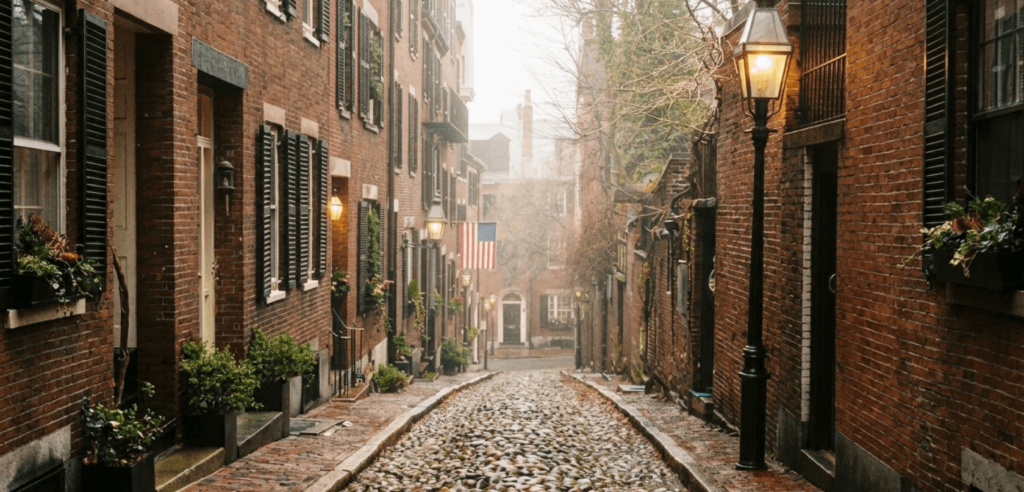
The Freedom Trail connects sixteen of the city’s foundational historic sites across 2.5 walking miles. You can join any number of Boston tours guided by costumed interpreters who bring Paul Revere and Samuel Adams to life with theatrical flair. But I would suggest walking the first half of the trail solo on your first morning — not because Boston tours aren’t worth it (they absolutely are), but because navigating the trail yourself forces you to notice things: the way Beacon Hill’s brick sidewalks slope unexpectedly, the gas lamps that still burn along Acorn Street, the old grave markers in Granary Burying Ground that list the names you studied in history class but never expected to find quite this real.
“Boston doesn’t show off its history — it inhabits it. The past here isn’t behind glass. It’s underfoot.”
Beacon Hill deserves its own afternoon. The neighborhood sits just north of the Common, rising steeply along streets so narrow that two cars can barely pass each other, which means most residents simply don’t bother with cars. There is something about the combination of red brick, climbing ivy, and those iron boot scrapers still mounted beside front doors that makes Beacon Hill feel like a secret the city is keeping from itself. Many of the best Boston tours use this neighborhood as a centerpiece, and rightly so — few urban residential districts anywhere in America are this intact, this livable, this genuinely old.
The Culinary Pilgrimage: Earning Your Meal in Boston
Boston received its first Michelin recognition in 2024, which was treated by locals with a mixture of pride and mild exasperation — the way you feel when a hidden beach you’ve loved for years finally goes viral. The restaurants here have always been extraordinary. The city was just modest about it.
If you visit once and can only eat one thing, make it the cold lobster roll at Neptune Oyster in the North End. The restaurant seats twenty-four people at a curved marble counter and accepts no reservations. On a summer weekend, the wait runs thirty to sixty minutes. You will spend that time standing on a narrow sidewalk, watching the North End go about its Saturday, and when you finally sit down and that split-top bun arrives — loaded with cold, sweet, mayo-laced lobster meat — you will understand that the wait was not an inconvenience. It was the appetizer.
The North End itself is one of the great things to do in Boston that requires no agenda. This is the city’s Italian-American neighborhood, compact and fragrant, where salumerias hang cured meats in their windows and old men sit outside coffee bars reading newspapers in Italian. The cannoli debate between Mike’s Pastry and Modern Pastry has been running for generations. Mike’s draws the longest line, sells the most boxes, and has become a kind of souvenir unto itself — those white cardboard boxes tied with baker’s twine are as Boston as anything you’ll find. Modern, two blocks away, is quieter, slightly crisper, and fiercely preferred by longtime residents. I have tested both extensively. I will not tell you which side I’m on. Forming your own opinion is one of the more essential things to do in Boston.
When evening comes and you want something less famous but perhaps more extraordinary, head to the South End and find Toro. It’s a Spanish tapas bar on Washington Street where, on any given Tuesday, half the tables are occupied by people who work in other restaurants. That is always the best possible endorsement. Order the corn with aioli and lime, the bone marrow, and whatever cured meat the server suggests. Stay longer than you planned.
🍽️ Local Eating Rules — Read Before You Dine
- Faneuil Hall: Walk through it, but eat somewhere else. The tourist-facing restaurants here are expensive and forgettable.
- Flour Bakery: Arrive before 10 AM for sticky buns. They run out, and this is non-negotiable information.
- Sweet Cheeks Q: The smoked brisket near Fenway is the best pre-game meal in the city, full stop.
- Eastern Standard: The oyster program and cocktails at Kenmore Square make this the ideal Fenway pre- or post-game bar.
- Drink: No menu. Bartenders in Fort Point build your cocktail based on a conversation about your mood. Trust them.
Culture Beyond the Surface: Museums Worth the Admission
The Museum of Fine Arts is one of the largest art museums in the United States and one of the finest things to do in Boston on a rainy afternoon — or any afternoon, honestly. The Egyptian collection alone is worth the trip. If your time is limited, ask at the entrance for the self-guided highlights map, which traces a route through twelve essential works in under an hour. But if you can linger, do. The Impressionist galleries in the afternoon light are something else entirely.
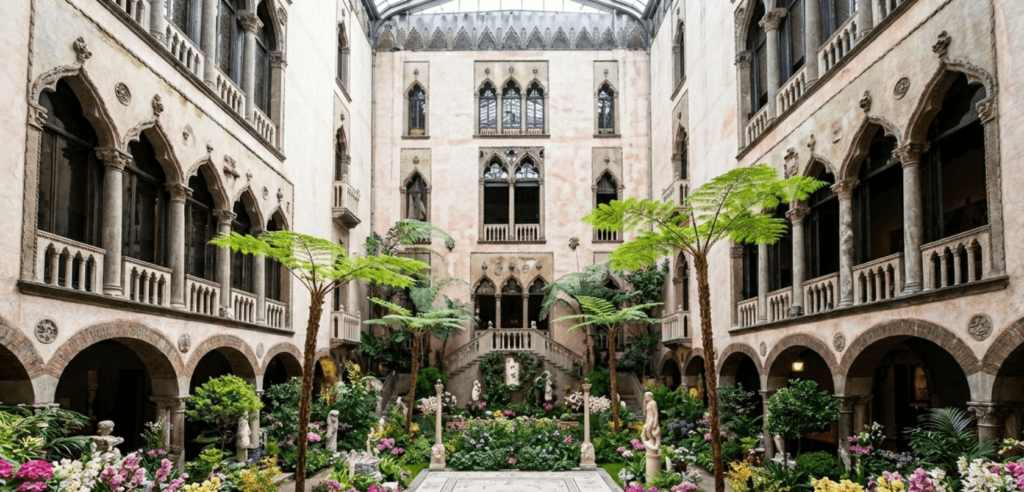
For sheer narrative power, nothing in Boston competes with the Isabella Stewart Gardner Museum. Gardner was one of the great American eccentrics of the Gilded Age — she designed the building herself, modeled on a 15th-century Venetian palazzo, and filled it with art and objects according to her own idiosyncratic logic. The central courtyard, open to the sky and planted with flowers that change each season, is one of the most unexpectedly beautiful rooms in any American city. Many Boston tours make the Gardner a centerpiece, and the museum’s audio guide is thoughtfully done — but what no tour can fully prepare you for is the Dutch Room, where thirteen stolen works — Vermeer, Degas, and Rembrandt’s only known seascape among them — are represented by empty frames. They have hung empty since 1990. The museum is legally bound to keep them there until the works are returned. Standing in front of them is one of those quietly haunting things to do in Boston that lingers for days.
In the Seaport, the Institute of Contemporary Art occupies a cantilevered glass building that hangs over the harbor. The view from the upper-floor galleries is genuinely theatrical — the harbor below, planes descending into Logan Airport above, the city skyline behind you. The Seaport District surrounding it has transformed faster than any other part of Boston in the past decade, converting from industrial warehouses into a dense corridor of galleries, restaurants, and design studios. Several of the best Boston tours now focus specifically on this transformation, documenting what was here before and what it has become.
Cambridge: Crossing the Charles for a Different Kind of City
Boston and Cambridge are separated by the Charles River and, in some ways, by an entire philosophy of urban life. Boston is a city that grew organically from its colonial plan — compact, layered, occasionally confusing. Cambridge was shaped decisively by its universities and carries that intellectual self-consciousness in its bones.
Walking through Harvard Square is one of the more pleasurable things to do in Boston’s broader metro area. Independent bookshops sit alongside vintage record stores and restaurants from a dozen different culinary traditions. Lovestruck Books is a genuinely excellent independent. Felipe’s, a taqueria tucked inside a former bank building, serves tacos that have no business being as good as they are in the middle of New England.
MIT’s campus, just down Massachusetts Avenue, runs on a completely different frequency — all exposed concrete and kinetic energy, with student projects half-built in glass-walled labs visible from the sidewalk. Several excellent Boston tours cover both campuses as a paired experience, drawing out the contrast between Harvard’s Georgian residential architecture and MIT’s modernist sprawl. The juxtaposition is genuinely illuminating.
The Arnold Arboretum — a 281-acre public park managed by Harvard, free to enter — is among the most underappreciated things to do in Boston for visitors who don’t know it exists. In October, during peak foliage, it is simply staggering. In May, during Lilac Sunday, the entire city seems to descend on it at once, which is itself a kind of annual local ritual worth witnessing.
“Cambridge is where Boston goes to think. Cross the river and you’ll understand why this city keeps producing ideas the rest of the world eventually borrows.”
Non-Touristy Gems: The Boston That Doesn’t Pose for Photos
The best things to do in Boston for returning visitors — or for anyone who wants to sidestep the well-worn tourist path — require only a little local knowledge and a willingness to wander.
Candlepin bowling is a New England original. The pins are narrower than standard tenpin, the balls fit in your hand without finger holes, and you get three rolls per frame instead of two. It sounds simple. It is genuinely difficult. Find a lane at one of the few surviving alleys in the city and you’ll spend two hours laughing with strangers in a way that no Boston tour could manufacture.
The Brattle Book Shop on West Street has been selling used and rare books since 1825. In summer, they stage an outdoor sidewalk sale on three tiers of shelving — dollar books at the bottom, rare editions behind glass inside. The Coolidge Corner Theatre in Brookline screens classic and foreign films in a restored 1933 movie house, and their Friday and Saturday midnight screenings of B-grade films are a neighborhood institution.
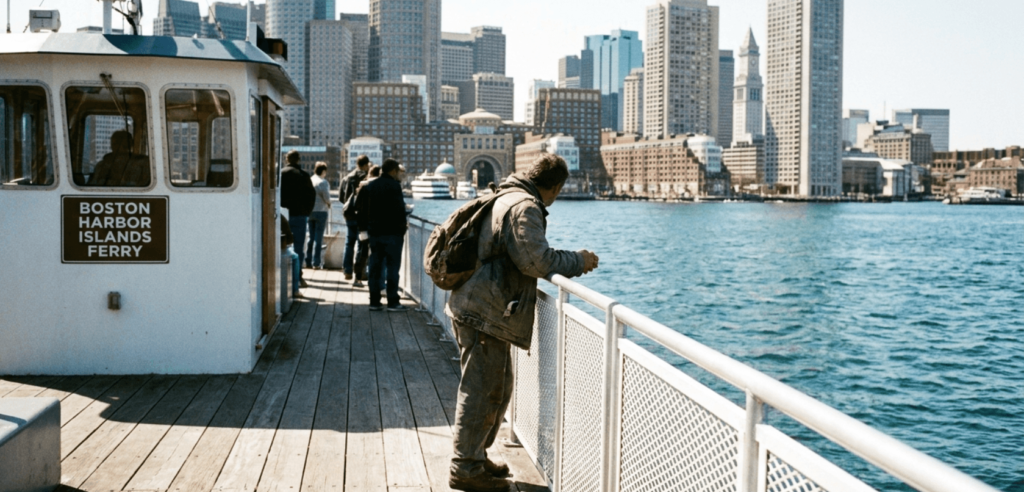
Taking the ferry to the Boston Harbor Islands is one of the most quietly rewarding things to do in Boston that most visitors never discover. Of the thirty islands in the harbor, four are accessible by public ferry. Georges Island has a Civil War-era fort. Spectacle Island has a beach and sweeping views back toward the skyline. On a clear weekday afternoon, you can sit on the ferry’s upper deck with almost no one else aboard and watch the city recede across the water.
Somerville’s Union Square — a short subway ride or brisk walk from Cambridge — rewards the effort. Bow Market is a small courtyard of independent shops and food stalls. Union Square Donuts makes what may be the finest raised donut in the region. These are the kinds of things to do in Boston that don’t appear in most travel features but that residents return to every weekend.
The $10 Weekend Strategy: New England by Rail
One of the most practical and underused things to do in Boston for budget travelers is to buy the MBTA’s weekend commuter rail pass for ten dollars. Valid all day Saturday and Sunday across every zone, this pass transforms Boston from a single destination into a regional base camp.
🚂 Best Day Trips From Boston via the $10 Pass
- Salem (30 min): The 1692 Witch Trials history is real and handled thoughtfully. The Peabody Essex Museum is world-class. Come in October for the full theatrical effect.
- Rockport (65 min): A working fishing village on Cape Ann with Halibut Point State Park, Roy Moore Lobster Co., and the kind of harbor views that make you want to paint something.
- Providence (60 min): Brown University, the RISD Museum of Art, and East Side Pockets — a small Mediterranean takeout counter where the line wraps around the block for good reason.
- Plymouth (60 min): Plimoth Patuxent is a living history museum that handles the complexity of the Pilgrim story with more nuance than you might expect.
- Ipswich (75 min): Castle Hill mansion and four miles of Crane Beach — arguably the most beautiful beach in the state, uncrowded on weekdays.
These rail-based Boston tours of the wider region are genuinely some of the finest travel value in the American Northeast. No rental car, no parking, no highway traffic — just a commuter train and an afternoon to spend.
For travelers who are building an East Coast itinerary around Boston, it’s worth knowing that the city connects naturally to a series of excellent American urban destinations. If you’re mapping out your journey, you might want to explore things to do in New York as a natural companion city — just four hours south by train — or look at things to do in Philadelphia, which sits between Boston and New York and rewards a stop of its own. Things to do in New Jersey are closer than most people realize, and the state has pockets of extraordinary food and coastline.
The Sports Spirit: Fenway and the Religion of the Red Sox
Fenway Park opened in 1912. It is the oldest active Major League Baseball stadium in America, and while it has been renovated over the decades — new seats added, the famous Monster seats atop the Green Monster installed — the bones of the place are original. Sitting in those seats, you can feel it.
Even if baseball means nothing to you, visiting Fenway is one of the essential things to do in Boston. The stadium Boston tours run daily and range from a panoramic overview tour to the early-morning field-level experience that brings you right down onto the warning track before the grounds crew arrives. Standing that close to the Green Monster — which looks almost cartoonishly tall when you’re standing beside it — is one of those moments that recalibrates your sense of the city’s scale.
The Kenmore Square neighborhood surrounding the park operates as a kind of satellite city on game days. Eastern Standard fills up by 5 PM. Sweet Cheeks Q runs out of brisket by 6. The streets fill with people wearing red jerseys, and the whole neighborhood takes on the low, pleasurable electricity of a crowd that knows it’s about to go somewhere together.
With the 2026 World Cup coming to Gillette Stadium, Boston is about to experience a different kind of sports energy — international, multilingual, arriving from every corner of the globe. The city’s existing pride in its teams creates a natural foundation for that kind of celebration. Watch for Boston tours operators to begin offering World Cup-themed itineraries through 2025 and into the tournament itself.
Practical Logistics: Moving Around the Hub Like a Local
Boston is the fifth-largest city in America by land area — but it’s actually quite compact, which means a surprising number of things to do in Boston are walkable from a central hotel. The T (the MBTA subway system) is America’s oldest, dating to 1897, and while it has its chronic unreliability, the color-coded lines cover the city’s major neighborhoods adequately. Load a CharlieCard at any station. Keep it topped up. Don’t rely on the app during rush hour.
The best times to visit for weather are April through June and September through October. Spring brings the Public Garden tulips and the marathon (Patriots’ Day weekend in April is a city-wide celebration). Fall brings foliage so vivid it looks digitally enhanced, and the Red Sox playoff energy if the season has gone well. Winter is cold — genuinely, New England cold — but the crowds thin dramatically, hotel rates drop, and the city’s indoor life (its museums, its restaurants, its bookshops) becomes even more central.
For accommodations, the neighborhoods closest to the most things to do in Boston are the Back Bay, Beacon Hill, the South End, and the Seaport. The Back Bay offers the most central position and easy access to Newbury Street shopping. Beacon Hill is the most atmospheric if you can find availability. The Seaport is newer, more polished, and slightly removed from the historic core — but convenient for the ICA and the innovation district.
Tip your servers 18 to 22 percent. Boston service workers are professional, knowledgeable, and deserve it. Do not honk your car horn. Do not jaywalk on streets with active traffic. These are not legal advisories — they are social ones. Boston has its own etiquette, and respecting it is one of the quieter things to do in Boston that will earn you a warmer reception from the city itself.
Boston in Context: How It Compares to Other American Cities
Travelers building a broader American itinerary often ask how Boston fits against other great U.S. cities. The comparison is genuinely useful for setting expectations.
Relative to things to do in Los Angeles, Boston is denser, older, and more walkable — but it lacks LA’s coastline and sprawling creative industry. Against things to do in San Francisco, Boston holds its own on history and food, and the two cities share a similar intellectual density thanks to their university ecosystems. Things to do in Seattle offer more access to dramatic natural landscape, while Boston’s nature is quieter and more coastal. If you’re comparing the South, things to do in Atlanta offer a faster-growing city with a different cultural rhythm — younger in its urban character, warmer in climate, and more expansive in geography. And things to do in Houston give you scale and diversity that rival any American city, though in a format that is fundamentally different from Boston’s compact, walkable density.
What Boston has that few other American cities can match is the specific feeling of deep civic continuity. Philadelphia and Boston are often paired as the two cities most defined by their founding history, and if you’ve explored things to do in Philadelphia, you’ll notice certain family resemblances — the pride in the role each city played in 1776, the brick architecture, the fierce neighborhood identities. But Boston has the universities, the harbor, and Fenway, and the combination creates something singular.
Final Word: The City That Grew on Me
I moved to Boston for what I thought would be a year. I stayed for more than a decade, and I’m still not sure I’ve seen everything. That is both the frustration and the gift of this place — it keeps revealing itself slowly, in layers, to people who are willing to stay a little longer and look a little closer.
The most essential of all things to do in Boston isn’t any single site or restaurant or museum. It’s choosing to move at the city’s pace rather than your own. Walk the trail slowly. Wait for the lobster roll. Have the cannoli debate with someone you’ve just met. Take the $10 train to the coast on a Sunday and sit on a rock above the Atlantic and let the city recede for a few hours.
The finest Boston tours — whether guided, self-directed, or entirely improvised — are the ones that lead you somewhere you didn’t expect to go. Boston will do that to you if you let it. The history here is not behind glass. It is in the sidewalk beneath your feet, in the grain of the wood at the ballpark, in the hiss of the coffee machine at a North End café where no one speaks to you in English because why would they? You’re in their neighborhood now.
That is the honest truth of this city. It is not performing for you. It is simply being itself — stubbornly, beautifully, four centuries deep. Your job is to show up and pay attention.
Boston is waiting. Don’t keep it.
Reviews
There are no reviews yet. Be the first one to write one.