
Planning your trip around the best things to do in Honolulu Hawaii is less about checking landmarks off a list and more about learning to read the city the way a local does — with patience, strategy, and a willingness to let the unexpected become the highlight. Honolulu is, by any honest measure, one of the most misunderstood cities in the Pacific. Most people arrive with a mental image assembled from old postcards: coconut palms, ukulele music drifting through sea air, and an uncomplicated shoreline. What they find instead is a layered, breathing metropolis where a 300,000-year-old volcanic crater sits thirty minutes from a Michelin-recommended ramen shop, and where the weight of American military history presses quietly against the rhythm of a Friday art walk. Getting the best things to do in Honolulu Hawaii right — really right — demands that you build your days with intention. That begins with understanding the single biggest shift in how Honolulu operates in 2026: the Reservation Economy.
Table of Contents
The 2026 Playbook: Planning Before You Land
The modern traveler who wants to experience top honolulu attractions — and there are dozens worth your time — books before boarding the plane. Researching honolulu attractions from home rather than scrambling on arrival is no longer a nice-to-have; it is the price of admission to the best version of this city. That is not an exaggeration. Diamond Head State Monument, arguably the most photographed honolulu attraction in the entire state, now requires non-residents to secure a timed entry slot up to 30 days in advance through the Hawaii DLNR portal. The $5-per-person fee is payable exclusively by credit card at the gate, and you must check in during the first 30 minutes of your designated two-hour window. Miss that window and the ranger will turn you away without negotiation. Pearl Harbor operates on an equally firm reservation structure. Tickets for the USS Arizona Memorial tour are released 60 days out and routinely sell out within hours. Treat these not as inconveniences but as the rules of a more considerate travel culture — one that protects the very places you came to see.
For those who want the scaffolding built for them, honolulu tours curated by local operators can absorb much of this logistical pressure. The market for honolulu tours has matured significantly — you can now find everything from narrated walking honolulu tours of downtown’s historic buildings to self-drive coastal routes with GPS audio narration. Shaka Guide’s East Oahu Shoreline Drive, for instance, pairs a Diamond Head start with a narrated coastal loop that unfolds at your own pace through a smartphone audio guide. It is one of the more intelligent honolulu tours available because it treats the crater not as a destination but as a launch point — a philosophy worth adopting for the entire trip. Self-paced honolulu tours like this one have expanded the market considerably beyond the traditional bus-based format.
The practical five-day architecture that most seasoned Honolulu visitors recommend works like this: open with Waikiki to decompress and calibrate, push into elevation and history in the middle days, then ease back toward leisure and neighborhood discovery at the end. Fighting this rhythm by front-loading every major honolulu attraction on day one is the fastest route to trip fatigue — that specific, dulling exhaustion that makes every experience feel less vivid than it should.
The Three Core Pillars of Any Honolulu Itinerary
Every competent honolulu city tour — whether you’ve designed it yourself or booked it through an operator — is built around three structural pillars. Operators who run honolulu city tour packages consistently organize their programs around these same three anchors because decades of traveler feedback have confirmed their centrality. Think of them as the load-bearing walls of your trip. You can decorate around them however you like, but removing any one of them leaves the whole structure feeling incomplete.
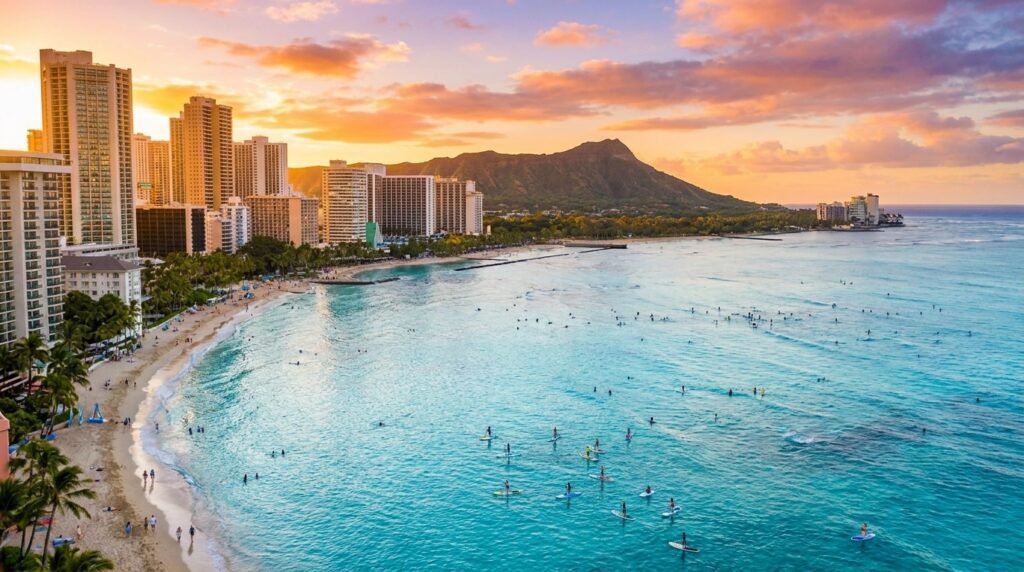
Diamond Head (Le’ahi): Ancient Hawaiians called this crater Le’ahi, a name rooted in the shape of the ridge, said to resemble the brow of a yellowfin tuna. The hike itself is a moderate 1.6-mile round trip with roughly 175 stairs inside the crater’s military-era tunnels. Plan for 90 minutes to two hours if you move at a conversational pace and stop to actually look at things — which you should. The panoramic view from the summit lookout, a sweep of blue-green Pacific interrupted only by the white geometry of Waikiki’s resort towers, is one of those sights that lands differently in person than in any photograph. It is among the hawaii attractions honolulu locals still genuinely recommend, which says something meaningful — hawaii attractions honolulu residents could drive past every weekend but still consider worth the effort.
Waikiki Beach: Dismiss Waikiki at your peril. Yes, it is commercialized. Yes, you will hear seventeen different languages before you finish your morning coffee. But it is also one of the most functional entry points of any beach city in the world. The surf is calm and protected by an offshore reef, making it ideal for first-time paddleboarders and anxious swimmers. Rental stands, food vendors, and public showers are densely distributed. Every major honolulu city tour route either starts or ends here because the logistics simply work — no car needed, no complicated transit calculations, just the city presenting itself at its most accessible.
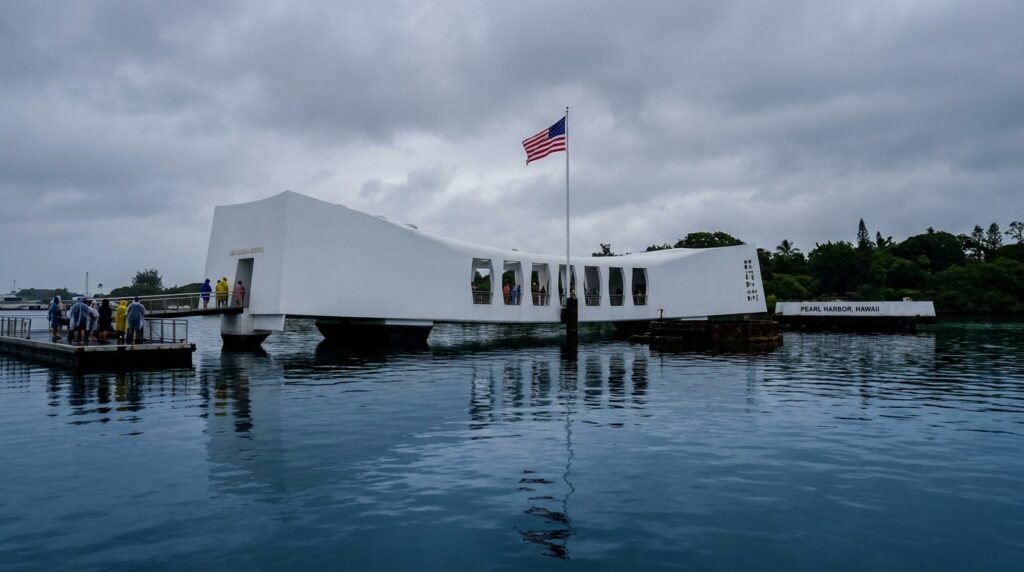
Pearl Harbor: This is the experience that shifts the emotional register of the entire trip. The USS Arizona Memorial — accessible only by Navy boat — floats directly above the hull of the battleship, which still holds the remains of 900 sailors who could not be recovered after December 7, 1941. The oil that still seeps slowly to the surface is called the “black tears” by site staff. No guide, however eloquent, can fully prepare you for what it feels like to stand there. Among the hawaii attractions honolulu offers, this is the one that stays with people the longest — not because it is pleasant, but because it is honest.
The Cultural Layer: Where Honolulu’s Soul Lives
Once the three pillars are secured, the real pleasure of discovering places to visit in Honolulu begins. This is where the city stops performing for tourists and starts revealing itself.
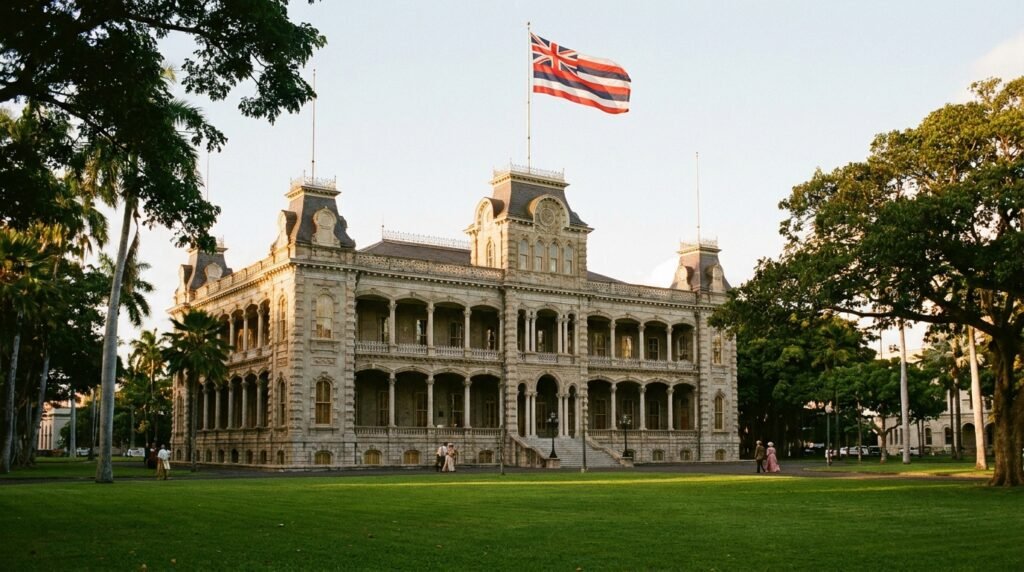
Iolani Palace stands at the corner of King and Richards Streets downtown, looking slightly incongruous among its modern neighbors — a Victorian-Italianate structure built in 1882 that once housed Hawaii’s royal family and, after the illegal overthrow of the monarchy in 1893, served as the territorial and then state capitol building. The palace is open Tuesday through Saturday for both docent-led and self-guided audio tours. Walking through the throne room — still furnished with the original koa wood pieces — or standing in the basement cell where Queen Lili’uokalani was imprisoned for nine months after attempting to restore Hawaiian sovereignty is an experience that no honolulu city tour built purely around beaches can replicate. It is among the places to visit in Honolulu that carries the most historical weight per square foot of any building on the island.
Chinatown sits just west of downtown and rewards anyone willing to peel back its touristy surface layer. The neighborhood is one of the oldest Chinatowns in the United States and its architecture — pressed tin ceilings, narrow storefronts, wet markets with fish still twitching in their bins — tells you so immediately. The Oahu Market on North King Street has operated continuously for over a century. Traditional lei shops perfume entire blocks. And on the first Friday of each month, the Chinatown Arts District hosts a gallery walk that draws an eclectic crowd of artists, collectors, and curious wanderers. For any honolulu city tour that aspires to show the city’s creative present alongside its historical past, First Friday is essential. These are the kinds of places to visit in Honolulu that don’t appear in airport brochures but define how locals actually spend their evenings — and they are the places to visit in Honolulu that generate the most interesting stories when you get home.
The Honolulu Museum of Art houses one of the largest collections of Asian and Pacific art in the United States and is perpetually underrated in travel coverage. Among the free-admission honolulu attractions available on certain days of the month, this ranks at the top. The architecture alone — open courtyards, bougainvillea-draped garden walls, interlocking galleries organized around a central courtyard — justifies the visit. Admission is around $20 for adults on standard days, and the museum’s café is one of the more civilized lunch options in that part of the city.
Eating Through the City: An Honest Culinary Map
The hawaii attractions honolulu is famous for extend well beyond its landscapes. The food culture here is a hybrid product of Hawaiian, Japanese, Chinese, Filipino, Korean, and Portuguese immigration, and it has produced a regional cuisine unlike anything else in the United States. Understanding hawaii attractions honolulu through its food is not a secondary activity — it is one of the primary ones.
Start with the plate lunch, which is less a dish than a cultural institution. Two scoops of white rice, a scoop of macaroni salad dressed with just enough mayonnaise to qualify as indulgent, and a protein — typically teriyaki beef, kalbi short rib, or chicken katsu — served in a segmented styrofoam container. Rainbow Drive-In on Kanaina Avenue has been producing this combination since 1961 and the line at noon tells you everything you need to know about its enduring relevance. Zippy’s, a local chain with multiple locations, offers a broader menu and is the place where Honolulu residents eat when they don’t want to think too hard about dinner.
For traditional Hawaiian food, Helena’s Hawaiian Food in the Kalihi neighborhood is the standard reference. James Beard Award-winning and family-run for three generations, it serves Lau Lau (pork and butterfish steamed inside taro leaves until the fat renders completely into the greens), Kalua pig (whole-roasted in an underground imu), and poi (fermented taro paste that you either love immediately or acquire a taste for over several visits). It is one of those hawaii attractions honolulu rarely advertises because it doesn’t need to — the locals have been keeping it alive for decades.
The sweet architecture of the city deserves its own paragraph. Leonard’s Bakery on Kapahulu Avenue has sold malasadas — Portuguese deep-fried dough rolled in granulated sugar — since 1952. The original is transcendent. The filled varieties (haupia cream, chocolate, dobash) are ambitious. Get both. Then, at some point in your trip, find Waiola Shave Ice on Mokihana Street and order the rainbow — a mountain of finely shaved ice drenched in flavored syrup with azuki beans buried at the bottom. These are not optional experiences. They are, in the most literal sense, places to visit in Honolulu that tell you who the city is.
The Luau Question: Choosing Without Regret
Most visitors to Honolulu attend exactly one luau, which means the choice carries disproportionate weight. The hawaii attractions honolulu scene offers several honolulu tours in luau format, each built around a different set of priorities. Unlike most honolulu attractions, which are fixed in location and content, luaus vary enormously in scale, setting, cultural depth, and food quality — making honest comparison genuinely useful.
Nutridge Luau is the most intimate of the serious options. Located in the Tantalus Mountains with a view over the city lights that genuinely earns the word “spectacular,” it accommodates small groups and feels more like a hosted dinner party than a performance. The cultural narrative here is careful and nuanced — the kind of honolulu city tour experience that leaves you feeling educated rather than entertained. For solo travelers or couples who find large-group honolulu city tour dynamics exhausting, Nutridge is the clear recommendation.
Ka Moana Luau at the Aloha Tower Marketplace trades mountain drama for urban convenience. It is walking distance from downtown and easily folded into a broader honolulu city tour itinerary without requiring a separate rental car or shuttle. The production values are high and the food is reliably good.
Toa Luau in Waimea Valley, on the North Shore, is the longest journey of the three — roughly 1.5 hours from Waikiki depending on traffic — but it offers something the others cannot replicate: an actual waterfall swim as part of the evening program. The cultural programming is educational in a way that enriches rather than overwhelms, and the valley setting, surrounded by botanical garden plantings and the sound of water, makes it among the most atmospheric honolulu tours available anywhere on the island. Across all three options, the honolulu tours in luau format are among the most-discussed honolulu attractions in any visitor survey — and with good reason. A luau done well is not a tourist trap; it is one of the honolulu attractions that most directly connects you to Hawaiian cultural tradition.
Getting Around: TheBus, Skyline, and the HOLO Card
Transportation anxiety kills more Honolulu trips than bad weather. Here is the truth: if you are staying in Waikiki or downtown, you do not need to rent a car to access the majority of honolulu attractions. The city’s public transit system, TheBus, is genuinely excellent — award-winning at the national level — and with a HOLO Card loaded from any ABC Store or 7-Eleven, you access fare capping that makes it financially efficient. Once you spend $7.50 in a single day, every subsequent ride is free. That is cheaper than parking at most honolulu attractions, and it means that even travelers who are methodically working through a long list of things to do in Honolulu Hawaii can move between sites without worrying about cost stacking up.
The key routes for most visitor itineraries are Line 2 (School/Waikiki), which connects Waikiki to downtown, and Line 13 (Liliha/Waikiki/University), which runs every 10 to 20 minutes and links many of the cultural places to visit in Honolulu with the main resort corridor. For west-side exploration, the Skyline rail — Oahu’s new elevated train system — arrives every 10 minutes at each station, accommodates bicycles, and is fully ADA accessible.
For honolulu tours that take you beyond the city core — out to Makapu’u Lighthouse on the eastern tip or up to Tantalus Crater Road for the city overlook — a rental car or rideshare becomes worth the cost. Many honolulu tours to these outer destinations operate on scheduled departure times from Waikiki hotels, making them a convenient option when TheBus routing becomes complex. But for the first two or three days of a standard five-day itinerary, TheBus handles everything without the stress of Honolulu’s notoriously congested parking situations.
A Five-Day Itinerary That Actually Works
Here is a day-by-day framework built around what the city does best, organized to minimize transit friction and maximize contrast — because contrast is what keeps the energy of a trip alive.
Day 1 — Waikiki Orientation: Walk the length of Kalakaua Avenue from the Kapahulu Grille end to the Hilton lagoon. Rent a paddleboard in the late afternoon when the wind drops. Eat at a plate lunch counter for dinner. Go to bed early.
Day 2 — Diamond Head and East Honolulu: Your reservation window at Le’ahi is early morning — ideally the 6:00 or 6:30 a.m. entry. Hike before the heat builds. On the way back, stop at Rainbow Drive-In. Spend the afternoon at Kaimana Beach (locals call it Sans Souci), which is quieter than Waikiki and within walking distance of the Waikiki Aquarium — one of the hawaii attractions honolulu families consistently underestimate.
Day 3 — History Day: Pearl Harbor opens its tours in the morning; book the 8:00 a.m. boat to the Arizona Memorial if available. The entire complex — Battleship Missouri, the Aviation Museum, the submarine Bowfin — can consume a full day. If energy remains, the 20-minute drive to Iolani Palace in the early afternoon is worth it. These two places to visit in Honolulu form a complete arc of the island’s 20th-century history.
Day 4 — Neighborhoods and Culture: Morning at the Honolulu Museum of Art, followed by lunch in Chinatown (the Nu’uanu Marketplace has excellent Vietnamese pho). Spend the afternoon in Kaka’ako — the city’s art and design district — where over 100 legally commissioned murals cover entire building facades as part of the POW! WOW! Hawaii project. If your timing allows, the Kaka’ako Night Market on weekend evenings combines food trucks, local designers, and live music in a format that captures the contemporary energy of hawaii attractions honolulu rarely packages for mass consumption. This is the side of hawaii attractions honolulu that feels genuinely lived-in rather than staged.
Day 5 — Decompress and Discover: Use your HOLO Card to ride TheBus in a direction you haven’t explored yet. The 62 Express to Haleiwa on the North Shore runs on certain schedules and deposits you in a surf town that feels genuinely different from anything in Waikiki. Or do nothing planned — sit at a beach, eat a malasada, let the city settle into memory at its own pace.
Practical Intelligence: What Nobody Tells You
The things to do in Honolulu Hawaii that define the best trips share a common quality: they were approached with awareness, not just enthusiasm. Every category of things to do in Honolulu Hawaii — from hiking volcanic craters to browsing galleries in Chinatown — sits inside a broader cultural and ecological context that rewards preparation.
Reef-safe sunscreen is not optional. Hawaii state law bans oxybenzone and octinoxate-containing sunscreens because of their documented coral-bleaching effects. Most major brands have compliant versions available everywhere on the island, but check the label — enforcement is active and fines are real.
Learn a few words of Hawaiian. Not as a performance of cultural sensitivity, but because it changes how the city reads to you. Mahalo (thank you). Mauka (toward the mountain). Makai (toward the ocean). Aloha, which means far more than hello or goodbye — it is a philosophy of mutual recognition that the islands take seriously. Every honolulu city tour guide worth listening to will tell you the same thing: Honolulu opens differently when you arrive with curiosity rather than consumption as your primary mode.
Weather timing matters more than most guides admit. The sweet spots are April through early June and September through November. These windows offer lower humidity, reduced rainfall on the south-facing Waikiki side, and thinner crowds at every major honolulu attraction. December through February is whale season in the Auau Channel (visible from the North Shore coast) but also peak tourist season with corresponding price surges.
Do not take anything from the land. Sand, rocks, lava — removing them is illegal under state law and, more importantly, it is considered deeply disrespectful to the concept of mālama ʻāina (caring for the land). Every cubic inch of this island is, in some sense, sacred. The best things to do in Honolulu Hawaii are done in the spirit of stewardship, not extraction.
The Synthesis: Honolulu on Its Own Terms
What emerges from an honest accounting of the things to do in Honolulu Hawaii is something more interesting than a ranked list of honolulu attractions. It is a portrait of a city that contains multitudes with unusual grace — a place where a morning hike up a volcanic crater can end with an afternoon in a 19th-century throne room and an evening eating Portuguese donuts beside surfers who just paddled in from a six-foot swell. The honolulu tours that capture this range, and the honolulu city tour itineraries built around genuine curiosity, tend to produce the most lasting impressions. No honolulu city tour worth the name treats any single attraction as the whole story — the city is always more than the sum of its famous parts.
The hawaii attractions honolulu offers are not competing with each other. Diamond Head does not diminish Pearl Harbor. The Chinatown Art Walk does not upstage the Honolulu Museum of Art. They are all facets of a single, complex place — one that has been shaped by volcanic geology, Polynesian navigation, colonial history, military strategy, immigrant culture, and an ongoing, complicated negotiation about what it means to be Hawaiian in the 21st century.
The best version of your trip begins the moment you stop trying to conquer the city and start trying to understand it. Book your honolulu attractions in advance, load your HOLO Card, learn what Le’ahi means, and find the plate lunch spot that has been open since before you were born. The places to visit in Honolulu that matter most are the ones that ask something of you in return — your attention, your respect, your willingness to be changed by what you find. And there are more places to visit in Honolulu worth your time than any single trip can contain, which is perhaps the best argument for returning.
That is the only itinerary that ever truly works.
Reviews
There are no reviews yet. Be the first one to write one.