
There is a moment, somewhere between the clouds and the Georgia red clay, when the plane begins its descent into Hartsfield-Jackson Atlanta International Airport and the trees appear before the city does.
Not skyscrapers. Not highways. Trees.
Miles and miles of dense, dark green canopy stretching toward the horizon like a secret the South has been keeping from the rest of the world. It is the kind of sight that makes first-time visitors press their faces against the oval window, and it is the kind of sight that makes people who grew up here cry a little when they come home.
This is Atlanta. And in 2026, this city is not just alive — it is on fire.
With the FIFA World Cup 26™ casting a global spotlight on its skyline, and the Atlanta Beltline celebrating two full decades of transforming forgotten railroad tracks into the most democratic public space in the American South, the timing has never been more electric to explore the places to visit in Atlanta. But this guide isn’t going to sell you a postcard. It’s going to hand you a map with honest notes scrawled in the margins, the kind your well-traveled friend would write after three visits and two wrong turns.
Let’s begin.
Table of Contents
The Downtown Nexus: Where the Story Starts
Every great city has a chapter one, and for Atlanta, it begins at Centennial Olympic Park.
Stand at the center of the Fountain of Rings on a warm evening, water rising and falling around you in choreographed arcs, and understand that this 22-acre space is not just a park — it is a monument to a city that rebuilt itself from the inside out. The 1996 Olympic Games left Atlanta with a public heart, and nearly three decades later, that heart is still beating.
Within a short walk of each other, three institutions form the cornerstone of places to visit in Atlanta that no first-timer should skip.
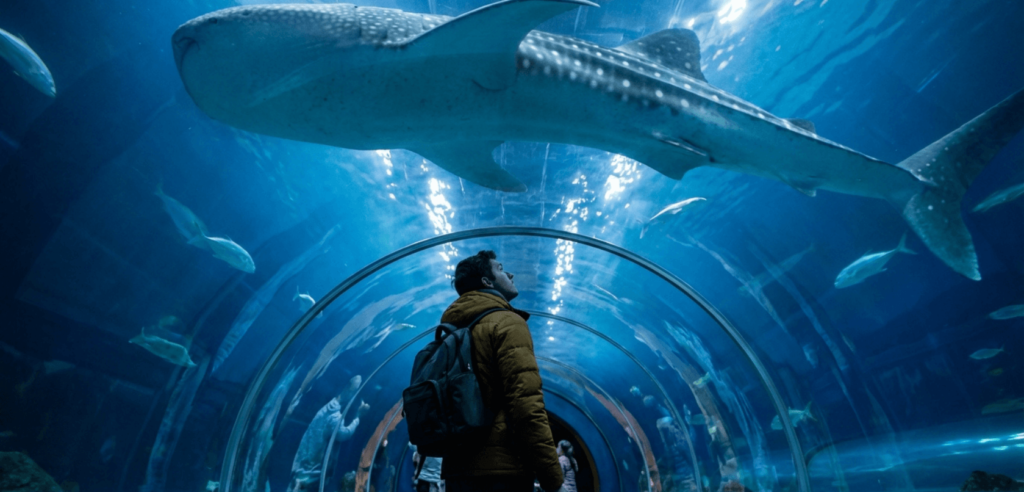
The Georgia Aquarium remains the largest in the Western Hemisphere, and no photograph has ever done it justice. The Ocean Voyager tunnel — that long, curved corridor where whale sharks glide overhead like slow-moving clouds — produces a silence in visitors that no tour guide script could manufacture. Find the bubble window. Stand there. Say nothing. That is cinematic travel in its purest form.
The World of Coca-Cola sits right next door and tells the story of the world’s most famous “accidental” headache remedy with a theatrical flair only Atlanta could pull off. The tasting room alone — 100 international flavors, some deeply questionable — is worth the admission price for the pure comedy of watching tourists try Beverly, the infamous Italian aperitif that has humbled millions.
But the building that stops me cold every single time is The National Center for Civil and Human Rights. If you only have one afternoon in Downtown Atlanta, spend it here. The Voice to the Voiceless exhibit, housing Dr. Martin Luther King Jr.’s personal writings and artifacts, is not a museum experience — it is a reckoning. It connects the lunch counter sit-ins of the 1960s to the human rights struggles of today with a precision that leaves you standing in the middle of a gallery, rethinking everything.
These three landmarks alone justify Atlanta’s position among the most compelling places to visit in Atlanta. But they are only the opening scene.
Best Places to Visit in Atlanta You Can’t Afford to Miss
Atlanta is a tapestry of soaring glass towers, ancient oak canopies, and a civil rights legacy that refuses to be forgotten. Whether you are standing inside the Ocean Voyager tunnel watching whale sharks glide overhead or losing yourself in the golden hour glow of the Atlanta Beltline, the places to visit in Atlanta are often discovered in the moments you stop rushing and let the city pull you in. From the gas-lit Victorian streets of Inman Park to the neon-soaked energy of Buford Highway at midnight, every neighborhood offers a new chapter in a story as layered as the people who built it. The places to visit in Atlanta range from sacred ground — the birth home of Dr. Martin Luther King Jr. on Auburn Avenue — to the thundering roar of Mercedes-Benz Stadium as 71,000 voices shake the walls around you. We’ve curated a list of essential experiences that capture the true soul of the City in the Forest, ensuring your next journey through the best places to visit in Atlanta is nothing short of extraordinary. 👇
- Georgia Aquarium Skip-the-Box-Office Entry Ticket
- Atlanta CityPASS®: Save up to 47% at 5 Top Attractions
- Stone Mountain Park Bus Tour
- Museum of Illusions Admission Ticket
- Atlanta City Lights Night Bus Tour with Photos & Dinner Stop
- 1.5-Hour Highlight Trolley Tour
- World of Coca-Cola General Admission Ticket
- Axe Throwing Experience
- Splatter Paint Room Experience
- Zoo Atlanta General Admission Ticket
- Private Scenic Helicopter Tour
- SkyView Ferris Wheel Ticket
- Black History & Civil Rights City Bus Tour
- Chattahoochee River Tubing Experience
- Atlanta 5 Hour City Tour by Air-Conditioned Bus
- The Burning & the Bound: Grievous Ghost Tour of Atlanta
Sweet Auburn: The Soul of the South
Walk east from Downtown, past the hum of Peachtree Street, and you will find yourself entering a neighborhood that once carried a title it earned the hard way.
“The Richest Negro Street in the World.”
That was how Fortune magazine described Auburn Avenue in 1956, at the height of its cultural and economic power. Today, Sweet Auburn is a living archive, a neighborhood where every brick seems to hold a memory. For travelers seeking places to visit in Atlanta that carry genuine historical weight, this district is non-negotiable.
The Martin Luther King Jr. National Historical Park is the spiritual anchor of this entire city. The birth home, the Ebenezer Baptist Church, the Freedom Hall — each site invites you to slow down and listen. Not to the audio tour, but to the actual silence between the exhibits. The weight of what happened here, what was dreamed here, what was lost and ultimately won here, settles on you like Georgia humidity. Respectful. Inescapable.
From here, the Atlanta University Center complex — home to Spelman College, Morehouse College, and Clark Atlanta University — represents the world’s largest consortium of historically Black colleges and universities. Walking these campuses feels like stepping into a living legacy, one that produced Dr. King himself, as well as generations of scientists, artists, lawyers, and leaders.
And when history makes you hungry — because it will — walk into Busy Bee Cafe and order the fried chicken.
Some things in Atlanta do not need to be reinvented. The mac and cheese at Busy Bee has remained largely unchanged for decades, and that is not a failure of imagination. That is the point. While you’re planning your time in the district, make sure you’ve mapped out all the things to do in Atlanta along this historic corridor, because Sweet Auburn rewards slow, unhurried exploration more than almost any other area in the city.
The City in the Forest: Breathing Room
Here is something the tourism brochures undersell dramatically: Atlanta is not a concrete jungle. It is a forest with a city growing through it.
The Atlanta Beltline is the most important urban infrastructure project in America right now, and in 2026, it is celebrating two full decades of existence. What began as a graduate student’s thesis — the audacious idea of converting 22 miles of abandoned railroad corridor into a public loop connecting 45 neighborhoods — has become the city’s circulatory system. Over 100 sculptures and murals line the trail. Families picnic on the grass beside it. Cyclists weave past dog walkers and skaters in an easy, unhurried rhythm that feels nothing like the Atlanta you experienced on I-285 an hour earlier.
The Eastside Trail, stretching from Inman Park to Ponce City Market, is the most heavily trafficked and photogenic segment. Walk it at golden hour on a Saturday and you will understand why this is one of the places to visit in Atlanta that locals guard most jealously.
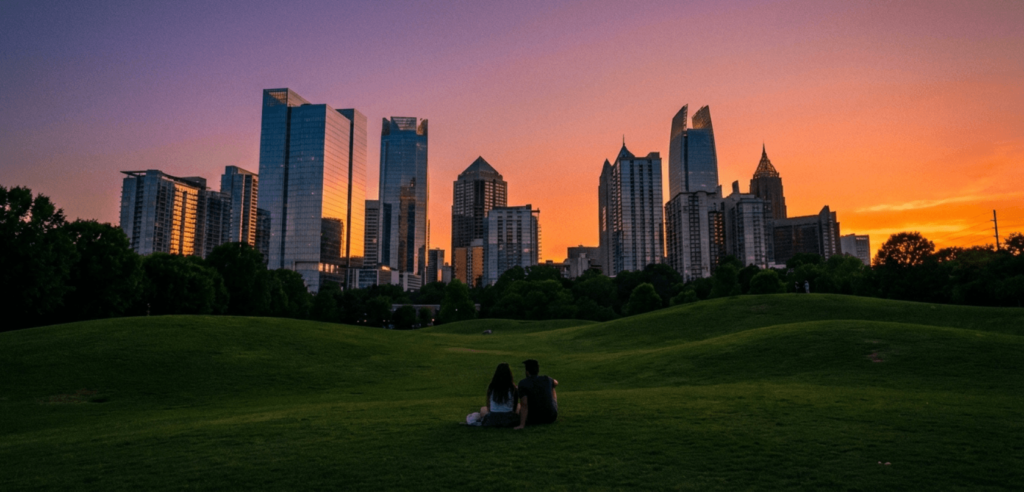
Piedmont Park spills into the northern edge of the Beltline and stretches across more than 200 acres of rolling hills and lakeside walking paths. The skyline view from the park’s upper lawn at dusk is one of those compositions that feels almost too good to be real — the kind of shot that cinematographers spend careers chasing. Inside the park sits the Atlanta Botanical Garden, where a 25-foot-tall Earth Goddess sculpture emerges from the landscape like something from a mythology you hadn’t read yet.
For those willing to venture slightly beyond the city limits, Stone Mountain Park offers a completely different kind of awe. The massive dome of exposed granite rises from the surrounding hills with geological patience, and the view from the Skyride gondola stretches all the way to the Downtown skyline on clear days.
The Table: Atlanta’s Culinary Reckoning
Atlanta entered its third year of Michelin recognition in 2026, and the dining scene that has emerged is genuinely unlike anything else in the American South. Among the places to visit in Atlanta for food obsessives, the range is extraordinary — from temple-quiet fine dining rooms to the cheerful chaos of Buford Highway.
Bacchanalia remains the gold standard. There is a reason this restaurant has dominated Atlanta’s fine dining conversation for decades: the sourcing is impeccable, the service is warm without being theatrical, and the food manages to feel both seasonal and timeless simultaneously.
Gunshow, Chef Kevin Gillespie’s interactive dining concept, is a completely different beast. Chefs wheel their creations tableside in a dim-sum format, pitching dishes directly to diners who accept or decline on the spot. It is part theater, part dinner party, and entirely Atlanta in its refusal to take itself too seriously.
Ponce City Market and Krog Street Market serve as the city’s great democratic food halls, where a James Beard-recognized Indian street food counter at Chai Pani sits a few stalls away from innovative raw bar work at Kimball House. These are not food courts — they are food arguments, loud and delicious and never fully resolved.
But the most honest meal in Atlanta is still found on Buford Highway.
Stretching northeast from Buckhead, this multi-mile corridor of immigrant-owned restaurants is one of the most quietly extraordinary food destinations in the entire country. Hand-pulled noodles from Sichuan. Authentic Korean barbecue. Vietnamese pho that has been perfected over decades by families who brought the recipe with them. The Buford Highway Farmers Market alone, with its labyrinthine international grocery section, is worth a two-hour exploration. This is Atlanta without the Instagram filter — raw, generous, and completely itself.
The Arts: What 2026 Brings
Culture seekers will find 2026 to be a particularly rich year among places to visit in Atlanta, largely due to what is happening inside and around the High Museum of Art.
The Amy Sherald: American Sublime exhibition is a landmark moment — a celebration of the Georgia native who painted the iconic official portrait of Michelle Obama, finally given the full retrospective treatment she deserves on home turf. The scale of the work, both literally and conceptually, demands more than a single visit.
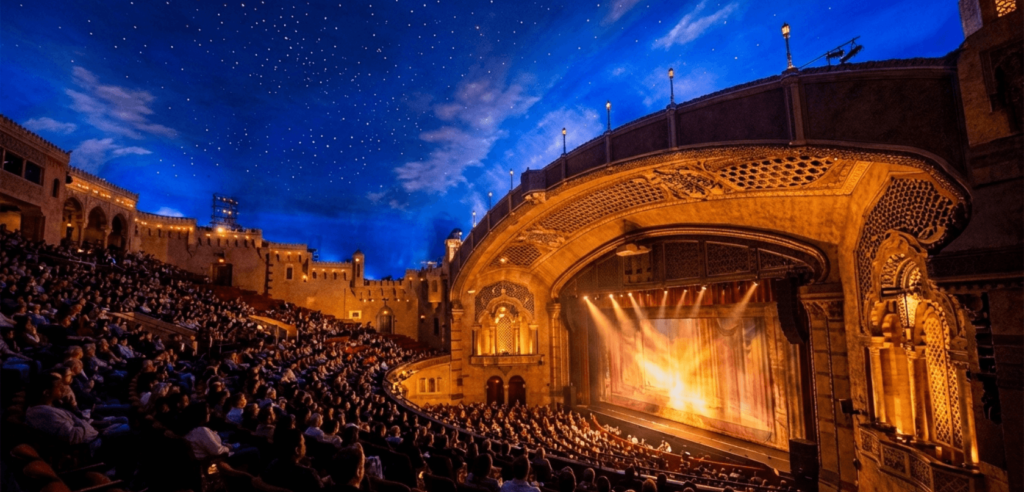
The Fox Theatre, built in the 1920s as a Shrine mosque and converted into one of the most opulent movie palaces in American history, continues to host Broadway touring productions under its cobalt-painted “sky” ceiling, complete with projected clouds and twinkling stars. There is no bad seat in this room, and the building itself outperforms most of its programming.
For travelers who want to move beyond the established institutions, Castleberry Hill offers a walkable gallery district with spaces like ZuCot Gallery anchoring a neighborhood that feels genuinely generative rather than gentrified. And the Doll’s Head Trail at Constitution Lakes Park — an outsider art installation built entirely from found objects arranged across a forested trail — is the most surprising and quietly haunting of all places to visit in Atlanta for art lovers.
Subcultures and Speed: Atlanta’s Louder Side
Atlanta’s modern identity has two dominant frequencies: the bass of hip-hop and the roar of a flat-six engine.
The Trap Music Museum is exactly what it sounds like and more than you expect. Founded by rapper 2 Chainz, the museum houses artifacts from Atlanta’s most globally influential cultural export — from Gucci Mane’s kitchen to T.I.’s Grammy awards. It is irreverent, immersive, and completely unapologetic. Among the places to visit in Atlanta that reflect the city’s living culture rather than its archived history, this is essential.
The Porsche Experience Center, located improbably adjacent to the world’s busiest airport, offers a 1.6-mile track where visitors can push a Porsche through handling circuits, wet skid pads, and off-road courses. It is absurd and wonderful in equal measure.
Pullman Yards, a former locomotive repair facility converted into an entertainment complex, has become one of the most in-demand film production locations in Georgia — itself now the third-largest film production hub in the world. Its weekly Chefs Markets and skate nights make it a living neighborhood anchor, not just an event venue.
The Stadium District: Global Eyes on Atlanta
The FIFA World Cup 26™ does not just bring matches — it brings scrutiny. And Atlanta, as one of the host cities, is ready.
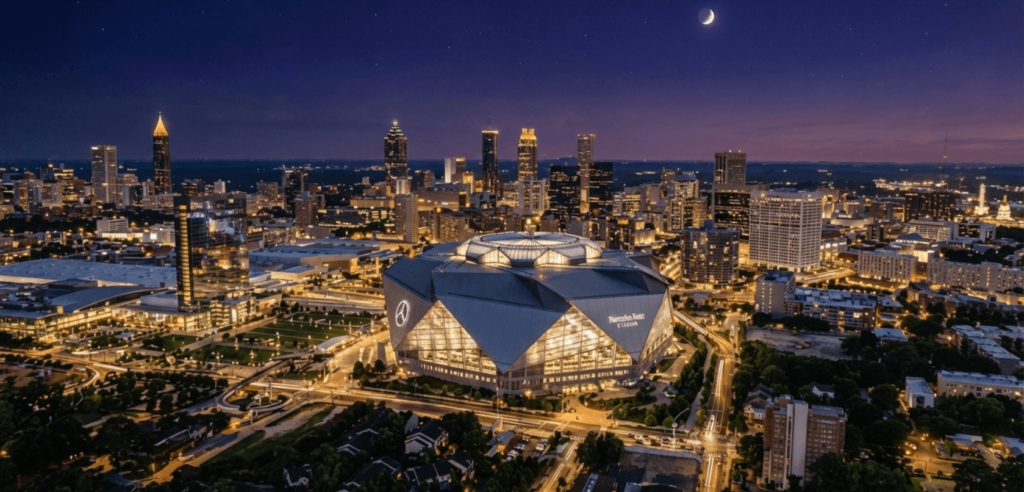
Mercedes-Benz Stadium is legitimately one of the most architecturally striking sports venues on earth. The 360-degree halo video board, the retractable roof that opens like a camera aperture, and the stadium’s certification as one of the greenest sports facilities in the world make it worth visiting on a non-game day simply for the architecture tour.
The College Football Hall of Fame rounds out the Downtown stadium district with high-energy interactive exhibits — including a skills zone where visitors can attempt a field goal or throw a spiral — making it one of the more entertaining places to visit in Atlanta for families.
Honest Logistics: What Nobody Else Will Tell You
Atlanta is spectacular and Atlanta is difficult, often within the same hour.
The traffic is real. The sprawl is real. And the heat in July is a physical presence that has humbled many a traveler who packed only optimism and light denim.
Use MARTA aggressively. The rail line connects the airport to Downtown, Midtown, and Buckhead in clean, air-conditioned dignity, and it is dramatically underutilized by visitors. The Atlanta Streetcar loops through Sweet Auburn and connects to the Beltline, making car-free exploration of the historic east side entirely viable.
If you plan to hit the Aquarium, Zoo Atlanta, and World of Coca-Cola, the Atlanta CityPASS saves approximately 44% on combined admission and eliminates the decision fatigue of individual ticket purchases.
Downtown Atlanta operates a uniquely helpful institution: the Ambassador Force, a team of friendly locals in pith helmets who patrol the improvement district offering directions, assistance, and local knowledge. Use them. They are one of the most underrated resources among all the places to visit in Atlanta.
And one practical note that sounds small but matters enormously: never leave valuables visible in a parked car. Practice the “Clean Car Campaign” without exception. Atlanta’s neighborhoods reward curious exploration, but careless habits create unnecessary risk.
Conclusion: The Story Never Really Ends
Atlanta is not a city you finish.
You return to it, season after season, and each time it has added a new wing to the story — a new mural on the Beltline, a new chef on Buford Highway, a new chapter in a history that refuses to close. The places to visit in Atlanta span centuries and subcultures, from the sacred ground of Ebenezer Baptist Church to the rooftop of Ponce City Market at midnight, where the skyline glitters in the Georgia dark and the bass from somewhere down below makes the railing hum faintly in your hands.
From Mary Mac’s Tea Room, where the sweet tea has been poured since 1945, to the high-speed corners of the Porsche track, this city contains multitudes. The places to visit in Atlanta are not just attractions on a checklist — they are arguments for a particular kind of American story, one where fire and loss and music and food and faith and speed all somehow coexist in the shadow of the tallest trees you’ve ever seen from a plane window.
Come for the World Cup. Stay for everything else.
Atlanta will be ready for you. The question is whether you are ready for Atlanta.
Reviews
There are no reviews yet. Be the first one to write one.