
There are places in the world that reach into your chest and rearrange something. Zanzibar is one of them. The things to do in Zanzibar stretch far beyond sprawling white-sand beaches and turquoise water — though those alone would be reason enough to book the flight. This is a living, breathing archipelago off the coast of Tanzania where Arab trading dhows once ruled the Indian Ocean, where the air carries the sweet-sharp scent of cloves year-round, and where Swahili culture has been quietly perfecting the art of hospitality for centuries. Whether you are fresh off a Serengeti safari, dust still in your boots, or arriving directly for a standalone island escape, you will find that Zanzibar offers a depth of experience that genuinely surprises people. History, marine wildlife, world-class cuisine, ethical adventure, and a pace of life that forces you to exhale — it is all here, waiting.
Table of Contents
Stone Town: Walking Through a Living UNESCO World Heritage Site
You can read about Stone Town before you arrive, study the maps, watch the documentaries — and still nothing quite prepares you for the moment you step into its labyrinthine alleys for the first time. The air is different here. Dense with spice, ocean salt, and something older that you cannot quite name. Stone Town is the historic heart of Zanzibar City and one of the most atmospheric places to visit in Zanzibar, officially recognized as a UNESCO World Heritage Site for the extraordinary way it embodies the collision of African, Arab, Indian, and European cultures.
The architecture alone tells a thousand stories. Coral-stone buildings rise shoulder-to-shoulder along alleyways barely wide enough for two people to pass, their facades adorned with intricately carved wooden doors that local craftsmen still take enormous pride in creating. Each door is slightly different — some with brass studs borrowed from Indian tradition, others with pointed tops reflecting Omani influence. Running your hand along them as you walk feels like reading a history book written in timber and brass.
Among the top Zanzibar attractions here are the Old Fort (Ngome Kongwe), the former Arab garrison now transformed into a cultural center hosting live Taarab music performances on certain evenings, and the House of Wonders — the first building on the island to have electricity and an elevator, now functioning as a museum. Most profoundly, the Former Slave Market stands as one of the most sobering and essential Zanzibar attractions on the entire island. Standing in the underground holding chambers where enslaved people were kept before auction is a moment that travels with you long after you leave.
Guided Zanzibar tours of Stone Town typically run between $110 and $150 depending on group size, and they are worth every cent. A good guide transforms a pleasant wander into something genuinely revelatory, pulling back the curtain on stories that the buildings themselves cannot tell. Most tours last three to four hours and can be arranged through reputable operators in the waterfront area.
➤ Secure your spot and book your Stone Town Walking Tour experience today.

Darajani Market & Jaws Corner: The Real Pulse of the Island
If Stone Town is Zanzibar’s museum, the Darajani Market is its living room — noisy, colourful, and completely unfiltered. This is one of those Zanzibar activities that you either love immediately or find overwhelming, but either way, you will not forget it. The market is a multi-sensory experience that begins at the nose. The fish section announces itself long before you arrive, while the produce stalls draw you in with towers of green mangoes, tamarind pods, jackfruit, and pyramids of dried spices in every warm shade from amber to rust.
This is where Zanzibaris actually shop — not tourists browsing for curios, but local families picking up ingredients for dinner, fishermen delivering the morning catch, and spice traders haggling in rapid Swahili. It is one of the most genuinely authentic places to visit in Zanzibar for anyone who wants to understand how the island actually functions beyond the resort gates.
Just outside the market’s northern edge sits Jaws Corner, a name that somehow perfectly captures its energy — a social square where local men congregate to play the ancient board game Bao, drink Arabic-style coffee from tiny handleless cups, and debate the issues of the day with great passion. Female travelers should note that this remains a predominantly male social space; many feel perfectly comfortable passing through for a look, while others prefer to observe from a respectful distance.
➤ Secure your spot and book your Darajani Market experience today.
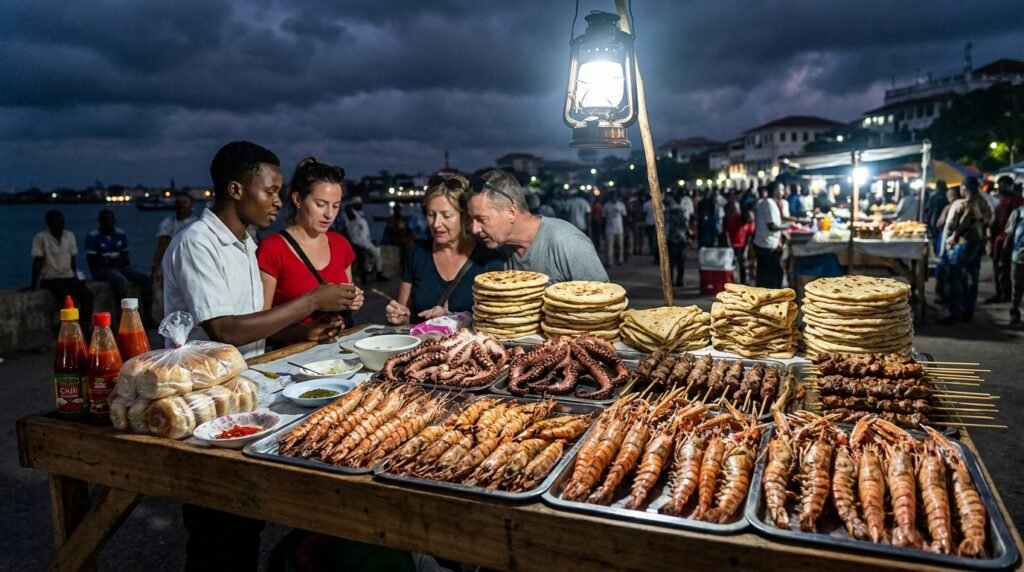
Forodhani Gardens Night Market: Street Food Under the Stars
As dusk settles over Stone Town and the Indian Ocean takes on that impossible shade of copper-pink, the Forodhani Gardens slowly transform. Stalls materialize seemingly from nowhere, gas burners hiss to life, and the waterfront fills with the sound and smell of one of the most beloved things to do in Zanzibar — the legendary night market.
Forodhani is simultaneously a food festival, a social gathering, a tourist attraction, and a community institution. Vendors arrange their offerings with quiet pride: skewers of prawns and calamari, freshly grilled lobster tails, plates of octopus cooked in coconut milk, and the unmissable Zanzibar Pizza. Despite the name, a Zanzibar Pizza is nothing like its Italian namesake — it is a thin crepe-style dough folded around a filling of minced meat, egg, vegetables, and processed cheese, cooked on a flat griddle until golden. Street food does not get more satisfying than this at 10 PM with the ocean breeze in your hair.
Equally worthy of your attention is Urojo, a beloved local street soup that has no real equivalent elsewhere. It is tangy, slightly spicy, and deeply complex — a mix of potato, fried dough, chutney, lime, and a tamarind broth that somehow works perfectly together. Order it in a small cup and drink it standing up, the way locals have always done. Beyond the food, Forodhani delivers one of the most theatrical free shows in East Africa: local boys performing gravity-defying dives from the seawall into the dark ocean below, cheered on by crowds who have watched this ritual for generations. One of the most freely joyful Zanzibar attractions on the island, and it costs nothing to enjoy.
➤ Secure your spot and book your Forodhani Night Market experience today.
Traditional Spice Farm Tours: Discovering the Island’s Soul
Zanzibar did not earn the nickname “Spice Island” by accident. For centuries, this archipelago supplied the world with cloves, nutmeg, cinnamon, cardamom, and vanilla — commodities so valuable they shaped trade routes and empires. Taking a traditional spice farm tour is one of the most educationally rich Zanzibar tours available, and it sits consistently at the top of recommended things to do in Zanzibar among travelers who appreciate cultural depth alongside natural beauty.
Walking through a working spice farm with a knowledgeable guide is a genuinely revelatory experience. You learn to identify plants that you have cooked with your entire life but never actually seen growing. Clove trees are taller than you expect, with their distinctive pink-tipped buds releasing that sharp, woody fragrance when you crush one between your fingers. Vanilla orchids cling to support poles, their thin green pods looking almost unremarkable until you split one open and the scent hits you like a memory. Cinnamon bark peels away in papery rolls from the branch. Nutmeg splits to reveal its dramatic red mace lining.
Beyond the agricultural education, these tours offer insight into the island’s traditional medicinal practices, with guides explaining how various plants have been used for generations to treat everything from fevers to digestive complaints. Most tours conclude with a traditional Swahili lunch and the opportunity to purchase handmade soaps, essential oils, and spice bundles directly from the farmers. Costs generally run around $55 per person for a guided half-day experience — genuinely excellent value among all the Zanzibar activities on offer.
• Best months: Year-round, though morning departures avoid afternoon heat
• Duration: Approximately 3 to 4 hours
• What to wear: Comfortable shoes you don’t mind getting muddy
• Don’t miss: The impromptu headwear your guide will fashion from palm fronds
➤ Secure your spot and book your Traditional Spice Farm experience today.
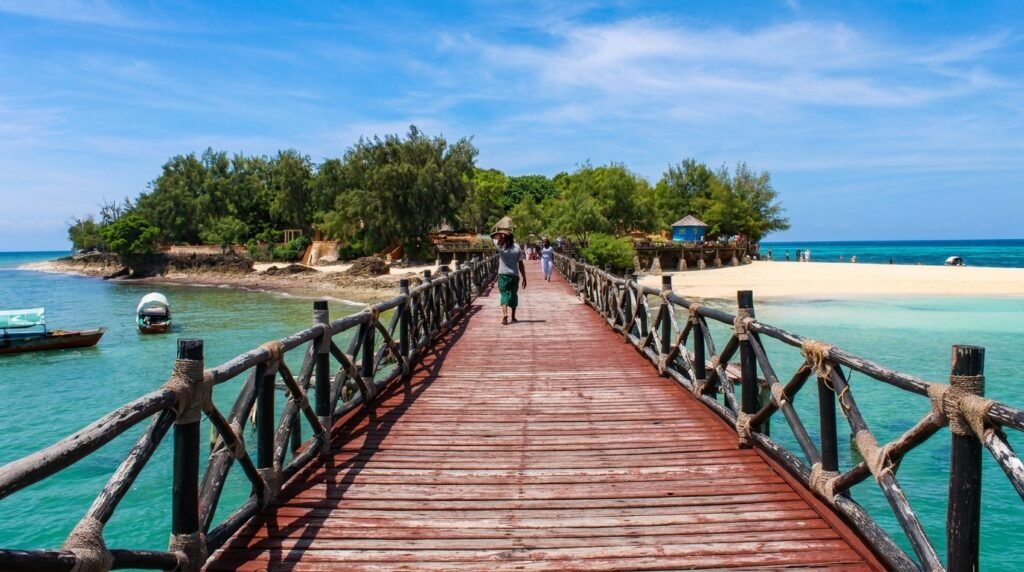
Prison Island (Changuu): Giant Tortoises and Hidden History
Just a 20-minute boat ride from Stone Town’s Stone Town jetty lies one of the most unexpectedly delightful things to do in Zanzibar. Changuu Island — known universally as Prison Island — earns its name from a genuinely fascinating and layered history. It was built as a prison for rebellious enslaved people, then repurposed as a quarantine station for yellow fever cases, and today serves as home to a colony of Aldabra giant tortoises that are among the island’s most beloved Zanzibar attractions.
The tortoises arrived in 1919 as a gift from the British governor of the Seychelles, and some of them are still here — ancient, unhurried, and apparently unimpressed by the cameras pointed at them from every angle. Approaching one of these creatures, watching it regard you with those prehistoric amber eyes, is a strangely moving experience. Some of the oldest individuals are believed to be over 150 years old, which means they were already adults when the First World War began. That is a lot of human history to have watched pass by from the shade of a coastal tree.
Beyond the tortoises, the island offers excellent snorkeling directly off its beach — the coral is healthy and the fish life abundant — and a peaceful, wind-cooled atmosphere that feels miles removed from the mainland bustle. The crumbling prison buildings are open to explore, their faded walls still carrying an eerie weight. All of this combines to make Prison Island one of the most multi-layered Zanzibar tours available as a half-day excursion.
➤ Secure your spot and book your Prison Island experience today.
The Safari Blue Experience: A Full Day on the Indian Ocean
Ask any experienced Zanzibar traveler to name their single favourite day on the island and there is a reasonable chance the answer involves a traditional wooden dhow, a cooler full of fresh fruit, and the turquoise channels of the Menai Bay Conservation Area. The Safari Blue experience is the gold standard of full-day Zanzibar tours, and it is spoken about with the kind of enthusiasm that only comes from something that genuinely exceeds expectations.
The day begins at the small fishing village of Fumba on the southwest coast, where your crew — sun-weathered, warm, and impressively efficient — prepares the dhow for departure. From the moment you push away from the dock and catch the morning breeze, the pace of the day shifts entirely. You are no longer a tourist. You are simply someone on the water.
The itinerary unfolds organically: guided snorkeling over pristine coral gardens, a stop on a deserted sandbank where you stand ankle-deep in the Indian Ocean with nothing visible in any direction except water and horizon, and — if the conditions cooperate — encounters with spinner dolphins that ride the bow wave of the boat with apparent joy. The midday highlight is a Swahili seafood BBQ served on a secluded beach: freshly caught fish, prawns, octopus, and lobster, paired with coconut rice, fresh salads, and tropical fruit. All of this for approximately $75 per person makes it one of the most outstanding Zanzibar activities by value anywhere in East Africa.
➤ Secure your spot and book your Safari Blue experience today.
Mnemba Atoll: East Africa’s Premier Marine Reserve
Off the northeast coast of the main island, a small ring of coral reef encircles a shallow, breathtaking lagoon. This is Mnemba Atoll, and among the places to visit in Zanzibar, it occupies a special category reserved for the genuinely extraordinary. A protected marine reserve managed under strict conservation guidelines, Mnemba is the kind of place that turns casual snorkelers into passionate ocean advocates.
The water here has a clarity that seems almost artificially perfect — visibility of 20 to 30 metres is common on a calm day. Below the surface, the reef teems with life in a way that more heavily visited marine areas rarely do: hawksbill sea turtles grazing on sea grass, Napoleon wrasse cruising the deeper channels with regal indifference, and schools of tropical fish so dense they block the light. For divers, Mnemba offers wall dives and drift dives that rank among the finest in the Indian Ocean.
Access is carefully controlled, which is precisely what keeps it beautiful. Specialized Zanzibar tours to Mnemba typically depart from Matemwe on the northeast coast, with reputable operators including underwater photography and GoPro footage in their packages. This ensures you leave with more than just memories of one of the island’s most transcendent Zanzibar attractions. Book well in advance during peak season (July through October and December through January).
➤ Secure your spot and book your Mnemba Atoll Snorkeling experience today.
Paje Village: Kitesurfing Capital of the Indian Ocean
Southeast Zanzibar holds a secret that the kitesurfing world discovered some years ago and has been unable to keep quiet since. The village of Paje, with its shallow tidal lagoon, predictable wind patterns, and laid-back atmosphere, has become one of the most celebrated kitesurfing destinations on earth — and one of the most exhilarating Zanzibar activities for anyone who loves wind and water.
The geography is near-perfect for the sport. The lagoon behind the reef creates a vast, protected expanse of knee-to-waist-deep water that is forgiving for learners but offers enough space for experienced riders to build serious speed and attempt aerial manoeuvres. Two distinct trade winds power the seasons: the Kusi blowing steadily from the south from June through September, and the Kaskazi arriving from the north between December and March. Between these two seasons, Paje is windy far more often than it is not.
Lesson packages for complete beginners typically run over three to four days and include IKO-certified instruction, safety equipment, and radio helmets so your instructor can guide you remotely from the beach. For experienced riders, there are plenty of rental operations along the beach strip. When you are not on the water, Paje’s bohemian beach bar scene provides excellent entertainment — think fresh-pressed juices, cold Kilimanjaro beers, and hammocks strung between casuarina trees. This is one of those places to visit in Zanzibar where people arrive intending to stay two days and end up staying two weeks.
Seaweed Farms: A Quiet Cultural Exchange at the Tide’s Edge
A short walk from the kitesurfing schools of Paje, you will notice something that most visitors overlook entirely: rows of wooden stakes stretching out across the tidal flats, connected by lines of rope from which reddish-green algae hangs to dry. This is one of Zanzibar’s most important local industries, and visiting the women-led seaweed farms is one of the more quietly meaningful Zanzibar activities you can add to your itinerary.
Female farmers have been cultivating Eucheuma seaweed here for decades, and a guided visit allows you to walk out onto the flats at low tide, learn the harvesting techniques, and watch live demonstrations of how the dried algae is transformed into soaps, creams, and cosmetics using traditional methods. The women who run these farms are entrepreneurial, knowledgeable, and delighted to share their work with curious visitors. Supporting this industry directly supports female economic independence in a community where that independence is genuinely hard-won.
Nungwi & Kendwa: The North Coast’s Crown Jewels
The northern tip of Zanzibar is where the most famous beaches are located, and they deserve every superlative thrown at them. Nungwi and its neighbour Kendwa are among the most-visited places to visit in Zanzibar, and the reason is simple: the beaches here are genuinely among the finest in the world, and the zanzibar attractions on this stretch of coast cater to every kind of traveler. White sand so fine it squeaks underfoot. Water in shades of blue and green that shift with the light. And crucially — unlike many parts of the island — tidal patterns that allow swimming throughout the day regardless of the hour.
Nungwi has evolved into a busy, resort-lined destination with a strong infrastructure of restaurants, bars, water sports operators, and dhow-building workshops where traditional wooden boats are still constructed by hand using methods passed down through generations. Kendwa, a short walk south along the beach, retains a slightly quieter, more intimate atmosphere — though both fill up significantly during peak season.
For families seeking something beyond the beach, the Splash Paradise floating waterpark — the island’s first of its kind — offers inflatable slides, climbing frames, and obstacle courses anchored just offshore. It is one of the more uniquely enjoyable Zanzibar activities for children and adult beginners alike, and the views back toward the beach from the water are genuinely spectacular. Sunset from Kendwa Beach is a social event in itself, with the sky performing in shades of orange, violet, and deep rose as dhows drift silently across the horizon.
Jozani Chwaka Bay National Park: Meeting the Red Colobus
Zanzibar’s biodiversity is far greater than most visitors expect, and nowhere is that more apparent than in Jozani Chwaka Bay National Park — the island’s only national park and one of the most important wildlife conservation areas in Tanzania. The park’s primary celebrities are the Zanzibar red colobus monkeys, a subspecies found nowhere else on Earth, which makes a visit here one of the most genuinely unique Zanzibar tours available anywhere in East Africa.
Walking the forest trails is a different sensory experience from the coast. The air is cool and damp, filtered through a canopy of fig trees, mahogany, and strangler figs. The red colobus troops are remarkably habituated to human presence and will often descend to the lower branches to observe you with the same curiosity you bring to observing them. Their distinctive reddish-brown fur and black-and-white faces make them extraordinarily photogenic, and watching a mother with a clinging infant navigate the canopy is one of those wildlife moments that transcends the photograph.
Beyond the monkeys, the park contains a remarkable mangrove boardwalk that extends over the tidal forest — a habitat of extraordinary ecological importance that most visitors to the island never see. Guided Zanzibar tours here last approximately two hours and provide essential context about the conservation challenges facing this fragile ecosystem and the local community efforts to protect it. An absolute must among Zanzibar activities for nature-focused travelers.
• Entry fee: Approximately $10 per person (contributes directly to conservation)
• Best time to visit: Early morning when monkeys are most active
• What to avoid: Feeding or touching the animals
• Combine with: A southern coast drive through the spice heartlands
➤ Secure your spot and book your Jozani Forest experience today.
The Rock Restaurant: Dining at the Edge of the Ocean
There are restaurants with ocean views, and then there is The Rock — a tiny establishment perched atop a coral outcrop in the shallow waters near Michamvi Pingwe Beach on the east coast, which has become one of the most photographed places to visit in Zanzibar and one of the most romantically impractical restaurants in the world.
Depending on the tides, you reach The Rock either by wading across a few centimetres of warm water at low tide or by summoning a small wooden boat that ferries you the ten-metre journey at high tide. Either approach feels appropriately theatrical. Inside, the restaurant seats perhaps 14 people at any one time, with panoramic ocean views in every direction and a menu focused on fresh-caught seafood prepared with local spices and technique.
The food — grilled lobster, calamari in coconut sauce, line-caught fish — is genuinely excellent, not merely coasting on its extraordinary location. Lunch in the sunshine with the ocean lapping at the walls below is one of those rare travel experiences where the reality matches the Instagram version and then improves on it. Advance booking is absolutely essential; tables are released up to several months ahead and disappear quickly. This is one of those things to do in Zanzibar that rewards planning.
➤ Secure your spot and book your The Rock Restaurant experience today.
Ethical Dolphin Watching in Kizimkazi: Wildlife on Their Terms
The fishing village of Kizimkazi on the island’s southern tip has been the departure point for dolphin-watching tours for decades, and the experience — when done properly — ranks among the most magical Zanzibar activities available. Resident populations of both bottlenose and humpback dolphins inhabit the channel waters year-round, and mornings frequently offer encounters with entire pods moving through the warm Indian Ocean.
The crucial qualifier here is “when done properly.” The Kizimkazi dolphin scene has a complicated history of overcrowded boats and aggressive approaches that stressed the animals and degraded the experience for everyone involved. The good news is that a growing number of operators have adopted a strict no-chase, no-crowd approach: boats maintain a respectful distance and allow the dolphins to approach on their own terms. When this happens — when a curious dolphin surfaces three metres from your boat and regards you with that perpetual half-smile — the experience is genuinely one of the best things to do in Zanzibar.
Ask your operator directly about their approach policy before booking. Responsible Zanzibar tours here insist on a maximum of two or three boats per encounter, no chasing behavior, and no entry into the water unless dolphins actively engage. These standards make the encounter better for the dolphins and better for you.
➤ Secure your spot and book your Ethical Dolphin Watching experience today.
Kuza Cave & Maalum Cave: Zanzibar’s Secret Swimming Holes
Zanzibar hides a geological secret beneath its coral limestone interior: a network of caves and sinkholes filled with crystal-clear freshwater that filters through the island’s ancient rock. Maalum Cave near Paje and Kuza Cave further south have become increasingly sought-after Zanzibar attractions for travelers looking for something beyond the beach — and finding them requires a little local knowledge that makes the discovery feel genuinely earned.
Maalum is the more dramatic of the two: a naturally occurring circular sinkhole perhaps 15 metres across, its walls draped in lush vegetation and the occasional rope that brave locals use to swing into the water below. The pool itself is shockingly clear, tinted turquoise by the algae on the limestone walls, and cool enough to feel refreshing even in the peak of the Zanzibar heat. Swimming here, with shafts of light penetrating through the natural opening above, produces one of those quiet, profound moments that even the most Instagram-saturated traveler struggles to immediately photograph.
Kuza Cave is larger and more accessible, with a series of connected chambers and a resident colony of small bats that most visitors find charming rather than alarming. Both caves are best visited in the late morning when sunlight angles into the openings most effectively. They are increasingly popular additions to private Zanzibar tours of the southern coast.
➤ Secure your spot and book your Maalum Cave experience today.
Cheetah’s Rock: Conservation Education Up Close
For travelers who want a wildlife encounter that goes deeper than observation, Cheetah’s Rock provides one of the most distinctive and carefully managed Zanzibar activities on the island. This is not a zoo or a petting farm — it is a legitimate conservation facility that rescues and rehabilitates big cats, primates, and other animals that cannot be returned to the wild, while funding its operations through carefully curated educational visitor experiences.
The four-hour tour gives small groups of visitors close-up access to cheetahs, lions, servals, and ring-tailed lemurs under the supervision of experienced handlers who maintain strict protocols around animal welfare. The emphasis throughout is on conservation storytelling — understanding why these animals are here, what their wild counterparts face in terms of habitat loss and human-wildlife conflict, and what can realistically be done to protect them. It is one of the more thought-provoking places to visit in Zanzibar, and the minimum age of 15 ensures that interactions remain focused and respectful.
Swahili Cooking Classes: Take the Island Home With You
Of all the Zanzibar activities that leave a lasting impression, the cooking class has a particular magic — because it is the one experience you can recreate at home. Swahili cuisine is one of the great undiscovered culinary traditions of the world: a vibrant fusion of Arab, Indian, and African techniques and flavors that has been evolving on this coastline for a thousand years, and it deserves far more international attention than it currently receives.
A good cooking class in Zanzibar begins in the spice garden or the market, selecting fresh ingredients with a local host who explains their origins and medicinal properties. Back in the kitchen, you learn to make coconut milk from scratch — cracking, grating, and pressing fresh coconut, then watching the rich white liquid pour into the pot. You learn the spice layering of pilau rice, the patient reduction technique of mchuzi wa pweza (octopus curry), and the art of making chapati so thin it is almost transparent.
These classes are among the most warmly personal Zanzibar tours available, often taking place in someone’s home kitchen rather than a commercial facility. The meal you cook at the end is eaten together, family-style, which transforms a cooking lesson into a genuine cultural exchange. It is one of those things to do in Zanzibar that travelers consistently describe as an unexpected highlight.
➤ Secure your spot and book your Swahili Cooking Class experience today.
Masingini Forest: Ziplining Over the Roof of Zanzibar
Zanzibar’s interior is rarely the focus of visitor itineraries — most people come for the coast and stay there — which makes the Masingini Forest one of the island’s better-kept secrets and one of the most unexpectedly thrilling Zanzibar activities available. Rising to roughly 120 metres above sea level, the Masingini ridge is sometimes called the “Roof of Zanzibar,” and the forest that covers it is a world apart from the flat, sun-baked coastline.
The guided hike through the forest reveals a cooler, damper environment rich with birdsong, rare butterflies, and the occasional Sykes’s monkey watching from the branches above. The forest is beautiful in a quiet, non-dramatic way — the kind of place that rewards slow observation rather than the quick wildlife-spotting rush of a game drive. For those who want more adrenaline, a zipline has been installed that carries riders through the tree canopy with genuinely impressive speed and some spectacular views of the forest below.
These nature-focused Zanzibar tours pair well with a spice farm visit in the same half-day, creating an inland itinerary that gives you a genuinely different perspective on an island most visitors only experience from the beach.
➤ Secure your spot and book your Masingini Forest Hike and Zipline experience today.
Combining Zanzibar With a Tanzania Safari: The Ultimate East African Experience
Zanzibar and Tanzania’s mainland safari circuit are separated by a 25-minute flight, and yet they feel like entirely different planets — which is precisely what makes combining them so satisfying. The “Bush and Beach” combination remains one of the most consistently recommended things to do in Zanzibar region for international visitors, and the logic is obvious: spend a week watching lions hunt on the Serengeti plains, then decompress completely on an Indian Ocean beach where the greatest decision you face is whether to read in the shade or swim again.
Short-haul options from Zanzibar include Saadani National Park — the only Tanzanian park where the bush meets the beach, allowing for game drives and snorkeling on the same day — and Mikumi National Park for a concentrated one or two-day experience. For those with more time, multi-day Zanzibar tours can be structured to incorporate the Serengeti, Ngorongoro Crater, and Tarangire before concluding on the island.
Logistically, this combination is straightforward. Coastal Aviation and Air Excel operate regular scheduled flights between the island and the safari circuit, and the journey typically costs between $150 and $250 per sector depending on the season. For a first visit to East Africa, there is arguably no better way to experience the region’s full range of possibilities.
➤ Secure your spot and book your Serengeti + Zanzibar Combination experience today.
Frequently Asked Questions About Zanzibar
Q: When is the best time to visit Zanzibar?
A: The best times are June through October (long dry season) and January through February (short dry season). The long rains fall in April and May, and short rains in November and December. The island is worth visiting year-round, but the dry seasons offer the most reliable weather for beach activities and ocean zanzibar tours.
Q: How many days do you need in Zanzibar?
A: A minimum of five days allows you to cover Stone Town, a spice farm, at least one full-day ocean excursion like Safari Blue, and some quality beach time. Seven to ten days lets you explore the north and south coasts properly and add marine activities like Mnemba Atoll snorkeling or kitesurfing in Paje. Most visitors find themselves wishing they had booked longer.
Q: Is Zanzibar safe for solo travelers?
A: Yes — Zanzibar has a well-established tourism infrastructure and is generally safe for solo travelers including women traveling alone. The usual cautions apply: use reputable tour operators for zanzibar activities, arrange transport through your accommodation, keep valuables secure, and dress modestly when visiting Stone Town or local villages out of respect for the predominantly Muslim community. All the places to visit in Zanzibar listed in this guide are accessible and safe for independent travelers.
Q: What currency is used in Zanzibar and should I bring cash?
A: The Tanzanian Shilling is the official currency, though USD is widely accepted at hotels, restaurants, and tour operators. Bring a mix of cash (small USD bills are useful) and a travel card. ATMs are available in Stone Town but can be unreliable outside the city, so withdraw before heading to remote areas.
Q: Do I need a visa for Zanzibar?
A: Most nationalities require a Tanzania visa, which covers both the mainland and Zanzibar. E-visas can be obtained online before arrival and are straightforward for most travelers. Always check current requirements for your nationality before traveling, as these can change.
Q: What are the most ethical zanzibar tours for wildlife?
A: Look for operators who follow no-chase policies for dolphin watching, minimum-disturbance guidelines for snorkeling at Mnemba Atoll, and conservation-focused facilities like Cheetah’s Rock. For Jozani Forest, stick to official guided paths and never feed or touch the colobus monkeys. Ethical choices preserve the zanzibar attractions that make this island special.
Planning Your Trip: Practical Tips for 2026 Visitors
Getting the most out of the things to do in Zanzibar comes down to a few practical decisions made before you arrive. From the most famous zanzibar attractions to lesser-known gems, the key is advance planning. Book the high-demand experiences — The Rock Restaurant, Cheetah’s Rock, Mnemba Atoll tours — as early as possible, especially if you are traveling between July and October or over the Christmas and New Year period. These are the zanzibar activities most likely to sell out.
Consider basing yourself in different parts of the island rather than staying in one place throughout. Two or three nights in Stone Town — one of the most unmissable places to visit in Zanzibar — gives you time to genuinely explore the historic city. Moving to the north coast (Nungwi or Kendwa) for a few days puts you close to the best sunset beaches and the Safari Blue departure point. Finishing on the east coast at Paje or Bwejuu offers kitesurfing, caves, and a more laid-back atmosphere. The south coast zanzibar attractions, including the caves and dolphin watching, round out a complete island circuit.
Most importantly: slow down. The single biggest mistake travelers make on this island is trying to see everything in a sprint. Zanzibar’s greatest pleasures are often discovered by accident — wandering into an alley that leads to a rooftop tea stall with a view of the entire medina, or chatting with a dhow builder on the beach as he shapes a plank with a traditional adze. The island rewards presence. It rewards curiosity. It rewards the traveler who arrives with an open schedule and a genuine appetite for experience.
There are twenty-two things to do in Zanzibar described in this guide, and each one of them is genuinely worth your time. Among all the places to visit in Zanzibar, from the spice heartlands of the interior to the marine majesty of Mnemba Atoll, you will find that the island consistently overdelivers. But Zanzibar will add a twenty-third, a twenty-fourth, and a twenty-fifth on its own terms, in moments you did not plan and cannot predict. That is the thing about this island. It always gives you more than you came for.
Secure your spot and book your things to do in Zanzibar experience today.
Reviews
There are no reviews yet. Be the first one to write one.