
You smell it before you see it, Like some part of your nervous system has been waiting for this exact chaos your entire life. If you’re searching for the best places to visit in New York, you’re not just looking for a list of buildings; you’re looking for the soul of the city.
Roasted nuts. Exhaust. Someone’s bodega coffee gone cold on a trash-stacked corner. You walk out of Penn Station and the city hits you — not with beauty, not with charm — with pressure. The air has weight here. The sidewalk has opinions. A cab honks at nothing. A man in a construction vest argues into his phone in three languages simultaneously. And somehow, weirdly, your pulse quickens. Not from fear. From recognition. Like some part of your nervous system has been waiting for this exact chaos your entire life.
Welcome to New York.
Or maybe it’s JFK for you. You’ve just spent nine hours folded into a middle seat, dragged your bag through customs, and stepped outside into the taxi line at Terminal 4. The sky is doing that specific New York thing — half overcast, half brilliant — where the light cuts sideways through the clouds and suddenly the tops of buildings you can’t even name look like something from a painting. The driver doesn’t ask how your flight was. He already knows the traffic is bad. He says nothing. You say nothing. You both watch the skyline appear over the Van Wyck and that’s it. That’s the moment.
New York doesn’t ease you in. It never has.
This isn’t a guide built from weekend trips or airport layovers. I’ve lived here ten years. I’ve had apartments in three boroughs. I know which subway car opens closest to the exit at Grand Central, which pizza place in the East Village is worth the 45-minute wait (and which one next door is almost as good with zero line), and exactly which corner of Central Park is still quiet on a Saturday afternoon in July when every other square foot looks like a travel influencer’s fever dream.
The best places to visit in New York aren’t hard to find. But knowing how to find them — knowing the difference between seeing New York and actually experiencing it — that takes something the Google results usually skip.
What you want isn’t a checklist. You don’t want to stand in front of Times Square, take a photo of the billboards, and check a box. You want to understand why this city matters. Why people come here broke, stay here exhausted, and still refuse to leave. Why people who grew up here and moved away spend the rest of their lives talking about it like an ex they’re still not completely over.
That’s what this guide is for.
We’re going to cover all five boroughs. We’re going to talk about food the way it deserves — as culture, as identity, as argument. We’re going to be honest about what’s overrated, what’s underrated, and what’s genuinely worth your limited time on this earth.
You ready?
Good. Keep up.
Table of Contents
The Evolution — NYC Isn’t Just One City
The Grit That Built the Glamour
People forget what this place used to be.
In the 1970s, New York was functionally broke. The city nearly went bankrupt in 1975 — a crisis so severe the Daily News ran its legendary headline: FORD TO CITY: DROP DEAD. The subway was covered in graffiti from floor to ceiling. Central Park wasn’t a destination; it was a warning. Times Square was strip clubs and survival instincts, not LED screens and M&M stores.
But here’s what that era did: it made space for artists, for weirdos, for people who couldn’t afford anywhere else and didn’t want to be anywhere else. Jean-Michel Basquiat wasn’t painting in a studio with good lighting — he was tagging downtown walls and sleeping on cardboard. The punk scene at CBGB didn’t happen because the city was clean and welcoming. It happened because the city was broken and didn’t care what you did in the cracks.
That grit wasn’t a flaw. It was the engine.
The New York That Exists Today
The city today is polished in ways that would be unrecognizable to anyone who lived through the ’70s and ’80s. Times Square is sanitized. The High Line — a former elevated freight rail — is now a manicured park where people Instagram their lattes against a backdrop of Hudson Yards glass towers that cost more per square foot than most people earn in a year.
Is it better? Safer, certainly. More livable, for some. But the creative friction that made New York New York didn’t disappear — it just relocated. To Bushwick. To Jackson Heights. To the Bronx. To the corners of the city that haven’t been discovered yet by the developers and the lifestyle brands.
The real New York has always been in motion. Always reinventing itself one block at a time.
That’s what we’re chasing.
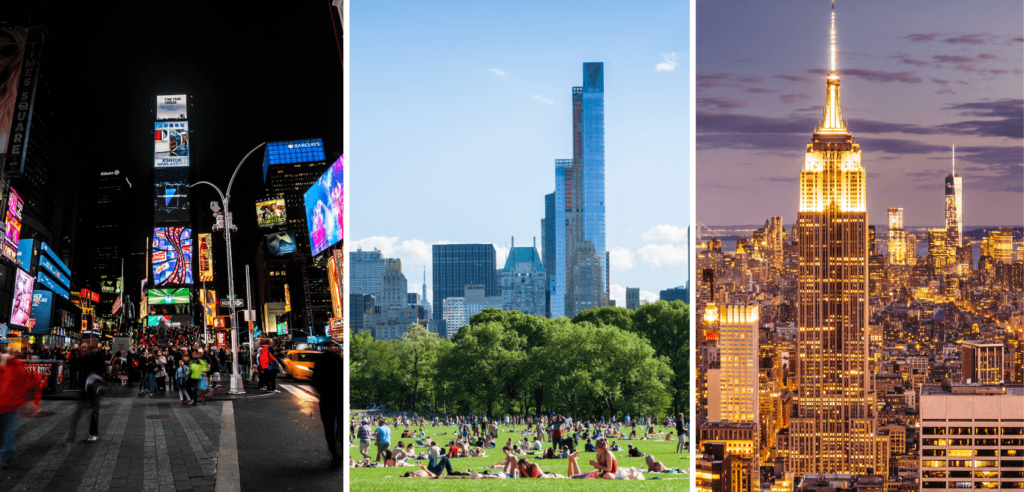
Manhattan — The Heavy Hitters
The Empire State Building: A Must-See Best Place to Visit in New York
You’ve seen it a thousand times before you ever see it. Movies, postcards, the skyline shot from every rooftop bar in Brooklyn. And yet. The first time you look up at it from Fifth Avenue — really look, neck craned, feet stopped dead on a sidewalk that doesn’t forgive you for stopping — it still does something to you.
Here’s the honest take: the observation deck is worth it once. Just once. The views from the 86th floor are legitimately extraordinary. Manhattan laid out below you like a circuit board that forgot to stop growing. The problem is the line, which can swallow two hours of your life if you show up uninformed.
Pro-Tip: Book the first entry slot of the day — 9am — online, in advance, always. The light is better anyway. Golden hour hasn’t burned off yet, the tour groups are still eating hotel breakfasts, and you’ll have elbow room on the deck that simply doesn’t exist by noon. Skip the 102nd floor add-on. The view difference doesn’t justify the price difference. Spend that money on lunch instead.
Central Park
838 acres. Literally inside the most expensive real estate market in the Western hemisphere. Think about that for a second.
Central Park isn’t a park in the way your hometown has a park. It’s a decision — a deliberate, almost radical act of preservation that Olmsted and Vaux forced onto a city that would have paved every inch of it if given the chance. And it works. On a weekday morning in October, with the leaves turning and the joggers finding their rhythm and the light filtering through the elm canopy on the Mall, it’s one of the genuinely perfect places on earth. No qualifications.
But most tourists do it wrong. They enter at 59th Street, take a photo of the Bethesda Fountain, maybe rent a bike, and leave. That’s fine. That’s also not the park.
Pro-Tip: Get a bagel — not just any bagel, go to Ess-a-Bagel on Third Avenue before you head in — and walk to Sheep Meadow. It’s a 15-acre lawn on the west side of the park, roughly mid-point. On weekends, it fills with New Yorkers doing what New Yorkers rarely do: nothing. Lying in the grass. Reading. Arguing amicably. People-watching with Olympic-level commitment. Sit there for an hour. Watch the city decompress around you. That’s the park.
Times Square
Say this clearly: Times Square is not where New Yorkers go. It’s not a secret. Everyone who lives here will tell you this immediately, unprompted, with the particular exhaustion of someone who has had this conversation four hundred times.
And yet — you should go. Once. Briefly. Because the scale of it is genuinely absurd in a way that deserves witness. The screens are the size of buildings. The noise has texture. At 11pm on a Friday in July, it’s so aggressively, almost defiantly a lot that it circles back around to being interesting.
Pro-Tip: Go at night, stay 20 minutes, then walk west toward Hell’s Kitchen for dinner. Don’t eat anywhere within a four-block radius of Times Square. The restaurants there exist solely to charge you $28 for a mediocre pasta because you didn’t know better. You know better now.
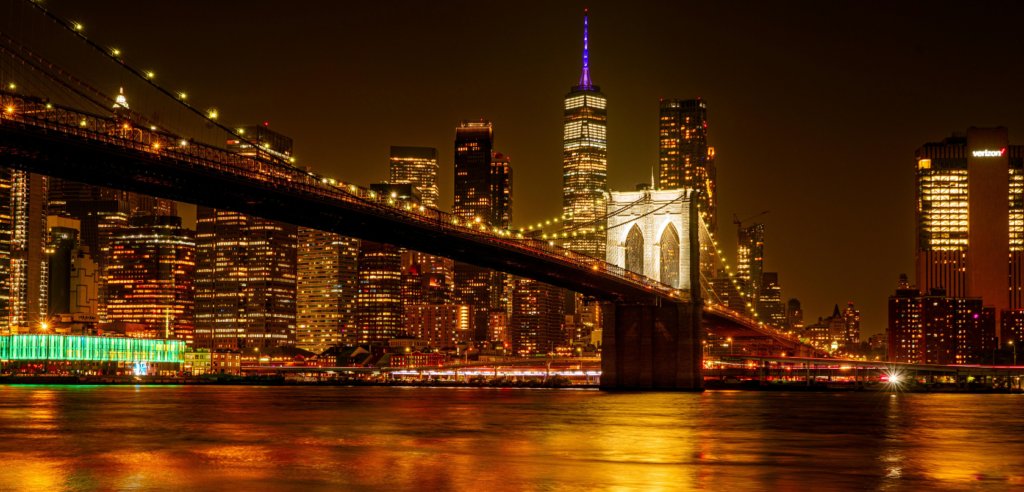
The Brooklyn Bridge
Walk it. Don’t bike it — the cyclists and the pedestrians share a path that wasn’t designed for this volume of either, and the resulting chaos is a misery for everyone. Walk it.
Start from the Manhattan side, at Centre Street. The Gothic towers rise above you as you climb the pedestrian ramp, and then the cables fan out in that perfect harp geometry that’s been photographed a million times and still somehow surprises you in person. Halfway across, stop. Look south toward the harbor. Look north toward Midtown. Feel the wind — and there is always wind on that bridge, real wind, the kind that makes you grab your hat and reminds you that you’re suspended over a river.
Pro-Tip: Cross into Brooklyn and walk directly to Time Out Market or, better, Grimaldi’s for pizza under the bridge. You’ve earned it. Your legs will tell you that. The view of the Manhattan skyline from the Brooklyn side, looking back at where you just came from, is one of those visuals that stays with you.
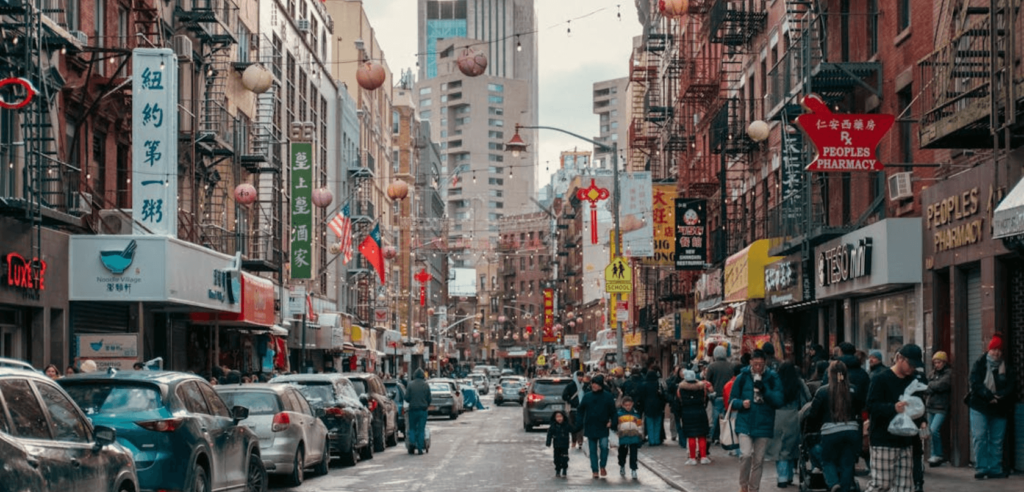
The Neighborhood Walks
The West Village → SoHo → Chinatown
Start on a Saturday morning. Get coffee from Joe Coffee on Waverly Place — not a chain, just a narrow, serious coffee shop that’s been here longer than most of the Instagram accounts that have tagged it. Walk the West Village slowly. The streets don’t follow the grid here; they do their own thing, crossing each other at angles that make no logical sense and somehow feel exactly right. The brownstones are old. The trees are old. The rent is obscene and the block still manages to feel like a neighborhood.
Walk south and east. You’ll feel SoHo shift in around you — the cobblestones, the cast-iron facades, the boutiques that sell things you won’t buy but might touch. It’s more polished than it used to be. The galleries mostly left years ago when the rents chased them to Chelsea and beyond. What remains is beautiful and a little hollow and still worth walking through.
Then turn the corner and Chinatown happens to you all at once. The smell changes first — roast duck, dried fish, something frying in a wok two floors above street level. The signage switches. The pace accelerates. Canal Street is sensory overload in the best possible way: stalls selling produce you can’t name next to jewelry shops next to bakeries with roast pork buns still warm in the case. Push through to Mott Street. Get the pork buns. Stand on the sidewalk and eat them. You’re not in SoHo anymore. You’re barely in the same century.
That three-neighborhood stretch — maybe two miles on foot — contains more contrast, more texture, than most cities offer in their entirety.
Eating the City
Let’s start with the $1 slice.
It doesn’t exist everywhere anymore — inflation has pushed most places to $1.50, sometimes $2 — but the principle holds. You can eat well in New York for almost nothing. A slice of cheese pizza, folded in half lengthwise the way God intended, eaten standing up outside a fluorescent-lit shop on a random Midtown block at 2pm on a Tuesday. That’s not a compromise meal. That’s a correct meal. Tourists fly past these places chasing reservation lists. Locals fold and eat and keep moving.
Then there’s the other end. Peter Luger in Williamsburg, cash only, where the porterhouse arrives sizzling in its own butter and the waiter has been there longer than you’ve been alive and will not pretend to be your friend. Keens Steakhouse in Midtown, where the ceiling is covered in clay pipes and the mutton chop is one of the more serious things you’ll put in your mouth. These meals cost real money. They are also, occasionally, worth it.
But before any of that — before the high-end dinner reservation and the celebrated ramen and the prix-fixe that requires a credit card to hold — you need to go to a bodega.
Not a deli. Not a café. A bodega. The one with the cat sleeping near the chip rack and the hand-lettered menu on a whiteboard above the grill and approximately four people ahead of you who all seem to know the guy making the sandwiches.
Order a bacon, egg, and cheese on a roll. Not on a bagel, not on toast — on a kaiser roll, salt-pepper-ketchup, wrapped in foil so it steams slightly and everything melds together in a way that no brunch restaurant has ever successfully replicated despite trying for decades.
Eat it on the sidewalk at 8am while the city shifts into gear around you.
That sandwich is $4. That sandwich is New York.
The immigrant kitchens are the backbone of all of it — the Cantonese roast duck in Flushing, the Bangladeshi curry on Kingsbridge Avenue, the Colombian bakeries in Jackson Heights where the cheese bread comes out warm on the hour. You could eat in a different country every day for a month without leaving the five boroughs. Most people don’t. That’s their loss. Don’t let it be yours.
The NYC Survival Manual
The Subway
It’s not dangerous. Stop listening to people who haven’t been here or who left in 1994. The New York City subway runs 24 hours a day, serves 3.5 million people on a normal weekday, and will get you where you’re going faster than a cab in traffic approximately 80% of the time.
Learn two things: how to read the map (Manhattan lines run north-south; crosstown buses fill the gaps) and how to use a MetroCard or OMNY tap-to-pay. Stand clear of the closing doors. Don’t block the pole. Let people off before you get on. These are not suggestions. They are the social contract.
The Scams
The CD guys in Times Square will hand you a “free” CD, and the moment you hold it, you owe them money according to a logic that only exists in that three-block radius. Don’t touch the CD. Don’t make eye contact. Keep walking.
Pedicabs charge whatever they want and will not tell you the rate upfront if they can avoid it. Always confirm price before you get in. Same with any unlicensed car that approaches you at the airport. Yellow cab or Lyft. That’s it.
When to Visit
Fall wins. September through November — specifically October — is New York operating at its absolute best. The heat has broken, the humidity is gone, the light goes golden in the late afternoon and hits the buildings at an angle that makes every block look like a film set. The parks are extraordinary. The city is busy but not summer-tourist-insane.
Winter is hard but honest. January in New York is grey and cold and the wind on the avenues is genuinely punishing. But there’s something about a snowy morning in Central Park, or a warm booth in a corner restaurant while the sleet hits the window, that feels distinctly, specifically New York. Go in if you understand what you’re getting into.
Summer is a gamble. Hot, crowded, occasionally transcendent. The free Shakespeare in Central Park is worth any inconvenience. The smell of the subway platforms in August is not.
The Perfect 24 Hours
7:00am — Wake up wherever you’re staying and walk outside. The city at 7am is a different animal — delivery trucks, dog walkers, the overnight shift heading home. Find the nearest bodega. Get the bacon, egg, and cheese. Eat it moving.
8:30am — Take the subway to the Brooklyn Bridge. Walk it Manhattan to Brooklyn. Stop in the middle. Look both directions. Feel the wind. Remember this.
10:00am — Walk through DUMBO. The view of the bridge framed through the archway on Washington Street is the most photographed spot in Brooklyn for a reason. Get a coffee from Vineapple or sit outside and watch the Manhattan skyline do its thing across the water.
12:00pm — Subway back to Manhattan. Walk the High Line from Gansevoort Street north. It’s genuinely well-designed. The art installations, the planted sections, the elevated views over the streets below — give it an hour. Exit at 30th Street and head into Chelsea Market for lunch. The Lobster Place for a lobster roll if budget allows. The taco counter if it doesn’t.
2:00pm — Take the 4/5/6 to 86th Street. Enter Central Park at the East 86th entrance and walk west across the park. Find a bench. Read something. Watch people. Do nothing for 30 minutes. You are on vacation. Allow it.
4:30pm — Walk down Fifth Avenue from 60th Street toward Rockefeller Center. Look up at St. Patrick’s Cathedral. Stand in the middle of the Channel Gardens as the flags whip in the wind and the buildings close in around you. This is the Midtown that earns its reputation.
6:30pm — Dinner in the West Village. The strip of restaurants on Cornelia Street, Jane Street, Commerce Street — pick one that has a chalkboard menu and smells like garlic from the sidewalk. Book ahead or be prepared to wait at the bar. Both options work.
9:00pm — Walk the High Line after dark if you didn’t earlier, or head to a rooftop bar. The Westlight in Williamsburg, the Top of the Strand in Midtown, the Refinery Hotel rooftop. Pick your skyline angle.
11:00pm — One last slice. Fold it. Eat it on the sidewalk. Call it a day.
Unique Activities and The Best Places to Visit in New York
- SUMMIT One Vanderbilt Tickets
- Top of the Rock Observation Deck Ticke
- Edge Observation Deck Admission Ticket
- Manhattan Sightseeing Helicopter Tour
- American Museum of Natural History Ticket
- The Lion King on Broadway
- Guided Day Trip to Washington DC by Van or Bus
- Gourmet Dinner Cruise with Live Music
- Central Park Guided Bike Tour
- See Yourself on a Times Square Billboard for 24 Hours
FAQ
Q: What are the best free things to do in New York City? Walk the Brooklyn Bridge, spend a morning in Central Park, catch the view from the Staten Island Ferry (completely free, spectacular Manhattan skyline return), visit the High Line, explore the American Museum of Natural History on pay-what-you-wish nights, or just walk through a great neighborhood. Some of the best New York experiences cost nothing.
Q: How many days do you need to see New York City properly? Honestly? A week minimum if you want more than a surface-level visit. Three to four days covers the major Manhattan landmarks. Five to seven lets you get into Brooklyn and Queens and start feeling the actual texture of the city. Anything less than three days and you’re just running between monuments.
Q: Is New York City safe for tourists? Yes, with the same awareness you’d bring to any large city. Keep your phone in your pocket in crowded areas, use licensed cabs or rideshares, and trust your instincts about your surroundings. The city is significantly safer than its pop culture reputation suggests.
Q: What neighborhood should I stay in as a first-time visitor? Midtown Manhattan is convenient and central, even if it lacks character. The West Village or Chelsea give you walkability plus actual neighborhood feel. Lower East Side puts you close to both downtown Manhattan and Brooklyn. If you want to save money and don’t mind a subway commute, Williamsburg in Brooklyn is a legitimate base with great food and good transit connections.
Q: What’s the best thing to eat in New York City? That’s a trap question, but the honest answer: a bodega bacon egg and cheese in the morning, a slice of pizza at lunch, and dinner somewhere that’s been on the same block for at least 20 years. If you can only eat one thing — one thing — get a bagel from Ess-a-Bagel or Russ & Daughters on the Lower East Side, loaded with lox and cream cheese. Eat it immediately. Don’t put it in a bag and walk around. Sit somewhere and eat it properly. That bagel is the city in one bite.
Conclusion
Here’s what New York actually gives you, if you let it.
It gives you the feeling — maybe for the first time, maybe again after you thought you’d lost it — that the version of yourself you’ve been building toward is actually possible. Not because the city is kind. It isn’t, particularly. Not because it’s easy. It never is. But because New York contains every kind of person who ever bet on themselves and moved toward something instead of away from it, and that energy accumulates. It gets into the walls. It comes up through the sidewalk.
The person who stepped off the plane at JFK with $200 and a contact name. The painter who shipped canvases here because this was the only city that would argue with her about them. The kid from Queens who learned English on the subway and now runs the restaurant where you’re going to have the best meal of your trip.
They’re all here. They’ve always been here.
New York doesn’t care who you were before you arrived. It cares what you do next. It asks that question — what do you do next? — every single morning, at volume, starting around 6am.
You can come here as a tourist and leave with a collection of photographs and a suitcase full of overpriced souvenirs. Or you can come here and actually look — at the faces on the subway, at the light changing over the East River, at the guy selling mangoes on a folding table who has lived ten more lives than you can imagine.
The best places to visit in New York are everywhere. They’re the landmark and the block behind it. The famous restaurant and the bodega next door. The park as described in every guidebook and the specific bench where someone is reading a letter they didn’t expect.
You just have to show up.
The city will do the rest.
Reviews
There are no reviews yet. Be the first one to write one.