
Dallas is a city that gets misread. A lot.
Ask someone who’s never been and they’ll paint you a picture of sprawling highways, oil money, and football stadiums so large they have their own zip codes. And sure, parts of that are true. But spend a few days actually moving through this city — really moving through it, on foot, by streetcar, along a lakeside trail at golden hour — and you start to understand why people who come for a weekend end up staying for years.
In 2026, Dallas has quietly become one of the most layered, culturally generous cities in the American South. It has the largest contiguous urban arts district in the United States. It has walkable neighborhoods filled with independently owned bookshops, taco counters, and pie shops that could hold their own in Brooklyn or East London. It has a Holocaust museum that opened in 2019 and is already considered one of the finest of its kind in the world. It has a park — a literal suspended green lawn over a freeway — that has become one of the most beloved public spaces in Texas.
The goal of this guide is simple: to give you the most honest, complete, and useful roadmap to the best places to visit in Dallas in 2026. Whether you have two days or two weeks, whether you’re traveling with toddlers or solo with a camera, whether you want to cry at a presidential assassination site or eat a donut ice cream sandwich — this city has something for you.
Let’s get into it.
Table of Contents
Why 2026 Is the Right Moment to Visit Dallas
There’s a particular energy in cities that have figured themselves out, and Dallas is right in the middle of that moment.
The past decade has seen serious investment in walkability, public art, and cultural infrastructure. The Bishop Arts District, once a neglected pocket of Oak Cliff, is now a nationally recognized commercial corridor. Klyde Warren Park transformed an ugly freeway gap into a beloved community anchor. The Perot Museum arrived and changed how families think about spending a Saturday in the city. Deep Ellum, which had seen its share of boom-and-bust cycles, has re-emerged with a mural culture and live music scene that feels organic rather than manufactured.
For travelers looking for the best places to visit in Dallas, 2026 offers a city that’s finally comfortable enough in its own skin to show you everything — the grand and the gritty, the world-class and the wonderfully local.
The Core Five: If You Only Have 48 Hours
Every city has a handful of places that, taken together, tell you almost everything you need to know about who that city is and what it has been through. In Dallas, those five places are non-negotiable.
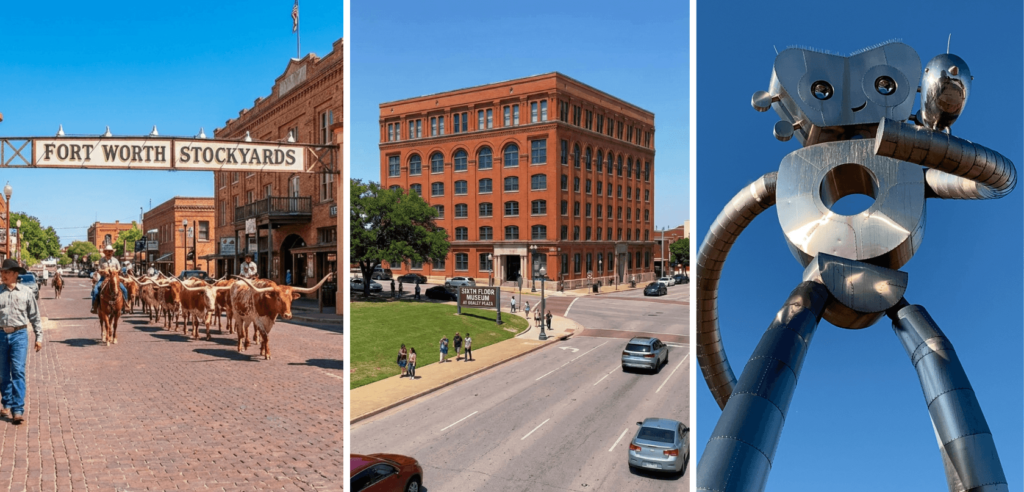
1. Dealey Plaza and the Sixth Floor Museum
There is no more emotionally specific outdoor space in all of Texas than Dealey Plaza.
Standing on Elm Street on a clear morning, it’s almost eerie how ordinary the geography looks. It’s a modest downtown plaza with a sloped grass knoll, a triple underpass, and an old red brick building on the corner. And yet, of course, it is the site of one of the most consequential moments in American history. On November 22, 1963, President John F. Kennedy was assassinated here, and the plaza has existed in a kind of suspended historical gravity ever since.
Visitors who take the time to stand on the actual X marked in the pavement — the precise spot where the motorcade passed — often report that photographs simply fail to prepare you for the smallness of the space. The distance feels impossible. The whole thing is smaller and quieter than the weight of history would suggest.
The adjacent Sixth Floor Museum, housed in the former Texas School Book Depository where Lee Harvey Oswald fired from a corner window, is arguably the most important of all places to visit in Dallas for anyone interested in American political history. The museum is thorough, tasteful, and deeply affecting, tracing the arc of the Kennedy presidency, the assassination itself, and its global aftermath. The preserved sniper’s perch is enclosed in glass and exactly as it appeared in 1963 — stacked boxes, a crouched position, a view straight down Elm Street. It is one of the most chilling historical installations anywhere in the United States.
Admission is charged, but the experience is worth every cent. Plan to spend at least two hours here.
2. The Dallas Arts District
Sixty-eight acres. That’s the size of the Dallas Arts District, and it is the largest contiguous urban arts district in the entire country.
What makes it remarkable isn’t just its scale — it’s the architectural pedigree. This neighborhood contains buildings designed by Renzo Piano, Norman Foster, I.M. Pei, and other Pritzker Prize winners. Walking through it on a weekday morning, when the crowds are thinner and the light hits the facades just right, feels like wandering through a living architecture textbook.
It’s also extraordinarily generous. Several of its flagship institutions are free.
The Dallas Museum of Art offers free general admission to its permanent collection — an unbelievable deal for a collection that includes a pre-Columbian Americas gallery that is the finest of its kind in any Texas museum, alongside strong holdings in European paintings, decorative arts, and American works. The Crow Museum of Asian Art, easily one of the most undervisited places to visit in Dallas, houses a breathtaking collection of Chinese jade, Japanese netsuke, and Southeast Asian bronzes, and it costs nothing to enter.
Then there is the Nasher Sculpture Center — often described by local art professionals as the single finest museum experience in the city. Raymond and Patsy Nasher assembled a private sculpture collection that is now the envy of institutions worldwide, and the outdoor garden designed by Renzo Piano is one of those spaces where you arrive expecting to stay 20 minutes and find yourself still there an hour later.
For families, the Perot Museum of Nature and Science is the crown jewel. A striking concrete cube designed by Thom Mayne, it contains 11 permanent exhibition halls and manages to make energy, geology, and the natural world feel genuinely exciting to children and adults alike.
3. The Bishop Arts District
If there is one neighborhood that will make a skeptic fall in love with Dallas, it is Bishop Arts.
Located in the Oak Cliff neighborhood southwest of downtown, Bishop Arts is a 60-block grid of 1920s commercial buildings that has been carefully preserved and developed into the most authentically independent commercial district in any Texas city. There are no chains here worth speaking of. Instead, you get coffee roasters, vintage clothing boutiques, bookshops, taco spots, and bakeries — all locally owned and fiercely proud of it.
The Wild Detectives, a bookshop and bar that hosts literary events most evenings, is alone worth the trip. Emporium Pies, which bakes some of the most architecturally beautiful pies you will encounter anywhere, typically has a line on weekend mornings and is absolutely worth the wait.
Getting here is easy and free: the DART Streetcar runs from Union Station directly into the heart of the district. A Sunday morning in Bishop Arts — coffee from one of the independent roasters, a slow walk through the boutiques, lunch at one of the dozens of independent restaurants — is one of the best ways to understand what makes Dallas genuinely interesting.
4. Deep Ellum
East of downtown, Deep Ellum is the city’s most historically creative neighborhood and, in 2026, it is having one of its strongest runs in decades.
The area has deep roots in Dallas’s African American cultural history. In the 1920s and 1930s, it was the center of the city’s blues and jazz scene, and names like Blind Lemon Jefferson and Lead Belly were regulars on its streets. Today that spirit lives on in a neighborhood that takes its creative identity seriously.
The mural corridor along Commerce and Main Streets is one of the most impressive collections of street art in the South — large-scale, technically accomplished pieces that cover entire warehouse facades. Walking through it feels less like a tourist attraction and more like wandering into someone’s genuine artistic statement.
Friday and Saturday nights in Deep Ellum are electric. The live music venues run the full stylistic spectrum, from blues and roots to experimental electronic, and the food scene — a cluster of independent restaurants and food halls — is strong enough to build an entire evening around.
5. Fort Worth Stockyards (Day Trip)
Yes, Fort Worth is technically its own city. And yes, it is 30 miles west of Dallas. But you cannot honestly claim to have experienced North Texas without spending at least a day there, and the Stockyards district is the single most irreplaceable part of that experience.
Over 100 million cattle were processed through this area during its commercial peak. Today it remains a working cattle yard, a National Historic District, and one of the most genuine Western heritage experiences available anywhere in the American Southwest.
The 4 PM cattle drive, in which a herd of longhorns is driven down Exchange Avenue by mounted drovers in period dress, sounds like it could be a tourist gimmick but consistently manages to be the opposite. The scale of the animals, the noise, the smell, the physical reality of it — it’s a surprisingly affecting encounter with a piece of American history that has mostly disappeared everywhere else.
After the cattle drive, Billy Bob’s Texas — the world’s largest honky-tonk, covering three acres — is an experience unto itself. Even if country music isn’t your preference, the sheer scale of the place is worth seeing once.
The Hidden Gems Layer: Secret Places to Visit in Dallas
Beyond the headline attractions, Dallas rewards the traveler who digs a little deeper.
Marie Gabrielle Gardens in Uptown is a manicured private garden that feels transported from another continent. The giant outdoor chess set alone makes it one of the most charming and photogenic places to visit in Dallas for those who stumble upon it.
The Samurai Collection, located above Mercat Bistro in the Saint Ann building, is a free museum that stops visitors cold. The collection of samurai armor, weaponry, and artifacts is extraordinary — and the fact that most Dallas residents have never heard of it makes it even more remarkable.
Half Price Books Flagship on Northwest Highway is an institution for book lovers. The original location of what has become a national chain, this store houses over half a million titles across new, used, and rare categories. It is one of those places where you go for 20 minutes and emerge two hours later with a stack of books and no regrets.
Lakeside Park in Highland Park is known for an unusual attraction: a collection of oversized bronze teddy bear sculptures scattered through the grounds. It sounds whimsical because it is, but the park itself — with its creek walks and canopy of mature trees — is genuinely beautiful and mercifully quiet.
For dessert, Milk & Cream in Bishop Arts serves what might be the most Instagram-optimized and actually delicious thing in the city: milk and cream buns, which are donut ice cream sandwiches topped with cereal. The line moves quickly and the payoff is real.
Outdoor Dallas: Parks and Green Spaces
The criticism of Dallas as a purely concrete landscape misses several outstanding outdoor destinations.
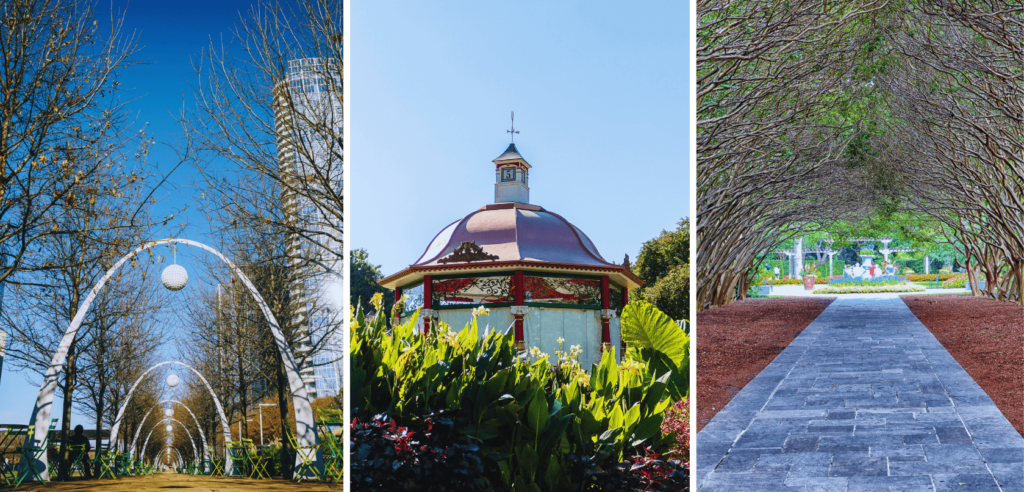
Klyde Warren Park is the city’s great urban planning success story — a 5.2-acre deck park built directly over the Woodall Rodgers Freeway that has brought downtown and Uptown together in a way that nothing else could. The daily programming, rotating food trucks, lawn yoga, and children’s play areas make it genuinely democratic: everyone uses it, all day long.
White Rock Lake Park is the city’s outdoor crown jewel. A 1,015-acre reservoir with a 9.3-mile loop trail, it is the destination for cyclists, runners, dog walkers, and anyone who needs to remember that Texas is not all concrete. The bird watching is exceptional.
The Dallas Arboretum and Botanical Garden, perched on the southern shore of White Rock Lake, is one of the most photographed places to visit in Dallas across all seasons. Spring brings the massive Dallas Blooms tulip festival; fall brings Pumpkin Village, in which thousands of carved and decorated pumpkins transform the grounds into something otherworldly.
The Katy Trail converts 3.5 miles of former railway into a paved urban trail running from the American Airlines Center through Uptown to Knox-Henderson. The bridge at Knox Street offers one of the best free views of the Dallas skyline at sunset — a fact that more visitors should know about.
Sports and Spectacle: Big-Ticket Experiences
Dallas takes its sports seriously — perhaps more seriously than anywhere else in the country.
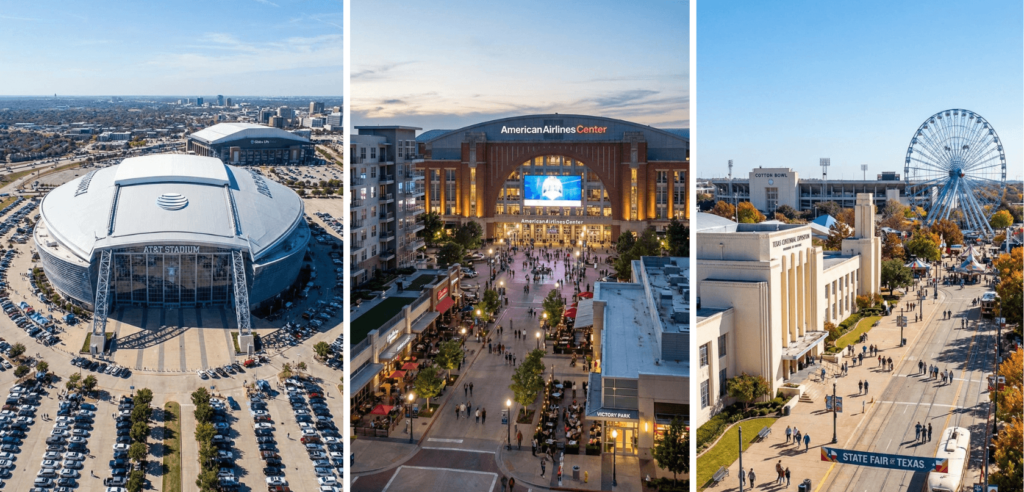
AT&T Stadium in Arlington — known locally as “Jerry World” — is one of the most visually overwhelming buildings in the state of Texas. Home to the Dallas Cowboys, it seats over 80,000 fans and houses a permanent art collection of approximately 13,000 works. Even if you don’t care about football, the stadium’s Art Tour on non-game days is a legitimately substantive cultural experience and one of the more unusual places to visit in Dallas adjacent to the city.
American Airlines Center in Victory Park is home to both the Mavericks (NBA) and the Stars (NHL). Its location makes it one of the most accessible sports venues in the city, and the surrounding Victory Park development makes for a pleasant pre-game walk from Klyde Warren.
Fair Park is a 277-acre National Historic Landmark that contains the world’s most complete collection of Art Deco fair buildings — a fact that surprises many first-time visitors. It is the permanent home of the State Fair of Texas every autumn, one of the largest state fairs in the country and an event that draws visitors from across the region specifically for its food, livestock competitions, and the famous Big Tex figure who greets fairgoers at the entrance.
Specialized and Historical Institutions
The Dallas Holocaust and Human Rights Museum, opened in 2019, has quickly established itself as one of the finest institutions of its kind. It is experientially designed, emotionally rigorous, and ultimately hopeful — tracing both the history of genocide and the ongoing struggle for human dignity. It is not an easy visit, but it is an important one.
The George W. Bush Presidential Library and Museum on the SMU campus offers a distinctive and interactive historical experience, most notably through its Decision Points Theater, which asks visitors to engage with the same intelligence and context the President had during major crisis moments. Whatever your political perspective, it is a thoughtful facility.
The Frontiers of Flight Museum at Love Field houses over 100 aircraft and includes an Apollo 7 Command Module — a legitimately rare artifact that rewards even non-aviation enthusiasts.
The Majestic Theatre, built in 1921 in the Spanish Baroque style, remains the most atmospheric performance space in the city. Catching a Broadway touring production here is an experience that modern glass-box theaters simply cannot replicate.
Fort Worth’s Cultural District: A Second Day Trip Worth Making
Beyond the Stockyards, Fort Worth’s Museum District offers a concentration of world-class art institutions that rivals anything in the Southwest.
The Kimbell Art Museum, designed by Louis Kahn, is routinely cited as one of the finest museum buildings in the world. Its permanent collection — which includes works by Caravaggio, Michelangelo, Matisse, and Picasso — is always free to the public. The quality of the light inside Kahn’s vaulted galleries is something architects study and visitors simply stand in and feel.
Directly adjacent, the Modern Art Museum of Fort Worth, designed by Tadao Ando, is one of the most photographically compelling places to visit in Dallas-adjacent Texas. The concrete and glass pavilions reflect in a large surrounding pond in a way that makes the whole complex look like a still from a film.
Practical Strategy: Clustering Your Visits
Dallas is a large, car-dependent city. The secret to navigating it without losing half your trip to traffic is to cluster your visits by geography and dedicate each day to a specific zone.
Day 1 — Downtown and the Arts District: Start at Dealey Plaza and the Sixth Floor Museum in the morning when crowds are thinner. Walk north through the West End to the Arts District in the afternoon for the DMA and Nasher. End the day at Klyde Warren Park at sunset.
Day 2 — Neighborhoods: Take the free DART Streetcar from Union Station to Bishop Arts in the morning. Spend the afternoon in Deep Ellum. In the evening, ride the M-Line Trolley through Uptown on McKinney Avenue.
Day 3 — East Dallas: Pair White Rock Lake with the Dallas Arboretum. This is a full half-day outdoor experience that ends with a walk along the lakeside trail at golden hour.
Day 4 — Fort Worth: Dedicate a full day. Morning at the Kimbell and Modern Art Museum. Lunch in the Sundance Square area. The 4 PM cattle drive at the Stockyards. Billy Bob’s Texas in the evening.
Best Activities in Dallas You Can’t Afford to Miss
Dallas doesn’t do anything halfway. Whether you’re here for the first time or coming back for more, the best activities in Dallas stretch far beyond what any single itinerary can hold. From rooftop views and world-class museums to hidden historical tours and legendary food trails — every day in this city hands you something worth remembering. We’ve done the hard work of finding them all, so you don’t have to. 👇
- JFK Assassination and Sixth Floor Museum Tour
- Balloon Museum – Let’s Fly – Entry Tickets
- Museum of Illusions Entry Ticket
- Reunion Tower GeO-Deck General Admission Ticket
- 1 or 2-Hour Electric Cruiser Open-Air Tour
- Sinister Strolls True Crime Walking Tour
- Deadly Dallas Ghost Tours: Blood, Bones & Burials
- Cowboys AT&T Stadium Tour with Transportation
- Aerial Adventure Course Park Pass
- DIY Candle Making Class at a Local Brewery
- Southfork Ranch, Dallas Highlights, and JFK Tour
- iFLY Dallas First Time Flyer Experience
- Dallas Party Bike Private Group Rental in Deep Ellum
Frequently Asked Questions About Places to Visit in Dallas
What is the single best thing to do in Dallas? If you can only do one thing, stand in Dealey Plaza and then spend two hours in the Sixth Floor Museum. It is the most historically significant and emotionally resonant experience the city offers.
Are there genuinely free things to do in Dallas? Dallas is one of the most generous major cities in America when it comes to free cultural attractions. The Dallas Museum of Art, the Crow Museum of Asian Art, Dealey Plaza, Klyde Warren Park, and the Kimbell Art Museum in Fort Worth are all free. A visitor could build an entire culturally rich four-day trip spending almost nothing on admission.
Is Dallas actually walkable? Selectively, yes. The city as a whole is car-dependent by design, but specific districts — the Arts District into Uptown corridor, Bishop Arts, and Deep Ellum — are highly walkable once you arrive. Using DART, the free DART Streetcar, and the free M-Line Trolley to connect between neighborhoods is genuinely practical.
How many days do you need? Three to four days is the sweet spot. Less than three days means choosing between Fort Worth and neighborhoods, and you shouldn’t have to make that choice.
What is the best time of year to visit? October and November are ideal. The summer heat is brutal and genuinely limits outdoor enjoyment. Spring is beautiful for the Arboretum’s blooms, and fall brings the State Fair of Texas, the Pumpkin Village, and some of the most comfortable walking weather in the region.
Final Thoughts
Dallas in 2026 is a city that has stopped apologizing for what it isn’t and started celebrating what it is. It is not New York. It is not Los Angeles. It is a sprawling, confident, occasionally surprising Southwestern city with a world-class arts district, a nationally significant historical site, neighborhood pockets of genuine independent culture, and a relationship with beef that you will need to personally investigate.
The best places to visit in Dallas are not the ones on every generic travel list. They’re the Nasher garden on a clear October morning. They’re a Sunday in Bishop Arts with no particular schedule. They’re a bookshelf you weren’t expecting at Half Price Books. They’re the exact moment the Fort Worth longhorns round the corner onto Exchange Avenue and the crowd goes quiet.
Come curious. Leave with more than you expected.