
Finding the Best Places to Visit in Morocco requires a certain willingness — a readiness to surrender to chaos, to breathe in centuries of history hanging in the air, to let a city unravel you slowly and put you back together differently. Morocco is not a destination you simply visit; it is one you absorb. Stretching from the jagged peaks of the High Atlas to the gold-dusted silence of the Sahara, from sun-bleached Atlantic coastlines to the emerald folds of the Rif Mountains, this North African kingdom packs more texture, more flavor, and more raw beauty into one country than most people see in a lifetime. Whether you arrive chasing adventure, culture, coastline, or all three at once, this guide covers the most essential morocco attractions, the most immersive morocco tours, and the full spectrum of things to do in Morocco — from iconic landmarks to the kind of quiet corners that never make it onto postcards.
Table of Contents
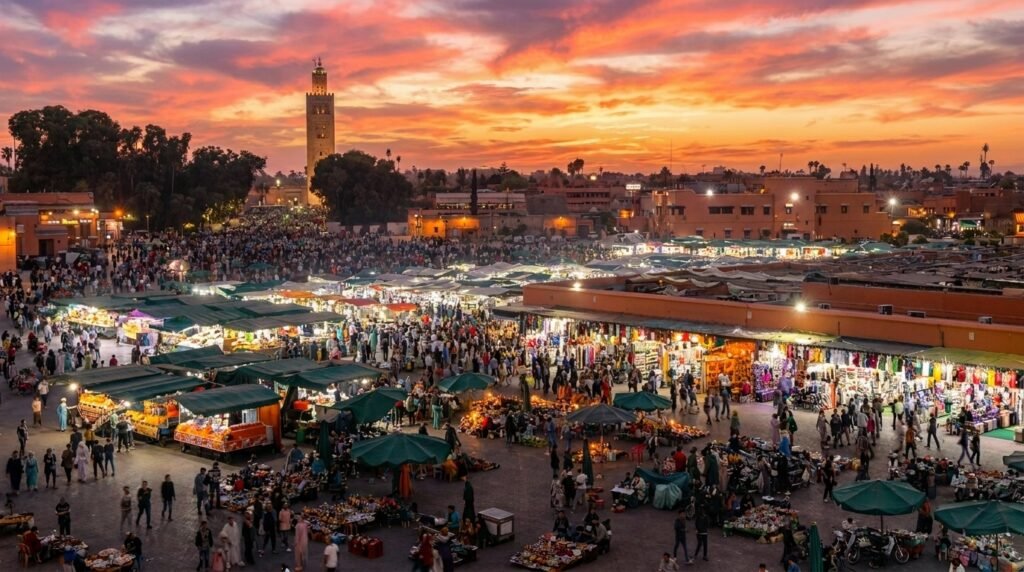
The Red City: Marrakech
There is a moment in Marrakech — usually somewhere between your first step into the Jemaa el-Fnaa and your third near-collision with a motorbike — when you realize the city is not going to wait for you to catch up. It moves at its own pace, ancient and electric at the same time, and your only option is to move with it.
The Jemaa el-Fnaa is the undisputed gravitational center of the medina and one of the most theatrical public spaces on earth. By day, orange juice vendors line the square in cheerful rows. By night, it transforms into something wilder: storytellers holding circles of wide-eyed locals, acrobats tumbling past snake charmers, the smoke from a hundred grills carrying the scent of cumin and charcoal through the warm evening air. It is one of the iconic morocco attractions of the south, and while it is genuinely spectacular, it pays to go in with your eyes open — vendors are persuasive and the tourist pressure is real. Stay friendly, stay firm, and soak in the spectacle.
Most morocco tours begin here, using Marrakech as both entry point and base camp. From the city, travelers fan out to explore the Saadian Tombs — a hidden necropolis sealed for centuries and only rediscovered in 1917 — and the Bahia Palace, where intricately carved stucco ceilings and mosaic floors tell the story of a 19th-century grand vizier with extraordinarily good taste. The Ben Youssef Madrasa, once the largest Islamic school in North Africa, is another architectural masterpiece not to be missed.
For the activities to do in Morocco that offer a breath of calm amid the medina’s beautiful chaos, the Jardin Majorelle is the answer. Once the private sanctuary of French painter Jacques Majorelle and later rescued from demolition by Yves Saint Laurent, the garden is a world of cobalt blue structures surrounded by towering cacti, lily ponds, and rare plant species from five continents. For photography enthusiasts, the contrast between the vivid blue architecture and lush greenery is endlessly compelling.
Despite being the country’s most touristy city, Marrakech earns its place at the top of every list of Best Places to Visit in Morocco because it delivers exactly what it promises: sensory immersion, architectural wonder, and a gateway energy that sets the tone for everything that follows. It is also an ideal launchpad for day trips to the nearby Agafay Desert or the foothills of the Atlas.
Secure your spot and book your Marrakech Medina experience today.
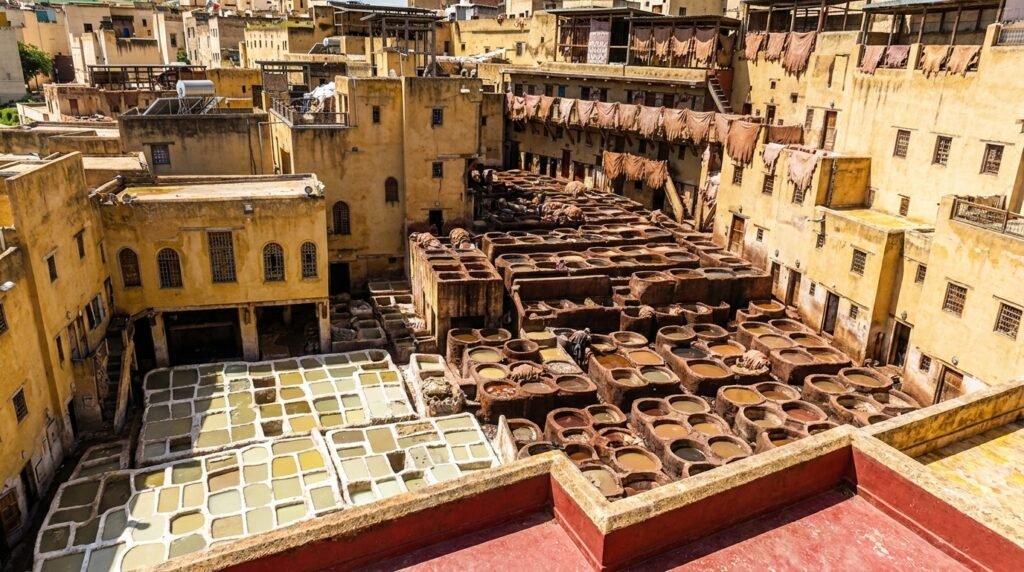
The Spiritual Heart: Getting Lost in the Medina of Fez
If Marrakech is the kingdom’s heartbeat, Fez is its memory. Walking into Fez El Bali — the world’s largest living medieval city — is genuinely like stepping through a door in time. The medina’s 9,000-plus alleyways form a labyrinth so dense and so old that even lifelong residents occasionally find themselves turned around. That sense of navigational surrender is not a bug; it is the experience.
The leather tanneries of Fez are among the most viscerally memorable of all morocco attractions. From the balconies of surrounding shops — where vendors helpfully offer sprigs of mint to hold under your nose — you look down onto a sea of stone vats stained vivid shades of saffron, poppy, and indigo. Workers stand knee-deep in the dye, using methods unchanged for a thousand years. It is stunning and pungent and absolutely unlike anything else in the world.
The most rewarding morocco tours in Fez go deep into the medina with a local guide who can unlock the city’s hidden layers: the Bou Inania Madrasa with its cedar-carved façades, the workshop of a copper artisan hammering lanterns by hand, the quiet courtyard of a neighborhood mosque glimpsed through a half-open door. Without a guide, you will get lost. With one, you will get lost on purpose, and it will be one of the best decisions you make.
For culinary travelers, a street food tour through Fez is one of the richest activities to do in Morocco. This is not cuisine designed for tourists — it is food built for a city that has been eating well for twelve centuries. Bissara (slow-cooked fava bean soup), meloui (layered flatbreads cooked on a griddle), and slow-braised lamb served from ceramic tagines are all available for coins on the street. The legendary Café Clock also offers traditional cooking workshops for those who want to bring a piece of Fez home in their recipe collection.
Fez holds a UNESCO listing not just for its architecture but for the living culture that still pulses through its streets. As a destination, it rewards the curious and the patient more than any other city in Morocco. Its place among the Best Places to Visit in Morocco is not negotiable.
Secure your spot and book your Fez Medina & Street Food Tour experience today.
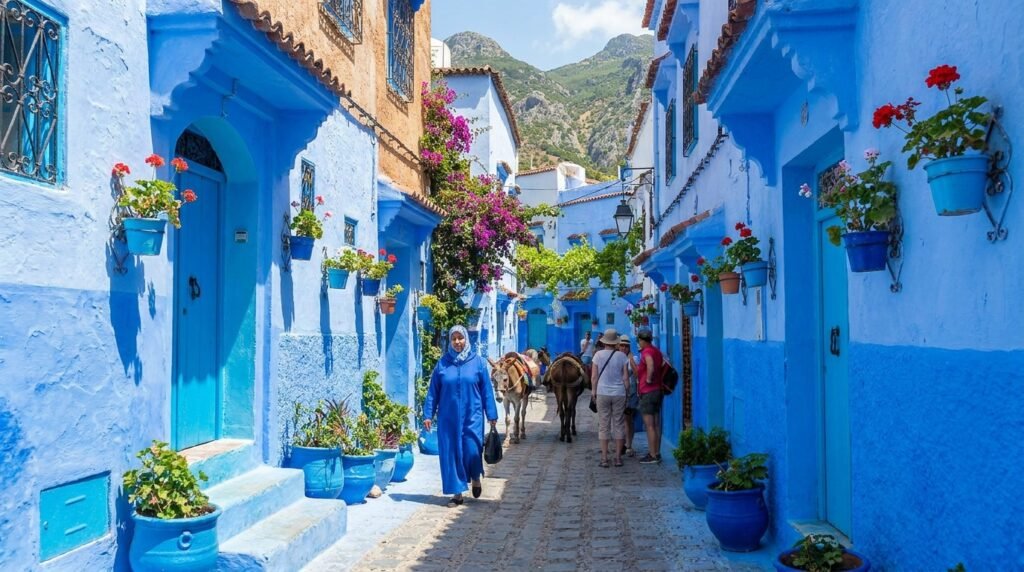
The Blue Pearl: Chefchaouen and the Rif Mountains
Somewhere in the folds of the Rif Mountains, painted almost entirely in shades of powder blue and chalk white, sits a town that seems to have been designed by someone who mistook real life for a dream. Chefchaouen — the Blue Pearl — is one of those places that photographs cannot fully prepare you for, and one of the most compelling Best Places to Visit in Morocco in the country’s north.
The medina here operates at a completely different register from Fez or Marrakech. Life spills unhurriedly from open doorways. Cats doze on blue-washed steps. Old men play cards under an archway. The pace is gentle enough that you find yourself slowing down without trying, lingering over a pot of mint tea for an entire afternoon without guilt.
Chefchaouen is also far more than a photogenic backdrop. The surrounding Talassemtane National Park offers hiking trails through Moroccan fir forests, past clear mountain streams and luminous waterfalls — some of the most accessible nature-based activities to do in Morocco in the entire north of the country. The full-day hike to the God’s Bridge natural rock arch is a particular highlight, threading through valleys that feel genuinely untouched.
The town has a thriving artisan culture too, with weavers producing the distinctive red-and-white striped wool that the Rif region is known for. Spending time with local craftspeople and watching the work being done on traditional looms is one of the most genuinely authentic things to do in Morocco that most morocco tours overlook in favor of the medina’s souvenir shops.
Timing matters here. Spring and autumn bring pleasant temperatures and clear mountain light — perfect for hiking and photography. Summer brings heat and considerably more visitors. Arrive early in the morning before the tour buses, and Chefchaouen reveals a quieter, more intimate version of itself.
Secure your spot and book your Chefchaouen & Rif Mountains Hiking experience today.
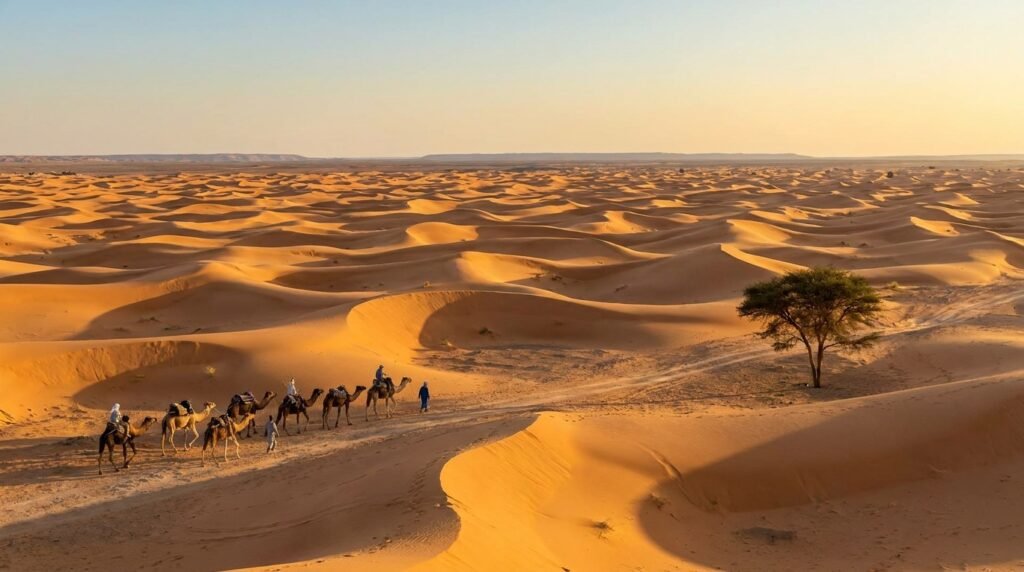
The Sahara: Camel Treks, Desert Silence, and a Sky Full of Stars
There is no preparing for the Sahara. You can read about it, look at photographs, talk to people who have been. None of it quite conveys what happens to you when you crest a ridge of sand and see the dunes stretching to the horizon in every direction, completely still, lit amber by a falling sun. It is one of those rare Best Places to Visit in Morocco that earns every superlative thrown at it.
The two main entry points are Erg Chebbi, near the village of Merzouga in the southeast, and the more remote Erg Chigaga, accessible from M’Hamid along tracks that feel like the edge of the world. Both offer the full desert experience — camel treks, Bedouin-style camps, and the kind of night skies that make you feel like a minor character in an astronomy documentary. Most organized morocco tours include at least one overnight camp in the dunes, and this is absolutely the right call: the desert at night, under that density of stars, with the temperature dropping fast and the silence pressing in from all sides, is one of the most profound activities to do in Morocco available to any traveler.
A practical note: those temperature drops are real. Even in summer, desert nights can surprise you with their chill, and in winter they can fall well below freezing. Pack layers you would not expect to need and thank yourself later.
Beyond the dunes themselves, the desert region holds one of Morocco’s most cinematic morocco attractions: the ksar of Aït Benhaddou, a UNESCO World Heritage site built from pisé — rammed earth and straw — rising from a hillside above a dry riverbed in tiered towers of rust-red adobe. It has appeared in dozens of films, including Gladiator, Lawrence of Arabia, and several seasons of Game of Thrones. Walking through its narrow lanes at golden hour, when the light turns the walls to fire, is extraordinary.
For travelers with limited time, the Agafay Desert — a rocky moonscape plateau just 40 kilometres from Marrakech — offers a taste of the desert aesthetic without the 10-hour drive south. It lacks the grand dunes of Erg Chebbi but delivers its own stark, cinematic beauty, and several high-quality camps operate there. It has become one of the most popular things to do in Morocco for short-trip visitors.
Secure your spot and book your Sahara Desert Camel Trek & Camp experience today.
Coastal Charms: Essaouira and Agadir
Stand on the ramparts of Essaouira at dusk and you understand immediately why this place earns such fierce loyalty from the travelers who find it. The wind comes off the Atlantic in long, salt-laced gusts. Below, blue fishing boats rock against the harbour walls. The smell is ocean and cumin and woodsmoke. It is one of the most atmospheric morocco attractions on any coastline in Africa.
The Windy City — as Essaouira is affectionately known — is a fortified Atlantic port with a Moroccan-Portuguese-Jewish history as layered as its medina. The whitewashed buildings with their blue shutters and the sea-worn defensive walls create a visual aesthetic that feels genuinely unlike anywhere else in the country. The souks here are less frantic than Marrakech’s, the vendors less aggressive, the overall energy more creative and bohemian. This is a city that has long attracted artists, musicians, and writers, and that spirit is still palpable.
Water-based activities to do in Morocco reach their peak here. The consistent Atlantic winds make Essaouira one of the best kitesurfing and windsurfing spots in Africa, and several schools operate along the wide beach south of the medina. Even non-surfers will find the beach walk — with its miles of open Atlantic horizon and the occasional camel standing in the surf — completely worth the trip.
The seafood is exceptional and unpretentious. The grills along the harbour serve the morning’s catch with nothing more elaborate than lemon, salt, and a piece of bread, and it is invariably better than anything you have eaten at a restaurant that tried much harder. Many morocco tours stop here on their way between Marrakech and Agadir, and it is always the stretch of the journey people remember most.
Further south, Agadir offers something entirely different: a modern, resort-oriented city rebuilt after a devastating 1960 earthquake that leveled the original settlement almost entirely. What rose from the rubble is Morocco’s most developed beach destination — long sandy shores, international hotels, golf courses, and a marina. It is a comfortable, easy base, and the surrounding region has some excellent day trips. The Old Kasbah at sunset, the weekly Souk El Had (one of the largest markets in the country), and the Crocoparc are among the most family-friendly things to do in Morocco in the south.
Secure your spot and book your Essaouira Surfing & Coastal Tour experience today.
Mountain Adventure: The High Atlas and the Todra Gorge
The High Atlas Mountains rise dramatically out of the southern plains, a spine of rock and snow running 2,500 kilometres across North Africa, and in Morocco they reach their peak at Jebel Toubkal — 4,167 metres of bare summit above the treeline, the highest point on the African continent north of the Sahara. Climbing it is one of the most ambitious but rewarding activities to do in Morocco, typically done over two days from the Amazigh village of Imlil.
The approach from Imlil is the journey as much as the summit. The trail passes through walnut groves and terraced fields, past stone-built Amazigh villages where life is organized around the seasons and the livestock, where bread is baked in communal ovens and hospitality is offered to strangers without calculation. Staying in a local guesthouse and eating a home-cooked meal the night before the summit push is one of the most genuinely immersive Best Places to Visit in Morocco experiences available anywhere in the country.
The High Atlas is not only for serious climbers. Valley hikes, mule treks, and cycling routes thread through landscapes that shift from snow-capped ridgelines to palm-fringed river gorges within a single afternoon. Many morocco tours use the Atlas as a scenic transit between Marrakech and the desert, but the region deserves far more than a windshield view.
At the Atlas’s eastern edge, where the mountains meet the pre-Saharan plains, the Todra Gorge cuts a dramatic slot through the rock. The cliffs here rise 300 metres above a river that runs clear and cold even in summer, and the scale of it — standing at the bottom, looking up at walls that seem to lean inward overhead — is genuinely breathtaking. It is one of the most visually spectacular morocco attractions in the entire country, and it requires no special fitness to experience. You simply walk in, and the gorge does the rest. Several small guesthouses cluster at its entrance, run by local families, and staying in one overnight — listening to the river in the dark — qualifies as one of the most quietly beautiful things to do in Morocco.
Secure your spot and book your High Atlas Toubkal Trek & Todra Gorge experience today.
The Imperial Legacy: Meknes, Volubilis, and Moulay Idriss
Of Morocco’s four imperial cities, Meknes is the one that tends to get bumped from itineraries when time is short. That is a mistake. Compact, undervisited, and stubbornly authentic, Meknes feels like the version of imperial Morocco that exists primarily for Moroccans — its souks still dominated by hardware merchants, spice sellers, and butchers rather than souvenir vendors. It is, in many ways, the most honest of the Best Places to Visit in Morocco in the Imperial Four.
The defining monument is the Bab Mansour gate, a theatrical piece of late Baroque Moroccan architecture built by Sultan Moulay Ismail in the early 18th century, faced with Zellige tilework and flanked by columns repurposed from the ruins of Volubilis. The scale of it is overwhelming in the best possible way. The nearby Heri es-Souani — the royal granaries and stables that Moulay Ismail built to house 12,000 horses — is equally impressive in its vast, vaulted ambition.
Most morocco tours combine Meknes with a half-day visit to Volubilis, the best-preserved Roman city in Morocco, set on a plateau above the plain about 30 kilometres north. The site is remarkable: triumphal arches, forum stones, and mosaic floors depicting Orpheus and Bacchus still bright after 2,000 years of sun. Walking among the ruins in the early morning, before the tour groups arrive, with storks nesting on the column tops and the Atlas visible on the horizon, is one of those activities to do in Morocco that stays with you long after you leave.
Nearby, the hilltop pilgrimage town of Moulay Idriss Zerhoun — Morocco’s holiest city and the resting place of Idris I, founder of the first Muslim dynasty on Moroccan soil — is an insider tip that most international visitors skip entirely. On Saturdays, a market spreads through the lower town, and the panoramic views from the rooftop terraces over the surrounding plains are extraordinary. It is the kind of place where you arrive planning an hour and leave three hours later, wondering why nobody told you to come here first. A true gem among the morocco attractions of the north.
Modern Morocco: Casablanca, Rabat, and Tangier
Casablanca tends to confuse travelers who arrive expecting a medina-and-mint-tea Morocco and find instead a sprawling, fast-moving commercial city that feels more like a hybrid of Marseille and Lagos than anything from a Humphrey Bogart film. But Casablanca has its own rewards, and the principal one is extraordinary.
The Hassan II Mosque, completed in 1993 after six years of construction involving 35,000 craftsmen, is one of the largest mosques in the world and the only one in Morocco open to non-Muslim visitors. Its minaret — the world’s tallest — is visible from kilometers away, and its location at the ocean’s edge, built partly on a platform over the Atlantic, means that on clear glass panels set into the floor of the prayer hall, you can see the sea moving beneath you. It is among the most architecturally audacious morocco attractions in the entire country. Guided morocco tours of the interior run several times daily and are genuinely worth it.
Beyond the mosque, Casablanca rewards urban explorers willing to look past the main boulevards. The Art Deco district around the Place Mohammed V contains some of the finest 1930s colonial architecture in Africa, a strange and beautiful collision of Moorish ornamentation and European modernism.
Rabat, the capital, gets far less attention than it deserves. The Kasbah of the Udayas — a 12th-century fortress above the river mouth, with blue-and-white painted alleys that rival Chefchaouen’s — is one of the most underrated morocco attractions in the country. The Chellah necropolis, a ruined Roman city later converted into a medieval royal burial complex now overrun with storks and wildflowers, is hauntingly beautiful. Rabat operates at a lower pressure than Marrakech, which makes it one of the most pleasant Best Places to Visit in Morocco for travelers who prefer their culture without the hard sell.
In the far north, Tangier sits at the meeting point of the Atlantic and the Mediterranean, Africa and Europe, two worldviews squeezed into a city that has always belonged to both and neither. Its literary history — Burroughs, Kerouac, Bowles all wrote here — gives it a bohemian intellectual edge that still lingers in certain cafés near the Grand Socco. Taking the Al Boraq high-speed train between Tangier and Casablanca — Africa’s first high-speed rail line — is one of the most pleasantly modern things to do in Morocco, cutting a 5-hour journey to just over 2 hours and providing a glimpse of the country’s rapidly evolving infrastructure.
Practical Advice: When to Go, What to Pack, and How to Travel Smart
Best Time to Visit Morocco
The ideal windows for experiencing the Best Places to Visit in Morocco are spring (March to May) and autumn (September and October). These months offer agreeable temperatures across most of the country — warm enough for beach days on the coast, cool enough for mountain treks, and comfortable for medina wandering in the cities. Summer in Morocco can be intensely hot, particularly in Fez and Marrakech, where temperatures regularly exceed 40°C in July and August. Winter is excellent for the desert (cold nights, warm days, almost no other tourists) but can mean snow and impassable roads in the High Atlas.
Is Morocco Safe?
Yes — Morocco is generally one of the safer countries in the region for international travelers. Crime rates are comparatively low, and violent crime targeting tourists is rare. The areas around the major morocco attractions are well-policed and well-trafficked. That said, sensible precautions apply everywhere:
- Keep valuables in your accommodation safe
- Stay alert in crowded souks where pickpocketing can occur
- Agree on prices before getting into petits taxis
- Be clear and confident when declining unwanted guide services
Many morocco tours now cater specifically to solo female travelers, and with reasonable awareness of surroundings and modest dress in conservative areas, solo travel for women is very manageable. The key things to do in Morocco as a solo female traveler include booking riads with female-friendly hosts, joining group tours for desert and mountain sections, and trusting your instincts in the medinas.
What to Pack
Packing for morocco tours is an exercise in balance: you need to respect local cultural norms while also preparing for a country with enormously varied climates. Key items:
- Lightweight, breathable clothing that covers shoulders and knees — appropriate in rural areas and religious sites
- A warmer layer than you think you need — desert nights, mountain mornings, and Atlantic wind can all surprise you
- Comfortable walking shoes — medina streets are cobbled, hilly, and uneven
- Sunscreen and a hat — the North African sun is serious business
- A day bag that closes securely — practical in busy souk environments
- Cash in dirhams — many of the best local restaurants and small medina shops do not accept cards
Food, Transport, and Cultural Tips
Eating your way through Morocco is one of the great activities to do in Morocco, and the depth of the culinary tradition here is often underestimated. Tagines and couscous are the headlines, but the real pleasure is in the details: the harira soup served with dates to break the day’s fast, the pastilla (pigeon pie dusted with icing sugar) in Fez, the fresh grilled sardines at a Essaouira harbour stall. Eat where the locals eat and you will spend less and taste more.
Grand taxis — old Mercedes shared between up to six passengers — connect most towns and are the most authentic mode of intercity travel. Trains link the major northern cities efficiently and comfortably. The Al Boraq line between Casablanca and Tangier is a revelation. In the south, renting a car or booking organized morocco tours is strongly recommended, as public transport becomes sparse and road quality variable.
Frequently Asked Questions About Visiting Morocco
How many days do I need to see Morocco? A minimum of 10 days allows you to cover the Imperial Cities and either the desert or the coast. Three weeks gives you the full picture — cities, mountains, desert, and coastline — without feeling rushed.
Do I need a visa for Morocco? Citizens of most Western countries (EU, US, UK, Canada, Australia) can enter Morocco visa-free for up to 90 days. Always verify current entry requirements with your country’s foreign affairs department before traveling.
Is it easy to find vegetarian food in Morocco? More than you might expect. Vegetable tagines, bissara (fava bean soup), harira, and msemen (griddle bread) are all plant-based staples. In cities, vegetarian restaurants are increasingly common. In rural areas, flexibility and willingness to eat simply helps.
What currency is used in Morocco? The Moroccan Dirham (MAD). It is a closed currency, meaning it cannot be obtained before you arrive. ATMs are widely available in cities, and most riads and large hotels accept cards.
Can I drink alcohol in Morocco? Yes, in licensed restaurants, hotel bars, and some tourist areas. Public drinking is socially inappropriate and alcohol is not available in traditional Moroccan medina restaurants.
Morocco does not reveal itself all at once. It layers its gifts slowly — a courtyard discovered at the end of an alley you almost didn’t take, a conversation over tea that goes on for an hour longer than you planned, a desert sunrise that resets something in your chest. The Best Places to Visit in Morocco span an enormous range of landscapes, histories, and experiences, and no two travelers will find the same country. That, perhaps, is the greatest thing it offers: the freedom to find your own version of it.
Reviews
There are no reviews yet. Be the first one to write one.